
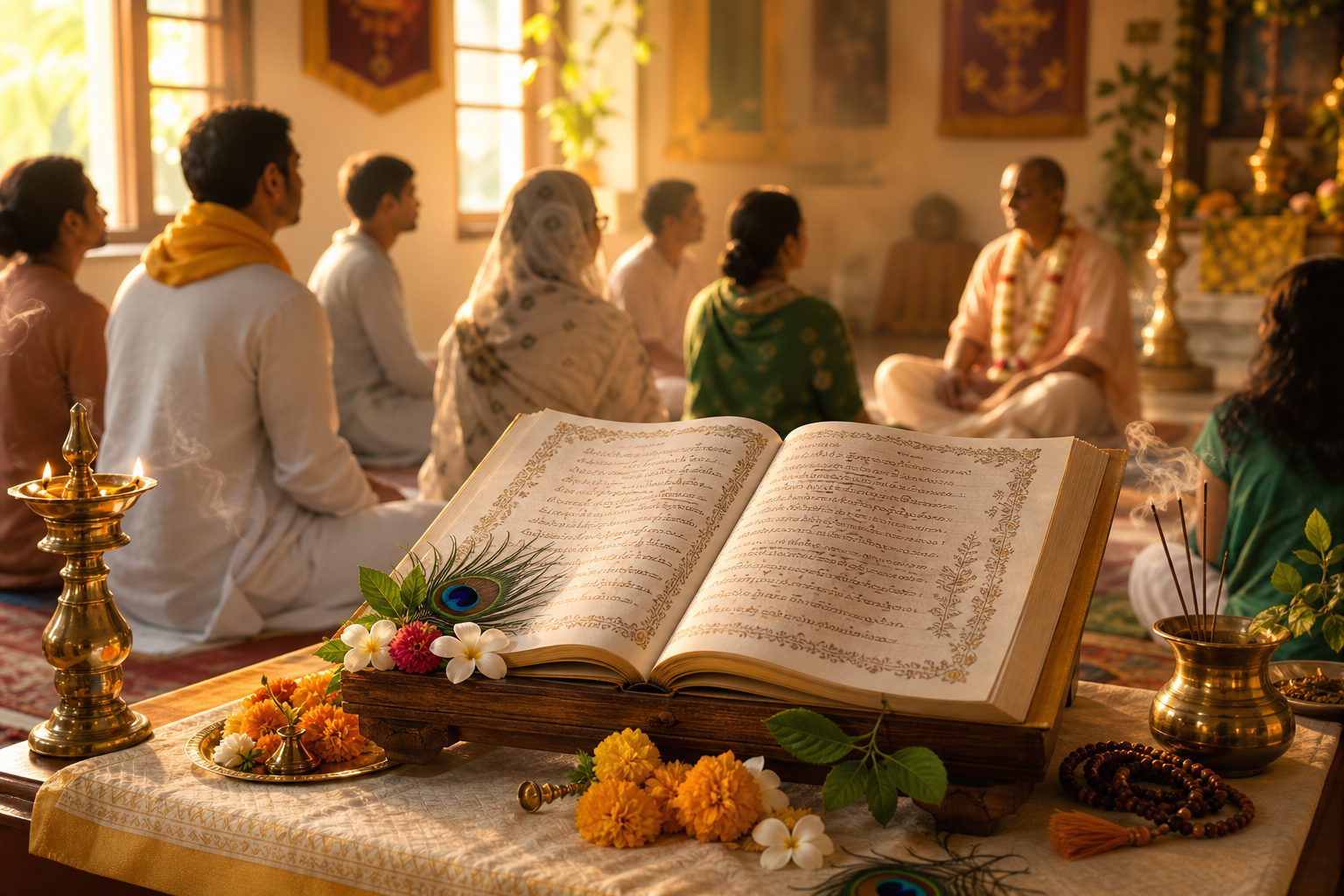
Gita Nagari’s daily Srimad Bhagavatam class represents a disciplined and devotional model of sacred learning within the Vaishnava tradition. Rather than treating scripture as a distant literary monument, the practice brings the Bhagavata Purana into the rhythm of everyday life through hearing, reflection, greetings, and puja. In this setting, study is not merely intellectual; it becomes a form of sadhana, a structured cultivation of attention, humility, and devotion.
The Srimad Bhagavatam, also known as the Bhagavata Purana, occupies a central place in the devotional culture of Krishna bhakti. It is revered for its theological depth, poetic narration, and sustained emphasis on bhakti as the highest expression of spiritual realization. Its teachings move through cosmology, ethics, metaphysics, history, devotion, and the lives of saints and divine personalities, making it both a sacred text and a comprehensive guide to spiritual culture.
A daily Bhagavatam class typically follows a careful pedagogical structure. The recitation of Sanskrit verses, word meanings, translation, and commentary provides a layered method of learning. This approach allows practitioners to engage the text through sound, language, philosophy, and lived application. It also preserves the traditional practice of śravaṇam, or attentive hearing, which is considered one of the principal limbs of bhakti.
At Gita Nagari, the daily class format is especially meaningful because it integrates scriptural study with community life. Greetings and puja are not incidental additions; they situate learning within reverence. A respectful greeting acknowledges the presence of the deity, the guru-parampara, the assembled devotees, and the sacred text itself. Puja then gives the study a ritual foundation, reminding participants that knowledge in the dharmic traditions is meant to refine conduct, perception, and consciousness.
The theological foundation of the Bhagavatam is deeply personalist. It presents the Supreme not as an abstract principle alone, but as Bhagavan, whose qualities, names, forms, and pastimes invite loving relationship. This is why the text has remained central to Vaishnava practice across generations. It teaches that devotion is not sentimentality; it is disciplined love shaped by hearing, chanting, remembering, service, worship, friendship, surrender, and ethical transformation.
The daily nature of the class is important. A single lecture may inspire, but daily hearing gradually reforms the inner life. Repetition, when grounded in sincerity, is not mechanical. It becomes a way of training memory, emotion, and judgment. The Bhagavatam’s narratives repeatedly return to themes of dharma, humility, divine protection, false pride, renunciation, service, and the dangers of ego-centered power. These themes remain relevant because they speak directly to recurring human struggles.
From an academic perspective, the Bhagavata Purana is also a sophisticated theological and literary work. Its layered narrative structure, embedded dialogues, symbolic episodes, and devotional metaphysics show a highly developed scriptural culture. The text does not present spirituality as a separate compartment of life. It connects family, kingship, ecology, austerity, education, community responsibility, and liberation within a single sacred worldview.
Puja in this context should be understood as embodied theology. Offering water, flowers, incense, lamp, food, or respectful gestures is a way of training the senses toward reverence. The Bhagavatam repeatedly teaches that the senses can either bind consciousness to distraction or become instruments of devotion. Ritual worship therefore functions as both symbolic expression and practical discipline.
Greetings within a devotional gathering also carry social and spiritual significance. They create a culture of mutual respect. In many dharmic traditions, learning begins with humility because knowledge is not viewed as private possession. It is received, preserved, practiced, and shared. A community greeting acknowledges that spiritual study is strengthened when participants gather with a shared intention rather than with a mood of argument or display.
The Bhagavatam’s emphasis on hearing is particularly relevant in the modern digital age. Contemporary life often fragments attention through speed, noise, and constant reaction. A daily class asks participants to slow down and listen carefully. This discipline has practical psychological value: it strengthens concentration, encourages reflective thinking, and offers a stable rhythm for those seeking inner balance.
The Gita Nagari setting also carries broader cultural significance. As a devotional community associated with Krishna consciousness, it reflects the continuity of Vaishnava practice outside India while remaining rooted in Sanskrit scripture, kirtan, prasada, deity worship, and guru-shishya transmission. Such communities show how Hindu spiritual traditions travel, adapt, and remain alive through daily practice rather than through identity alone.
The study of Srimad Bhagavatam also supports unity among dharmic traditions. Hinduism, Buddhism, Jainism, and Sikhism differ in doctrine, discipline, and historical development, yet they share deep concerns with self-mastery, compassion, truthfulness, detachment, ethical living, and liberation from ignorance. A Bhagavatam class, when approached with maturity, can strengthen respect for this wider dharmic civilizational family while preserving the distinctive voice of Vaishnava bhakti.
Bhakti, as presented in the Bhagavatam, is not hostile to inquiry. The text is filled with questions: kings question sages, sages question other sages, seekers question divine teachers, and devotees question the meaning of suffering, duty, and liberation. This question-and-answer format makes the Bhagavatam a living teaching text. It encourages disciplined inquiry while directing the heart toward devotion and service.
For practitioners, the most relatable aspect of a daily Bhagavatam class is its ability to bring sacred perspective into ordinary life. Family tensions, social duties, fatigue, grief, uncertainty, and ambition can all be examined through the lens of dharma and bhakti. The text does not deny human complexity. Instead, it offers a way to interpret life’s difficulties without losing moral clarity or spiritual hope.
The combination of class, greetings, and puja also demonstrates that knowledge and devotion are not separate paths in practical Vaishnava life. Study without reverence can become dry intellectualism. Ritual without understanding can become habit without depth. When both are held together, scripture informs worship, and worship softens the heart for scripture.
In this sense, the Gita Nagari daily Srimad Bhagavatam class is more than a religious program. It is a model of spiritual education. It teaches that sacred learning requires regularity, community, humility, careful listening, and practical application. Its enduring value lies in the way it transforms a text into a daily encounter with dharma, Krishna bhakti, and the possibility of inner refinement.
The deeper lesson is that devotion grows through disciplined remembrance. A morning or daily gathering around the Bhagavatam can become a stabilizing force in a restless world. It offers participants not only information about scripture, but a lived method for aligning thought, speech, action, and worship with a higher spiritual purpose.
Inspired by this post on Dandavats.










Leave a Reply
You must be logged in to post a comment.