
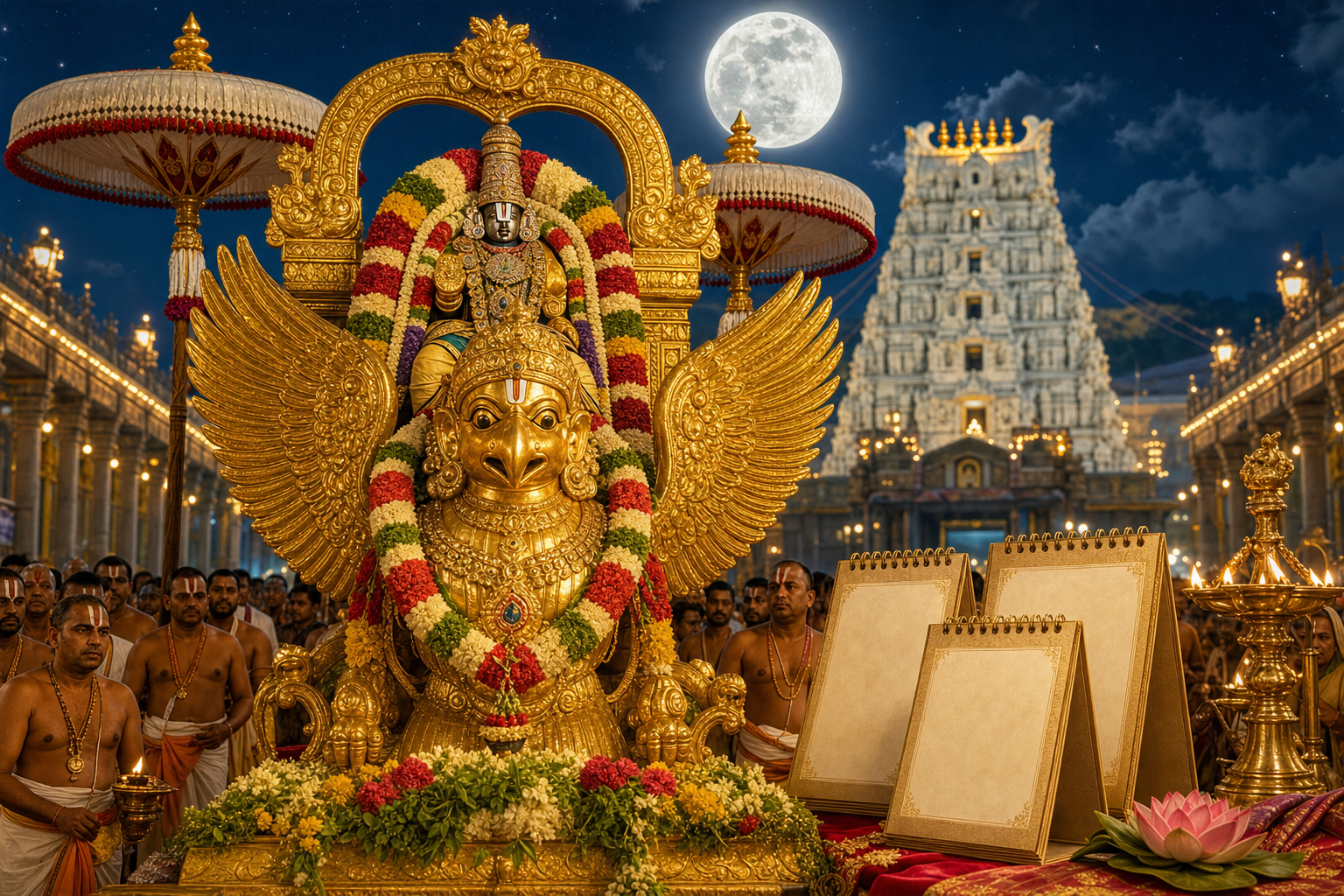
Srivari Pournami Garuda Seva in 2026 occupies a special place in the ritual calendar of Tirumala, where Sri Venkateswara Swamy is worshipped through one of the most beloved vahana sevas of the temple tradition. The observance is connected with Pournami, the full moon day, and it draws devotional attention because Lord Malayappa Swamy, the processional form of Sri Venkateswara, is taken in procession on Garuda Vahana, the divine eagle associated with Lord Vishnu.
The 2026 schedule released for Tirumala identifies seven Pournami Garuda Seva dates on which the Garuda Vahana Seva is planned. These dates are May 01, 2026, Friday; May 31, 2026, Sunday; June 29, 2026, Monday; July 29, 2026, Wednesday; August 28, 2026, Friday; September 26, 2026, Saturday; and October 26, 2026, Monday. Two further Pournami dates are noted as cancelled: November 24, 2026, Tuesday, due to Karthika Deepotsavam, and December 24, 2026, Thursday, due to Adhyayanotsavam.
For devotees planning a Tirumala pilgrimage in 2026, these dates are more than entries in a Hindu calendar. They indicate nights when the streets around the sacred temple become a moving theatre of bhakti, sound, discipline, and public worship. The experience of Garuda Seva is often remembered not only for the darshan of the deity, but also for the collective rhythm of thousands of devotees waiting together, chanting together, and seeing the same sacred image move through the Mada streets of Tirumala.
Garuda Vahana has deep theological significance in Vaishnava tradition. Garuda is the vahana of Lord Vishnu and is also revered as a symbol of alert devotion, strength, Vedic wisdom, and complete surrender to the divine. When Sri Venkateswara Swamy appears on Garuda Vahana, the procession visually expresses a central Vaishnava idea: the Lord who protects dharma becomes accessible to devotees through ritual, community, and temple tradition.
In Tirumala, the processional deity is generally worshipped as Sri Malayappa Swamy, accompanied according to temple tradition by Sridevi and Bhudevi in many ceremonial contexts. During Garuda Seva, however, the focus turns intensely toward the majesty of the Lord seated on Garuda. The visual form is powerful because it combines royal imagery, scriptural symbolism, and devotional intimacy. The devotee sees not an abstract doctrine, but a living ritual expression of Vishnu bhakti.
The word Pournami refers to the full moon day, a tithi traditionally considered spiritually charged across many Dharmic traditions. In Hindu practice, full moon days are associated with worship, vrata, dana, japa, temple visits, and heightened devotional observances. At Tirumala, the Pournami Garuda Seva gives this lunar rhythm a distinct Vaishnava form by connecting the fullness of the moon with the public darshan of Sri Venkateswara on Garuda Vahana.
The first scheduled Srivari Pournami Garuda Seva of 2026 falls on May 01, 2026, a Friday. This date is important because it opens the series after the major early-year festival period and gives devotees an opportunity to witness Garuda Vahana Seva during the Vaishakha season. Friday also carries devotional importance in many temple-going households, especially for worship connected with prosperity, grace, and auspiciousness.
The second scheduled date is May 31, 2026, a Sunday. For many pilgrims, a Sunday Garuda Seva may be easier to plan around work, school, and travel schedules. This practical detail matters because Tirumala is one of the most visited Hindu pilgrimage centers in the world, and devotees often coordinate darshan, accommodation, transport, tonsure, annadanam, and family obligations well in advance.
The third date is June 29, 2026, a Monday. A Garuda Seva on a Monday may attract families and pilgrims who combine the visit with other forms of worship in Tirupati and nearby temples. The Tirumala Tirupati Temple ecosystem includes not only the main shrine but also a broader sacred geography, including Tiruchanur, Srinivasa Mangapuram, Govindaraja Swamy Temple, Kapila Theertham, and other important places of worship.
The fourth date is July 29, 2026, a Wednesday. By this time of year, monsoon conditions may influence travel planning, especially for devotees coming by road from Andhra Pradesh, Telangana, Tamil Nadu, Karnataka, and other regions. The academic value of recording such dates clearly lies in helping pilgrims understand that a temple festival is not only a ritual event; it is also a logistical, social, and community experience shaped by season, crowd flow, and local administration.
The fifth date is August 28, 2026, a Friday. This period often falls within a dense ritual season in many Hindu calendars, and devotees may connect their Tirumala visit with other vrata and festival observances. The presence of Garuda Seva during this time reinforces the way Hindu temple worship functions as a living calendar, where time is not merely counted but sanctified through darshan, procession, mantra, and remembrance.
The sixth scheduled date is September 26, 2026, a Saturday. A Saturday event can draw a larger number of devotees because weekend access is convenient for many households. Pilgrims should therefore expect heavier movement around Tirumala, especially in the evening hours when the procession generally becomes the focus of public attention. Crowd discipline, patience, and respect for temple instructions become part of the devotional practice itself.
The seventh scheduled date is October 26, 2026, a Monday. This is the final listed Pournami Garuda Seva for 2026 before the two cancellations in November and December. Its placement near the later part of the year makes it significant for devotees who wish to complete a long-planned pilgrimage before the calendar becomes absorbed in other temple observances and end-of-year ritual cycles.
The cancellation of the November 24, 2026 Garuda Vahana Seva is attributed to Karthika Deepotsavam. This is not a reduction in religious importance, but a reflection of how temple calendars are structured by priority, ritual sequencing, and overlapping observances. Karthika is a sacred month across many Hindu traditions, especially for worship connected with light, lamps, austerity, Shiva, Vishnu, and temple-centered devotion.
The December 24, 2026 Garuda Vahana Seva is listed as cancelled due to Adhyayanotsavam. Adhyayanotsavam is associated with the recitation and celebration of sacred texts in the Vaishnava tradition, especially in temples where the liturgical heritage of the Divya Prabandham and related forms of devotional learning occupy an honored place. The cancellation therefore reflects the primacy of another established temple observance rather than an administrative omission.
From an academic perspective, Pournami Garuda Seva demonstrates how temple ritual operates through several layers at once. It is theological because it expresses the relationship between Vishnu and Garuda. It is social because it gathers devotees across region, language, caste, class, and generation. It is aesthetic because ornaments, lamps, music, chanting, and procession create a sacred visual grammar. It is practical because the Tirumala Tirupati Devasthanam must coordinate movement, security, timings, and devotee services.
The emotional force of Garuda Seva often lies in the moment of waiting. Devotees may stand for long periods, sometimes with children or elders, watching the movement of volunteers, priests, security personnel, and other pilgrims. In that waiting, the distinction between personal devotion and collective worship becomes less rigid. The individual prayer becomes part of a larger current of faith, and the public procession becomes a shared spiritual memory.
Such observances also reveal the unity of Dharmic traditions through shared values of reverence, discipline, sacred time, pilgrimage, and community service. While Garuda Seva is specifically rooted in Hindu Vaishnava temple practice, its larger principles resonate across Hinduism, Buddhism, Jainism, and Sikhism: honoring the sacred, cultivating humility, moving from ego toward service, and participating in traditions that connect individual life with a wider moral and spiritual order.
For pilgrims, the most responsible approach is to treat the schedule as a planning foundation while checking current Tirumala Tirupati Devasthanam updates closer to the travel date. Temple timings, darshan arrangements, accommodation availability, crowd rules, and seva procedures can change based on festival density, administrative decisions, weather, or security requirements. A carefully planned pilgrimage respects both devotion and practical reality.
Those intending to attend Srivari Pournami Garuda Seva in 2026 should consider reaching Tirumala early, confirming accommodation through official channels, keeping identification documents ready, and following queue and movement instructions. Families travelling with elderly devotees or young children may need additional planning, especially around food, hydration, rest, and return transport after the evening procession.
The 2026 Srivari Pournami Garuda Seva schedule can therefore be understood as both a devotional guide and a cultural document. It records when the sacred procession is planned, but it also points toward the living continuity of Tirumala worship. Each date invites devotees to encounter Sri Venkateswara Swamy not only inside the sanctum through darshan, but also in the public, processional, community-centered form that has shaped South Indian temple culture for centuries.
In summary, the confirmed 2026 Pournami Garuda Seva dates at Tirumala are May 01, May 31, June 29, July 29, August 28, September 26, and October 26. The Garuda Vahana Seva dates of November 24 and December 24 are cancelled due to Karthika Deepotsavam and Adhyayanotsavam respectively. For devotees of Sri Venkateswara Swamy, these dates offer a meaningful opportunity to witness one of Tirumala’s most spiritually resonant and visually majestic observances.
Inspired by this post on Hindu Pad.










Leave a Reply
You must be logged in to post a comment.