
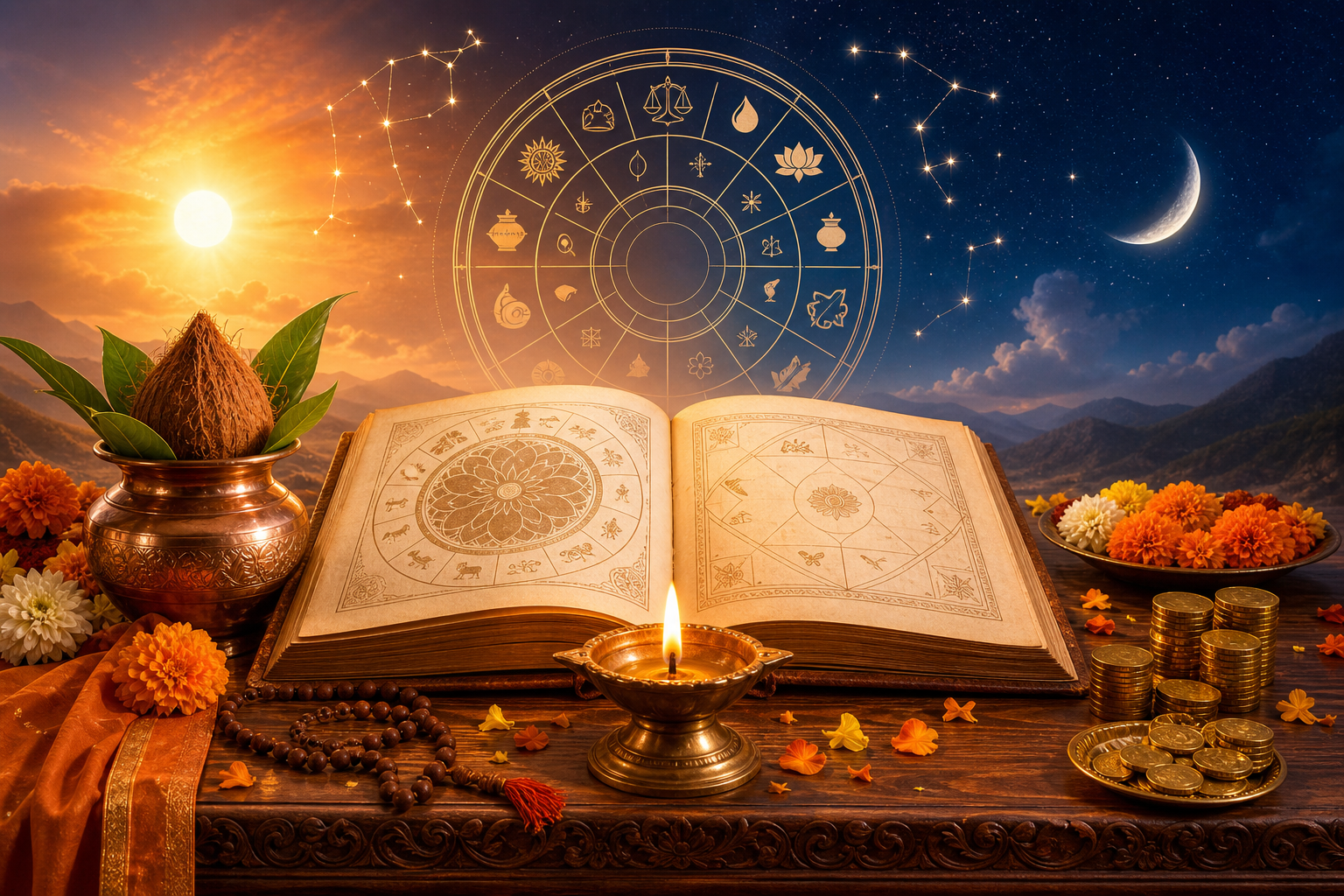
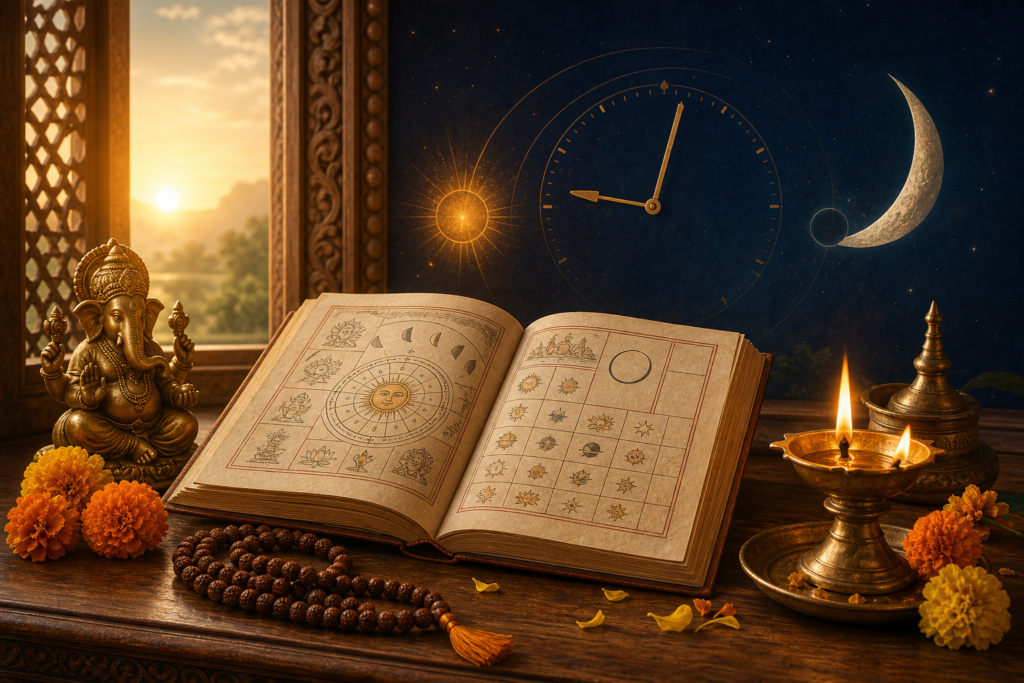
The Panchang for 20 February 2026, a Friday, offers a structured view of the Hindu calendar day through Tithi, Nakshatra, Yoga, Karana, Choghadiya, Rahu Kaal, Abhijit Muhurat, Amritakalam, Tarabalam, and other time divisions traditionally used for planning religious, domestic, financial, and cultural activities. In the dharmic calendar tradition, the day is not treated as a flat unit of twenty-four identical hours; it is understood as a living sequence shaped by the Sun, Moon, lunar mansion, and qualitative periods of time.
For 20 February 2026, the listed timings are given according to IST. Panchang calculations can vary by location because sunrise, sunset, Moonrise, and local horizon conditions influence daily observances. Therefore, these details are most useful as an India Standard Time reference, while local temple calendars or regional Panchangam traditions should be consulted for highly location-specific rituals.
The sunrise for the day is 6:43 AM IST, and the sunset is 6:15 PM IST. These two points frame the daytime Choghadiya divisions and also provide the practical rhythm for daily worship, vrata observance, travel planning, and household ceremonies. Traditional practitioners often begin by noting sunrise because many daily Hindu calendar elements are measured in relation to it.
The Moon phase is Shukla Paksha, the waxing fortnight, a period generally associated with growth, increase, renewal, and outward movement. In many Hindu traditions, Shukla Paksha is considered supportive for constructive undertakings, devotional observances, learning, family rituals, and new beginnings, though the final decision also depends on Tithi, Nakshatra, Tara strength, Choghadiya, and avoidance of inauspicious windows.
The Tithi on 20 February 2026 is Tritiya until 2:38 PM, after which Chaturthi begins. Tritiya is often treated as a favorable lunar day for refinement, creative work, relationship-centered activities, and orderly beginnings. Once Chaturthi starts, the texture of the day changes, and many traditions become more cautious about major launches unless a specific vrata, Ganesha-related observance, or family custom gives the period a different ritual meaning.
The Nakshatra is Uttara Bhadrapada until 8:07 PM, followed by Revati. Uttara Bhadrapada is traditionally associated with depth, steadiness, restraint, wisdom, and inward strength. Revati, which follows later in the evening, is often connected with completion, protection, nourishment, safe movement, and gentle transition. This shift from Uttara Bhadrapada to Revati gives the day two distinct astrological tones: one sober and stabilizing, the other more fluid and supportive of closure or movement.
The Yoga for the day is Sadhya until 6:23 PM, followed by Subha. Sadhya suggests attainability, effort, and the capacity to complete purposeful work. Subha, as its name indicates, is associated with auspiciousness and a generally favorable quality. In practical Panchang reading, Yoga is not interpreted in isolation; it is combined with Tithi, Nakshatra, Karana, and Muhurta to understand the more complete character of the day.
The Karana is Garija until 2:38 PM, followed by Vanija. Since Karana is half of a Tithi, it provides a finer time division for action. Garija is traditionally treated as steady and functional, while Vanija is commonly connected with trade, negotiation, exchange, and transactional activity. This is one reason the afternoon period, especially when supported by favorable Muhurta or Choghadiya, may be considered relevant for business-related planning.
The main inauspicious periods listed for 20 February 2026 are Rahu Kaal from 11:03 AM to 12:29 PM, Yamagandam from 3:23 PM to 4:49 PM, Varjyam from 07:37 AM to 09:09 AM, and Gulika from 8:10 AM to 9:36 AM. These periods are traditionally avoided for major new beginnings, important travel departures, financial launches, ceremonial starts, and public commitments. Routine work, ongoing duties, prayer, study, and necessary responsibilities are generally not abandoned merely because such a period is active.
Rahu Kaal is one of the most widely recognized cautionary intervals in the Hindu calendar. On this date it falls before midday, from 11:03 AM to 12:29 PM. A practical way to use this information is to avoid scheduling a first signature, first payment, first public announcement, or first step of a major venture during this window when alternatives are available.
Yamagandam, from 3:23 PM to 4:49 PM, is also traditionally avoided for initiating important undertakings. Gulika, from 8:10 AM to 9:36 AM, carries a more complex interpretive history, but many household calendars still mark it as unsuitable for fresh auspicious beginnings. Varjyam, from 07:37 AM to 09:09 AM, is connected with Nakshatra-based avoidance and is usually treated carefully in ritual planning.
The auspicious windows are especially important for those seeking a balanced day of spiritual practice and practical action. Amritakalam is listed from 03:28 PM to 05:01 PM, and Abhijit Muhurat is listed from 12:06 PM to 12:52 PM. Abhijit Muhurat is traditionally respected as a powerful midday period, though on this date it overlaps partly with Rahu Kaal, so careful practitioners may give additional weight to the overlap and consult a knowledgeable priest for high-stakes rituals.
Amritakalam from 3:28 PM to 5:01 PM is identified as an auspicious period, particularly useful for wealth, prosperity, business decisions, and constructive planning. However, it also overlaps with Yamagandam from 3:23 PM to 4:49 PM. This creates a nuanced Panchang situation: one factor is favorable, another is cautionary. For ordinary reflection, accounting, planning, or devotional intention, the period may still feel meaningful; for major inaugurations, a more precise Muhurta consultation would be prudent.
The Day Choghadiya begins with Shubh from 6:43 AM to 8:08 AM, followed by Rog from 8:08 AM to 9:34 AM, Udveg from 9:34 AM to 11:00 AM, Char from 11:00 AM to 12:26 PM, Labh from 12:26 PM to 1:52 PM, Amrit from 1:52 PM to 3:18 PM, Kaal from 3:18 PM to 4:44 PM, and Shubh from 4:44 PM to 6:15 PM. Among these, Shubh, Labh, and Amrit are generally treated as favorable for auspicious activities.
The Night Choghadiya begins after sunset with Amrit from 6:15 PM to 7:50 PM, Kaal from 7:50 PM to 9:25 PM, Shubh from 9:25 PM to 11:00 PM, Rog from 11:00 PM to 12:35 AM, Udveg from 12:35 AM to 2:10 AM, Char from 2:10 AM to 3:45 AM, Labh from 3:45 AM to 5:20 AM, and Amrit from 5:20 AM to 6:43 AM. These segments are estimated by dividing the time from sunset to the next sunrise into eight parts, a method that gives Choghadiya its practical, time-management character.
For wealth-oriented work, the Panchang highlights Amritakalam from 3:28 PM to 5:01 PM, Abhijit Muhurat from 12:06 PM to 12:52 PM, and the favorable Choghadiya periods of Shubh, Labh, and Amrit. These intervals may be considered for financial planning, business reflection, investment review, devotional offerings for prosperity, and disciplined household budgeting. At the same time, Rahu Kaal, Yamagandam, Varjyam, and Gulika are traditionally avoided for formal wealth events or the ceremonial launch of major financial projects.
Tarabalam gives another layer of interpretation by relating the day’s Moon Nakshatra to the individual’s Janma Nakshatra. When the Moon is in Uttara Bhadrapada until about 8:07 PM, the Tara results are as follows: Ashwini is Sampat, Bharani is Vipat, Krittika is Kshema, Rohini is Pratyak, Mrigashira is Sadhana, Ardra is Naidhana, Punarvasu is Mitra, Pushya is Parama Mitra, Ashlesha is Janma, Magha is Sampat, Purva Phalguni is Vipat, Uttara Phalguni is Kshema, Hasta is Pratyak, Chitra is Sadhana, Swati is Naidhana, Vishakha is Mitra, Anuradha is Parama Mitra, Jyeshta is Janma, Mula is Sampat, Purva Ashadha is Vipat, Uttara Ashadha is Kshema, Shravana is Pratyak, Dhanishta is Sadhana, Shatabhisha is Naidhana, Uttara Bhadrapada is Mitra, and Revati is Parama Mitra.
After the Moon moves into Revati at about 8:07 PM, the Tarabalam pattern changes: Ashwini is Vipat, Bharani is Kshema, Krittika is Pratyak, Rohini is Sadhana, Mrigashira is Naidhana, Ardra is Mitra, Punarvasu is Parama Mitra, Pushya is Janma, Ashlesha is Sampat, Magha is Vipat, Purva Phalguni is Kshema, Uttara Phalguni is Pratyak, Hasta is Sadhana, Chitra is Naidhana, Swati is Mitra, Vishakha is Parama Mitra, Anuradha is Janma, Jyeshta is Sampat, Mula is Vipat, Purva Ashadha is Kshema, Uttara Ashadha is Pratyak, Shravana is Sadhana, Dhanishta is Naidhana, Shatabhisha is Mitra, Uttara Bhadrapada is Parama Mitra, and Revati is Janma.
The Tarabalam interpretation key is practical: Parama Mitra, Sampat, Sadhana, Mitra, and Kshema are generally favorable for growth, prosperity, protection, and meaningful progress. Janma and Pratyak are more neutral or mixed, requiring moderation and awareness. Vipat and Naidhana are traditionally treated with caution, especially for important new undertakings.
This Panchang also illustrates how dharmic timekeeping balances faith, astronomy, inherited cultural memory, and everyday decision-making. A family may use it to choose a prayer time, a business owner may use it to avoid Rahu Kaal for a launch, and a student may use it to understand how Tithi, Nakshatra, Yoga, and Karana interact. The system is technical, but its lived purpose is simple: to bring attention, discipline, and reverence into action.
For 20 February 2026, the strongest practical takeaway is that the day belongs to Shukla Paksha Tritiya until mid-afternoon, carries Uttara Bhadrapada energy until evening, and later transitions into Revati. Favorable periods include selected Shubh, Labh, and Amrit Choghadiyas, while caution is advised during Rahu Kaal, Yamagandam, Gulika, and Varjyam. The Panchang therefore becomes not a rigid command but a refined cultural instrument for mindful timing, shared dharmic continuity, and respectful participation in Hindu calendar traditions.
Inspired by this post on Hindu Pad.






Leave a Reply
You must be logged in to post a comment.