
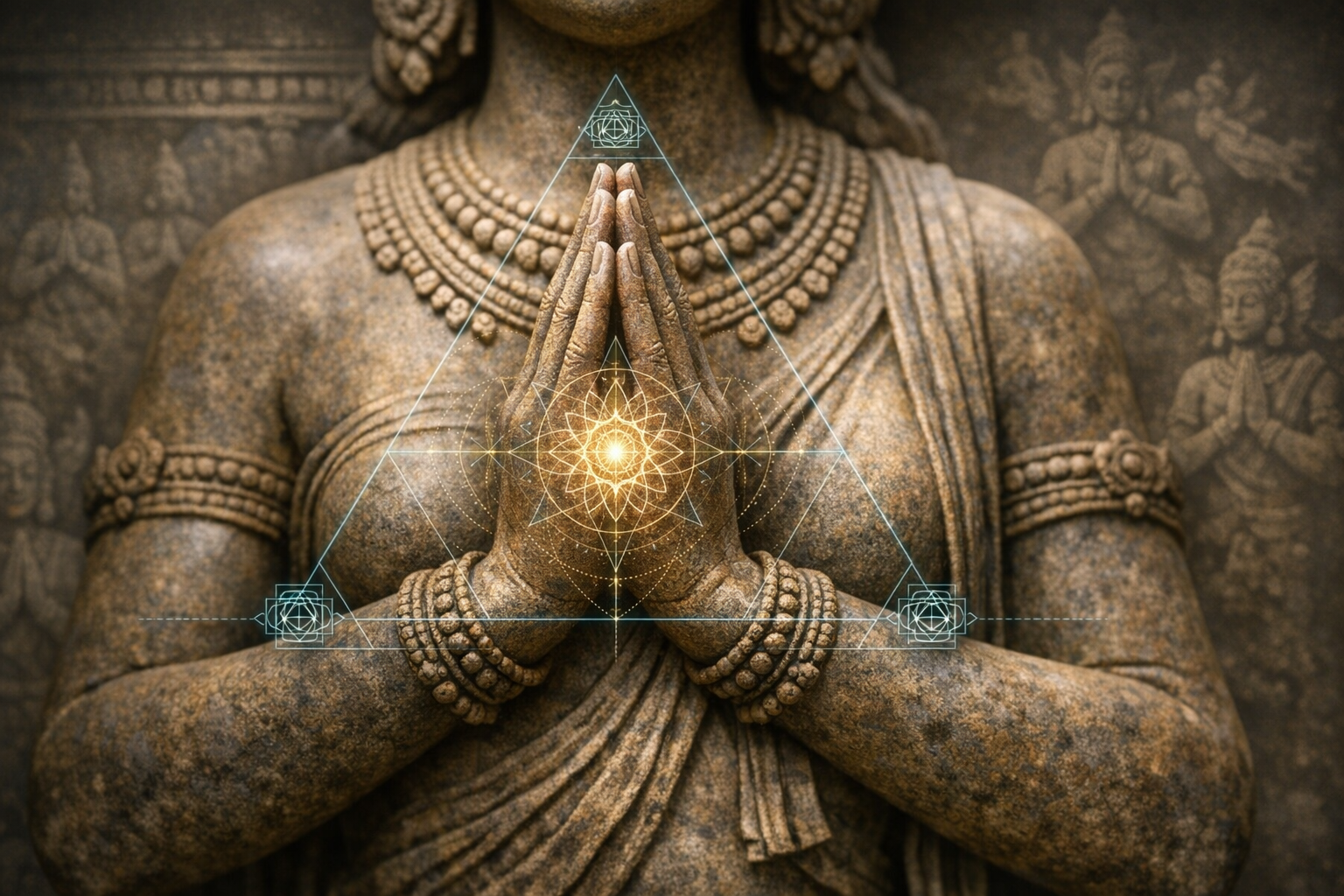
Among the most immediately recognizable gestures in the entire visual vocabulary of Hindu sacred art, Anjali Mudra appears as folded hands held at the heart or raised before the face in an attitude of reverence. Both palms are pressed together evenly, fingers extended upward and held close, thumbs resting lightly and symmetrically. This simple yet exacting configuration communicates devotion, welcome, and inner composure in a single, balanced silhouette, making it a foundational element of Hindu sculptures and a living gesture across South Asia and beyond.
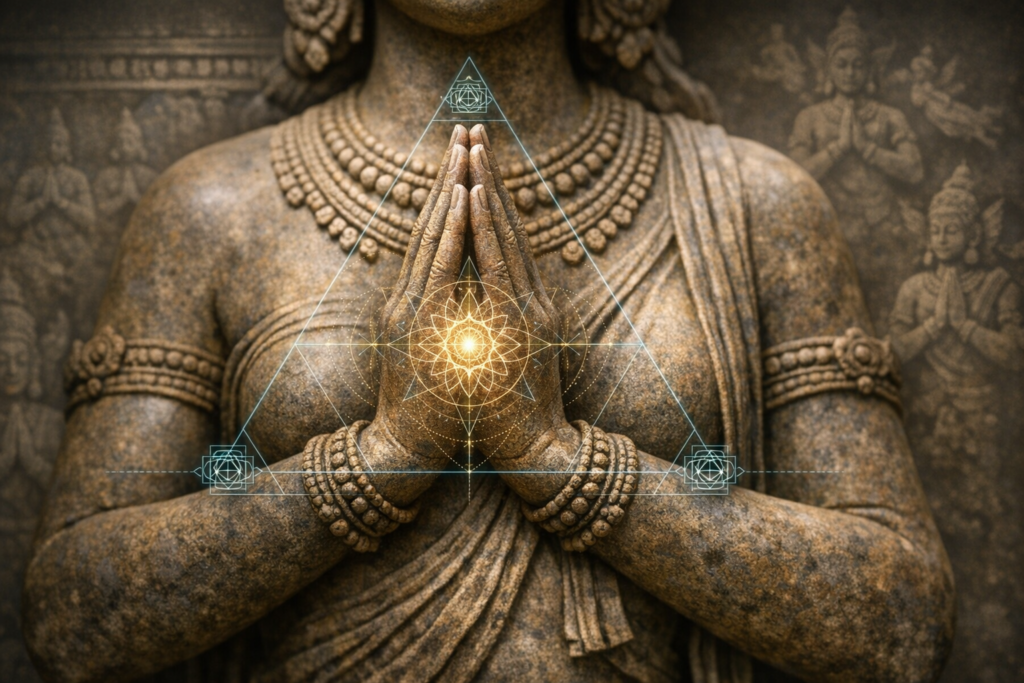
In iconographic terms, Anjali Mudra (also called Namaskara or Ātmanjali) is a samyuta-hasta—hands joined—whose precision matters. Sculptural canons guide the fingertips to align cleanly, the wrists to remain relaxed, and the forearms to form a gentle triangular frame over the torso. When carved in stone or modeled in bronze, the gesture stabilizes the figure’s axis, complements samabhanga (frontal balance) or, at times, soft tribhanga (triple flexion), and visually concentrates attention toward the heart center. This anatomical economy and compositional clarity allow viewers to intuit the image’s devotional tenor before reading any other attribute.
The Sanskrit term “añjali” derives from the verbal root añj, “to honor, adorn, or anoint,” and also denotes a cupped-hand “measure” in Ayurveda—the volume that fits between two joined palms. In ritual usage, an añjali is both the vessel and the act: the hands become the offering bowl, and the gesture itself becomes worship. Classical dramaturgical and dance treatises, such as the Abhinaya Darpana, prescribe Anjali to salute divinity, teacher, and audience, signaling a graded etiquette of respect that sculpture encodes in durable form.
Shilpa Shastra traditions—texts that guide sacred image-making—do not merely repeat a spiritual truism; they codify a visual grammar. Proportional canons (tāla-māna), surface treatment (rekhā), and hand morphology (hasta-lakṣaṇa) ensure that Anjali appears measured, centered, and serene. In mature examples, sculptors articulate nail beds, finger taper, and knuckle planes with extraordinary restraint, so the gesture reads clearly at temple distances and holds its integrity as light moves across relief and bronze.
Context fine-tunes meaning. At heart level, Anjali Mudra signifies greeting and devotional steadiness; at the face or brow (ajñā) level, it signals heightened veneration; lifted above the head, it marks surrender before the supreme. Sculptors exploit this vertical scale to locate the devotee within a sacred hierarchy, allowing a viewer to infer the status of the venerated presence even when the deity is off-frame in a narrative panel.
Historically, the gesture is pan-dharmic and pan-regional. Early stone reliefs at Buddhist sites such as Sanchi (circa 2nd–1st century BCE) already show lay donors and celestials in Anjali; Gupta-period art (4th–6th centuries CE) refines its serenity and symmetry; and the Deccan and Tamil regions translate it into high classicism. In the caves of Elephanta and Ellora, flying vidyādharas fold their hands as they circle monumental icons; at Mahabalipuram’s great reliefs, processional figures punctuate narrative flow with Anjali, anchoring the eye amid visual abundance.
South Indian bronzes and stone sculpture from the Chola and Hoysala periods often set Anjali in dynamic dialogue with other mudras. Royal donors, saints, attendants, and airborne gandharvas commonly appear with folded hands around Somāskanda panels or in circumambulatory friezes, their compact, vertical palms reading as luminous markers of bhakti amid ornamental density. The quiet geometry of the gesture counterbalances the kinetic energy of jewelry, textiles, and bodily curves.
The visual language radiates beyond the subcontinent. In Khmer, Thai, and Javanese traditions—shaped by Hindu and Buddhist exchange—the gesture persists as Khmer sampeah, Thai wai, and the Javanese sembah, retaining both devotional and social significance. Temple reliefs at Angkor and Prambanan, and narrative panels across mainland Southeast Asia, mirror the Indic canon’s symmetry while adapting local costume and physiognomy, illustrating how Anjali Mudra travels, translates, and endures.
Across dharmic lineages, the gesture serves a shared ethic of reverence and presence. Hindu sculptures depict devotees and celestials in Anjali before śiva or viṣṇu; Buddhist murals and reliefs show monks, donors, and bodhisattvas’ attendants saluting the Buddha; Jain temple panels present lay followers and vidyādharas with folded hands around tīrthaṅkara images; Sikh practice maintains folded hands during Ardas, reflecting humility and focused prayer. Despite doctrinal distinctions, the common bodily syntax affirms a civilizational commitment to respectful greeting, ethical reciprocity, and interior stillness.
Performing arts preserve and broadcast this grammar. In Bharatanatyam and other classical forms, Anjali is the salutation that opens performance, honors the divine, teacher, and audience, and seals transitions with unambiguous clarity. Sculpted dancers on temple walls and bronze figures of performers frequently display the same codified palms, binding living stagecraft to its stone and metal counterparts through a continuous lineage of hasta-lakṣaṇa.
Yogic literature associates Anjali Mudra at the sternum with the anāhata (heart) center, framing it as a gesture that harmonizes attention, breath, and affect. Contemporary contemplative discourse often notes the calming effect of symmetrical, midline postures; while scientific interpretation evolves, there is broad experiential agreement that the gesture steadies focus, softens facial musculature, and invites diaphragmatic breathing. In asana sequences, Pranāmāsana and Tādāsana with Anjali Mudra introduce and close cycles with composure.
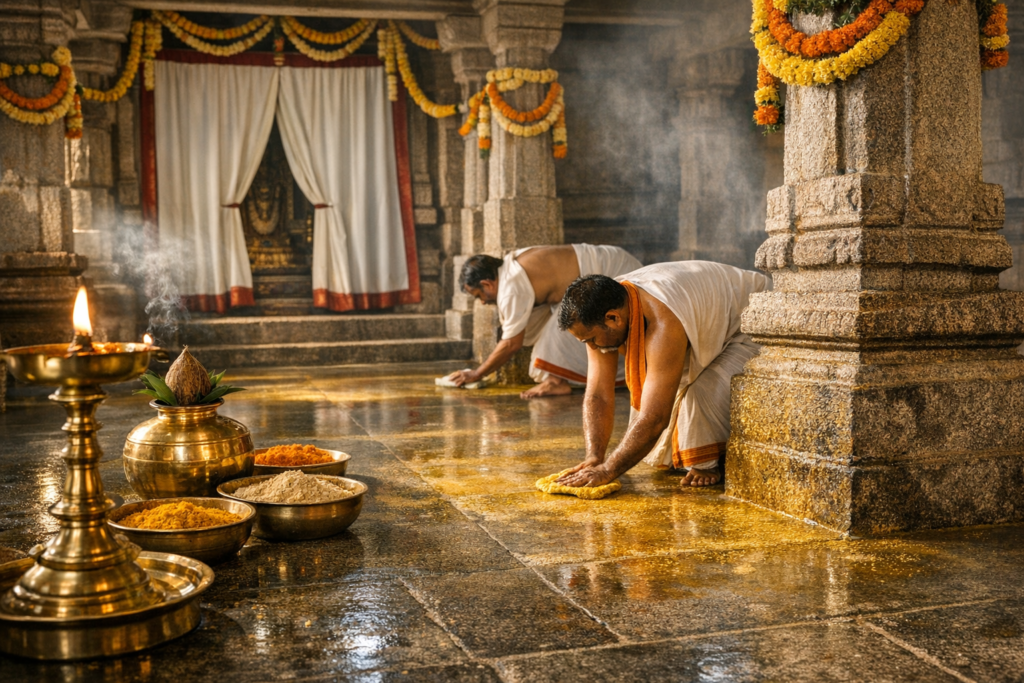
Ritually, the hands as bowl and bridge recur throughout pūjā. Flowers, rice, and water are gathered in the palms as an añjali and offered, making the same gesture the vehicle of transport from devotee to deity. This doubleness—Anjali as both sign and substance—helps explain why sculptors and ritualists consider the gesture indispensable, and why it remains one of the most legible visual cues in Hindu sacred art.
In everyday life, Namaste suggests more than a greeting; it encodes an ethic. Viewers often reflexively mirror Anjali upon entering a shrine or encountering a sacred image in a museum, experiencing a quiet shift from observation to participation. The instinct to fold the hands—to center attention, to acknowledge another’s dignity—links polished temple bronzes, weathered basalt guardians, and contemporary practice into a single, living continuum.
Aesthetically, Anjali organizes space with elegant economy. The triangular aperture formed by the forearms guides the gaze to the face and chest, stabilizing line-of-sight and intensifying the icon’s psychological presence. Carvers and casters use this geometry to pace narrative friezes, punctuate processions, and create moments of visual rest—techniques as critical to reading a temple wall as to appreciating an individual icon.
For close looking—whether in a garbhagṛha, on a museum plinth, or in field photographs—note alignment of the metacarpals, parity of finger heights, and the relation of the joined thumbs to the midline. Heart-level Anjali often accompanies devotional subjects and donor portraits; face-level and overhead Anjali frequently frame theophanies, aerial beings, and climactic narrative moments. These cues help decode relative sacred hierarchy and narrative emphasis without extensive textual scaffolding.
Across millennia and traditions, Anjali Mudra fuses sacred intention with sculptural intelligence. It is an embodied philosophy of respect, a compositional masterstroke, and a social ethic rendered in stone and bronze. Seen in the round or in relief, at home or in diaspora, the gesture invites a common center—where devotion, discipline, and dignity meet—and affirms a unifying current that flows through Hinduism, Buddhism, Jainism, and Sikhism alike.
Inspired by this post on Hindu Blog.







Leave a Reply
You must be logged in to post a comment.