
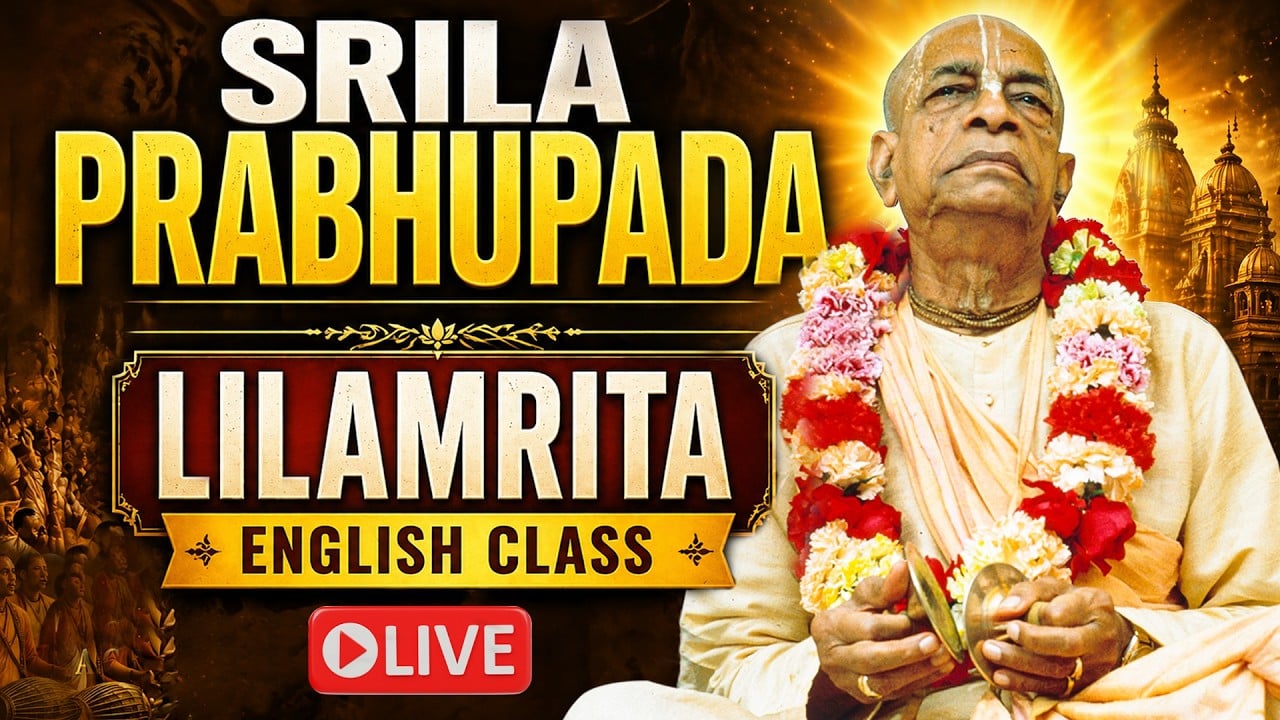
On 21.06.2026, a widely shared discourse by HG Daivi Shakti Mataji focused on Srila Prabhupada Lilamrita and why this biography continues to orient the Hare Krishna Movement (ISKCON) in both scholarship and practice. Framed through the devotional and historical lens of Gaudiya Vaishnavism, the discussion invited careful reading of lila as lived history, spiritual pedagogy, and community memory.
Srila Prabhupada Lilamrita—authored by Satsvarupa dasa Goswami and published by the Bhaktivedanta Book Trust—draws upon letters, journals, interviews, Back to Godhead articles, and contemporaneous records to narrate the life of A. C. Bhaktivedanta Swami Prabhupada. The text functions as both biography and hagiography, presenting verifiable events alongside the theological grammar of lila that animates bhakti literature.
Historically, the narrative traces a clear arc: birth in Calcutta (1896), early Vaishnava formation, the decisive 1922 meeting with Bhaktisiddhanta Sarasvati, formal initiation (diksha) in the 1930s, the launch of the Back to Godhead magazine in the 1940s, and the renounced order (sannyasa) undertaken in 1959. This preparatory period culminates in the Jaladuta voyage of 1965, a watershed that relocates Gaudiya Vaishnavism into a global conversation.
In 1966, the International Society for Krishna Consciousness (ISKCON) was incorporated in New York, and Srila Prabhupada’s mission expanded rapidly through kirtana, study of Bhagavad-gita and Srimad-Bhagavatam, initiation of sadhana-bhakti, and the systematic training of disciples. The period 1966–1977 is documented as one of intense traveling, translation, commentary, temple establishment, and institution-building that connected India, North America, Europe, and beyond.
For readers approaching Srila Prabhupada Lilamrita as a historical source, several technical features stand out: triangulation across letters and interviews, dateable public events, cross-references to manuscripts and lecture transcripts, and editorial notes that clarify provenance. Far from diminishing faith, this apparatus situates devotion within traceable documentary footprints, allowing scholars and practitioners to meet on shared evidentiary ground.
From a theological perspective, the biography is structured by acintya-bheda-abheda—the Gaudiya doctrine of simultaneous difference and non-difference between the divine and all beings. Within this frame, lila is not embellishment but a category of meaning: the Lord’s compassionate outreach, the guru’s mercy (kripa), and the disciple’s responsive seva become interpretive keys for understanding agency, causality, and mission.
The discourse underscored how Srila Prabhupada operationalized bhakti into repeatable disciplines: daily japa, nama-sankirtana, scriptural study, and the four regulative principles. This conversion of theology into habit forms an ethical ecology that many across the Sanatana Dharma family—Hinduism, Buddhism, Jainism, and Sikhism—recognize as consonant with yama–niyama, sīla, anuvrata, and seva.
In leadership studies, the Lilamrita offers case material on mission-centric governance: vision framed by shastra, decisions oriented to preaching (prachar), and resource stewardship aligned with dharma. These dynamics extend beyond religious administration, modeling how clarity of purpose, accountability, and compassion can animate institutions in rapidly changing cultural contexts.
The guru-shishya parampara emerges throughout as a living conduit for knowledge, character formation, and cultural translation. Srila Prabhupada’s capacity to teach across languages and continents illustrates how parampara harmonizes fidelity to Vedic wisdom with adaptability to new audiences—an enduring lesson for global pedagogy.
Because the Lilamrita is both devotional and documentary, responsible reading invites source comparison. Letters, recorded lectures, memoirs by early disciples, and contemporaneous media reports help situate episodes within corroborated timelines, enabling historians to distinguish genre features of hagiography from empirical claims, without dismissing the theological register that gives the text its coherence.
At the level of cultural history, ISKCON’s expansion demonstrates the portability of Gaudiya Vaishnavism: kirtana in public squares, prasadam distribution, and temple culture created inclusive civic spaces long before intercultural literacy became an academic keyword. In this sense, Srila Prabhupada Lilamrita documents not merely a life but the formation of a transnational religious public.
HG Daivi Shakti Mataji’s emphasis on compassion and inclusivity aligns closely with dharmic unity. Shared commitments—nonviolence (ahimsa), truthfulness (satya), disciplined practice (tapas), remembrance of the Divine Name, and seva—provide a sturdy bridge across Hindu, Buddhist, Jain, and Sikh traditions, validating plural spiritual itineraries while honoring distinct lineages.
Where some modern narratives set religions in competitive frames, the Lilamrita invites a different hermeneutic: unity in diversity anchored in Ishta, respect for multiple sadhanas, and dialogue grounded in mutual uplift. This is not syncretism but hospitality, a virtue deeply embedded in Indic philosophy and community life.
Readers seeking an entry plan may find it effective to pair chapters of Srila Prabhupada Lilamrita with corresponding segments from Bhagavad-gita and Srimad-Bhagavatam, followed by reflective journaling on sadhana, seva, and satsanga. Such a sequence retains theological depth, historicizes life events, and translates inspiration into personal practice.
Methodologically, the biography also illuminates how religious movements transmit memory: eyewitness testimony, ritual calendars, sacred sites such as Vrindavan, and institutional archives together compose a durable memory architecture. Engaging that architecture critically and reverentially strengthens both scholarship and devotion.
In contemporary ethics, the Lilamrita’s insistence on personal transformation—through disciplined japa, vegetarianism, and community service—interfaces constructively with environmental stewardship, public health, and social cohesion. Here, bhakti is not private sentiment but a civically consequential mode of life.
Finally, the 21.06.2026 reflection curated through ISKCON Vrindavan media reaffirms why the biography endures: it offers an empirically anchored, theologically articulate, and practically actionable map of bhakti for the twenty-first century. Approached with humility and rigor, Srila Prabhupada Lilamrita continues to cultivate unity, resilience, and joy across the broader dharmic world.
In sum, the narrative of Srila Prabhupada—teacher of Bhagavad-gita, commentator on Srimad-Bhagavatam, and founder of ISKCON—remains a touchstone for understanding how Vedic wisdom travels, takes root, and flourishes. The enduring message is simple and demanding: chant, study, serve, and honor every sincere seeker’s path to the Divine.
Inspired by this post on Dandavats.





Leave a Reply
You must be logged in to post a comment.