
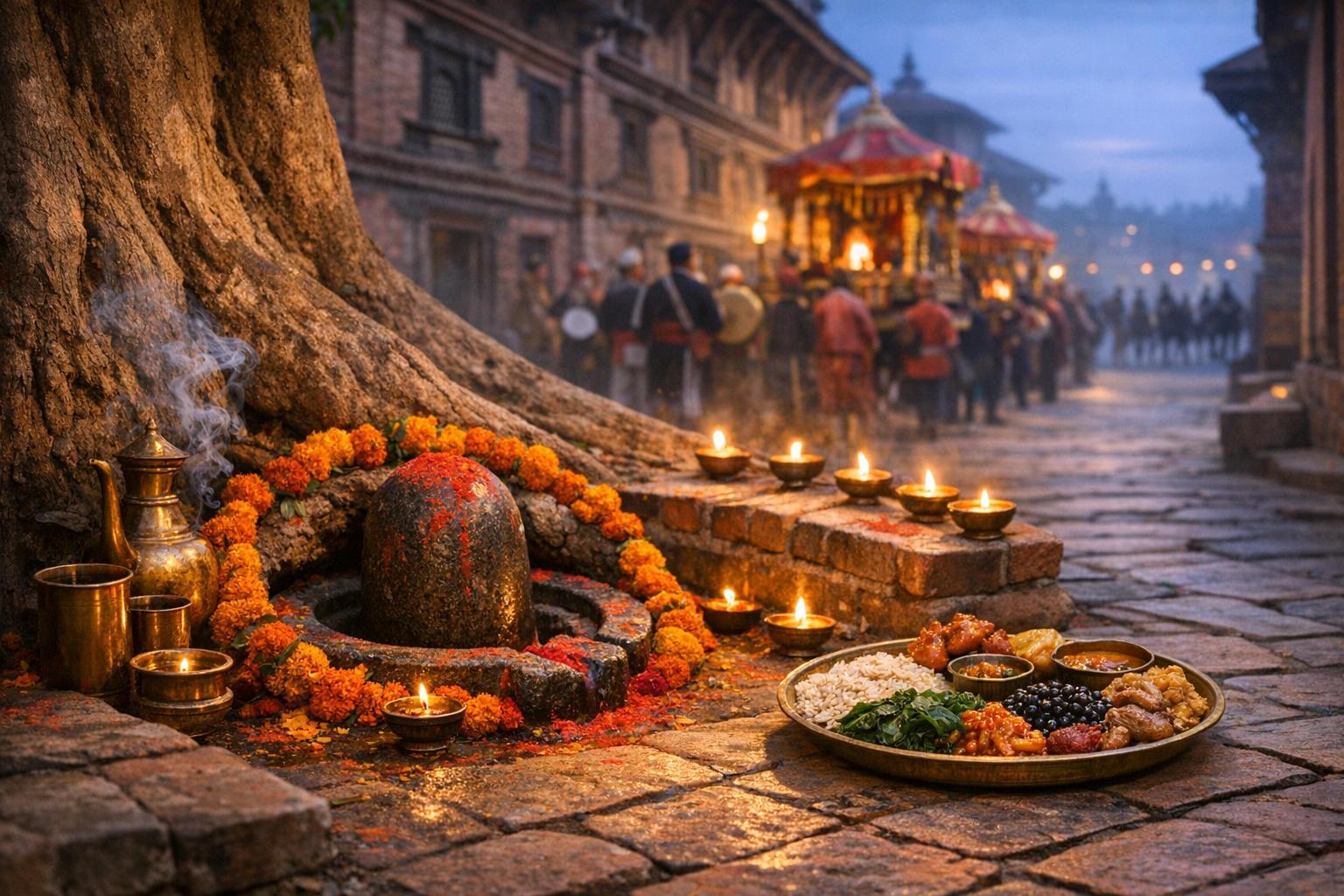
Nepal’s Kathmandu Valley nurtures an intricate religious life in which ritual, cityscape, kinship, and memory interlace. Among its most evocative observances is Pahachare (also written Pahan Charhe), a three-day Newa festival that centers on Luku Mahadyo—the “Hidden Shiva”—and culminates in the wider civic spectacle of Ghode Jatra. Quietly profound yet socially expansive, Pahachare reveals how a community sustains sacred presence in everyday spaces while honoring guests, ancestors, and guardian deities who protect the city’s living mandala.
In Nepal Bhasa, Pahachare/Pahan Charhe is widely glossed as “when guests come,” expressing the festival’s chief social ethic: one invites kin and friends—especially married daughters—to share food, blessings, and the continuity of household bonds. The theological center is Luku Mahadyo (also called Luku Mahadev), an aniconic form of Shiva whose distinct presence is literally “hidden” in sunken or partially buried shrines distributed across Newa neighborhoods. The festival’s ritual grammar thus integrates the intimate (family feasts and ancestral courtyards) with the civic (goddess processions and urban guardianship), creating a powerful continuum of sacred life.
By the lunisolar calendar, Pahachare generally falls in late March or April, during the waning fortnight of Chaitra, and often aligns with Ghode Jatra on the concluding day. While precise dates vary by local almanac, the three-day arc is stable: day one foregrounds Luku Mahadyo; day two stages the meeting of mother goddesses (Ajima) through neighborhood processions; day three opens to the broader urban rite of Ghode Jatra at Tundikhel. This cadence moves from private household worship to expansive civic protection, mirroring Newa cosmology in which home, neighborhood, and city are ritually nested.
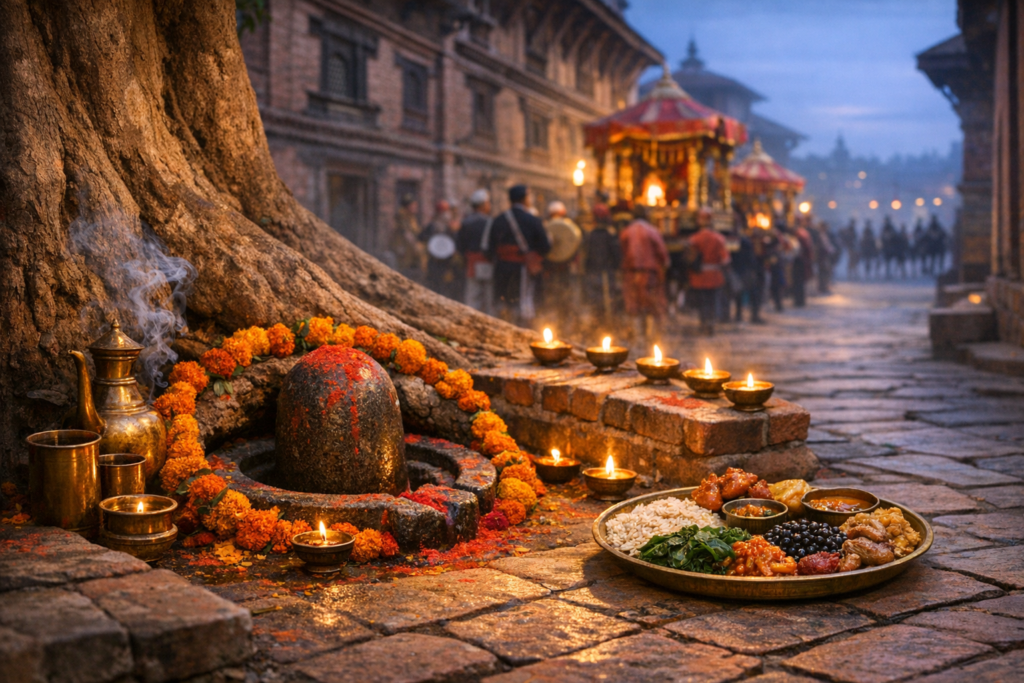
Luku Mahadyo, the “Hidden Shiva,” is worshipped at small, often ground-level or recessed shrines, frequently beneath pipal trees or in discreet corners of residential lanes. The term luku (hidden) signals a theological poetics: divinity need not be elevated or monumental to be efficacious; it may be cthonic, intimate, and embedded in place. On the first evening of Pahachare, families clean and refresh these shrines, light lamps, and offer a rich ceremonial platter. In a religious landscape where Shiva appears as cosmic pillar, family deity, and city guardian, Luku Mahadyo embodies the humility of presence and the nearness of grace.
A striking feature of the Luku Mahadyo worship is the permissibility of meat offerings within Newa ritual norms. Described colloquially as a deity who “feasts on meat,” Luku Mahadyo receives naivedya that may include spiced meat alongside grains and pulses. Framed within the Tantric matrix historically prevalent in the Valley, such offerings are not transgressive spectacles but disciplined, context-specific sacral acts. They express a theological realism: abundance is shared with the deity as the household’s honored guardian; the elements of life—vegetal, animal, fermented—are ritually reintegrated into cosmic order through mantra, mudra, and mindful offering.
The culinary idiom is anchored by samay baji, the quintessential Newa ceremonial spread. Typically composed of baji (beaten rice), black soybeans, spicy meat preparations like choila, boiled egg, stir-fried greens, fried fish, pickles, ginger, and seasonal items, and often accompanied by thwon (rice beer) or aila (distilled spirit), samay baji is both offering and social food. Its diversity symbolizes fullness, while its portability and shareability suit courtyard worship and neighborhood exchange. Placed before Luku Mahadyo, it reaffirms the reciprocal relationship between household economy, seasonal cycles, and sacred guardianship.
Beyond the shrine, Pahachare is remembered as a time when guests fill homes, conversation bridges generations, and kinship networks are renewed. Married daughters and relatives are invited home; elders recount the neighborhood’s deities and processions; children watch lamps flicker at luku shrines and learn the precise etiquette of offering. The social grammar of hospitality is thus inseparable from ritual practice: honoring guests mirrors honoring the deity; feasting in the home echoes feasting at the shrine.
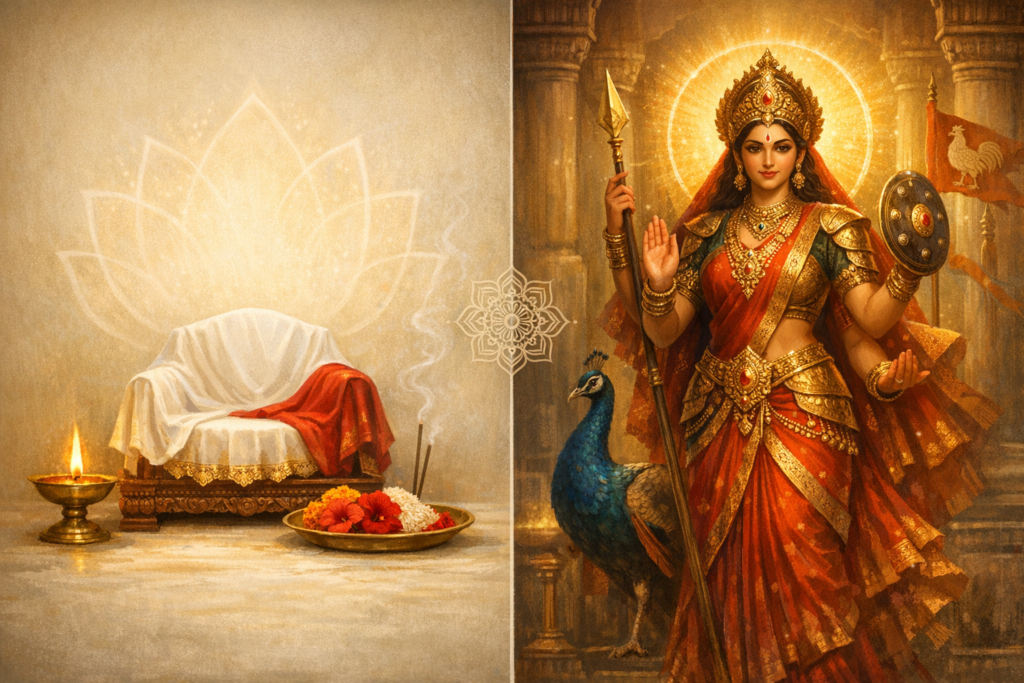
The festival’s second day expands from domestic altars into the city’s ceremonial routes through an observance popularly known as Dyah Lwakegu—“the meeting of the deities.” Portable images and palanquins of local Ajima (mother goddesses) circulate along historic markets and squares such as Asan and Indra Chowk, convening at predesignated points. What unfolds is not a single centralized spectacle but a web of neighborhood processions that greet, circumambulate, and momentarily gather, reaffirming the protective girdle of the city’s mother goddesses.
Ajima, as the matriarchal protectress in Newa tradition, binds domestic well-being to urban security. The processional logic is both spatial and metaphysical: when deities “meet,” communities meet; when palanquins pause face-to-face, reciprocal blessings circulate; when musical ensembles answer one another across a square, a sonic mandala enfolds the crowd. These convergences of Ajima images, bearers, and devotees render a living cartography of the Valley in which religious unity is practiced through movement, salutation, and mutual recognition.
The third day coincides with Ghode Jatra at Tundikhel, the historic parade ground of Kathmandu. While Ghode Jatra is a state-facing event featuring horse parades and martial precision, its deeper cultural function is apotropaic: the pounding of hooves and the disciplined spectacle ritually subdue malevolent forces said to trouble the city. In the Pahachare arc, this closure is coherent—household protection (day one) and neighborhood goddess guardianship (day two) scale into civic protection (day three). The city’s safety, in this view, is an outcome of harmonized domestic, communal, and state ritualities.
The liturgy at Luku Mahadyo shrines is locally inflected but follows an intelligible sequence. The site is swept and washed; a lamp is lit; incense, water, flowers, and vermilion are offered; samay baji is arrayed; mantras are recited with hands joined in namaskar. Meat, when offered, is prepared respectfully and placed as naivedya according to the household’s vow and local custom. The rite concludes with prasada distribution and a brief moment of stillness before the shrine is re-covered, returning the deity to hiddenness until the next cycle of worship.
“Hiddenness” in this context is a sophisticated theological motif rather than a mere physical descriptor. In Shiva traditions across South Asia, the aniconic linga anchors the paradox of transcendence and immanence—the infinite made graspable without fixing form. Luku Mahadyo intensifies this insight by receding below the eye-line, reminding practitioners that sanctity runs underfoot, in foundations and roots, in places that support rather than distract. The shrine’s modesty is an argument: the power that guards the home and lane does not always announce itself; it simply abides.
Urbanistically, Luku Mahadyo belongs to a broader Newa pattern in which deities and trees, wells, courtyards, and crossroads compose a sacred infrastructure. Many hidden shrines sit at nodal points—near water sources, shade trees, or thresholds—where community life naturally aggregates. The festival’s acts of cleaning, lighting, and feeding the shrine therefore double as custodianship of the micro-commons. In tending the deity, residents tend the lane; in renewing the altar, they renew the social ecology around it.
Pahachare also expresses an inclusive dharmic imagination characteristic of the Newa world, where Hindu and Buddhist lineages share spaces, symbols, and processional routes. Households that propitiate Luku Mahadyo may also venerate Lokesvara and other Buddhist deities; Buddhist monastic communities participate in neighborhood goddess observances; and Ajima’s motherhood is intelligible across traditions. This lived pluralism aligns with the broader dharmic commitment to honoring many valid paths, allowing Hinduism and Buddhism—alongside Jain and Sikh values of non-harm, community service, and truthfulness—to find active resonance within one civic weave.
From a ritual theory perspective, the permissibility of meat and aila in certain Newa rites reflects the survival of Tantric paradigms in which elements of life are not shunned but ritually transmuted. The intention and containment provided by mantra and rite delimit ethical boundaries while acknowledging material realities. Far from undermining ahimsa as an ethical ideal, this framework situates diverse household vows along a continuum of disciplined practice, with mutual respect across lineages that choose vegetarian offerings and those that maintain inherited Tantric observances.
Material culture deepens the festival’s texture. The samay baji plate constitutes an edible archive of Newa history: beaten rice and black soy speak to agrarian cycles; choila to artisanal fire and spice economies; aila to refined distillation technologies; ginger and pickles to preservation and trade. When this array is placed before Luku Mahadyo, everyday labor—farming, fermenting, cooking—becomes liturgy, and the tastes of home become the flavors of devotion.
Memory-work animates Pahachare. Elders recall being taught not to tread carelessly near luku shrines; parents instruct children to bow before lamps in alleyway altars; neighbors exchange small portions of prasada, enacting reciprocity beyond kin lines. The sensory field—lamp-smoke, drum-cadence, the tang of aila, the crunch of baji—becomes a mnemonic carrier, so that later in life the mere aroma of samay baji can summon the hush of twilight offerings and the glow of recessed altars.
Variations across the Valley are real and meaningful. In Kathmandu, Asan and Indra Chowk provide stages for Dyah Lwakegu; in Lalitpur (Patan), neighborhood rhythms and courtyards shape distinct processions; in Bhaktapur, the seasonal calendar bends toward Biska Jatra, even as households maintain Luku Mahadyo worship according to inherited pledges. Such regional inflections do not fragment the tradition; they enrich it, ensuring that the festival breathes through local textures while cohering around shared theological cores.
For those who wish to experience Pahachare respectfully, attention to place and pace is key. The first evening is best spent in neighborhoods where luku shrines are accessible; visitors maintain a low profile, step aside for bearers and elders, and refrain from photographing offerings at close range without permission. The second day rewards patience at meeting points like Asan, where processions ebb and flow. On the third day, Ghode Jatra at Tundikhel is a commanding civic ritual; yet even here, one senses the quiet of the first evening pulsing beneath the parade—households fortified, deities greeted, city guarded.
Read as a whole, Pahachare articulates a sophisticated theology of scale and relation. It begins at the hidden shrine where the deity is nearest, feeds the bonds of kinship and guesthood, escorts the mother goddesses into mutual salutation, and yields the city to disciplined protection. The result is neither spectacle nor secrecy alone but a choreography of both—devotion practiced in courtyards and crossroads, in palanquins and parade grounds, in lamps lit low and hooves thundering high.
Luku Mahadyo, finally, anchors the festival’s most resonant claim: that the sacred does not always stand above; it often abides below—beneath trees, under thresholds, within the habits of care that sustain families and lanes. To bend down at a luku shrine is to accept that guardianship begins with humility, that a city’s strength rests on a thousand small acts of tending, and that unity among dharmic traditions is not an abstraction but a practice—shared food, shared routes, shared vows to keep the peace of the valley.
Inspired by this post on Hindu Blog.






Leave a Reply
You must be logged in to post a comment.