
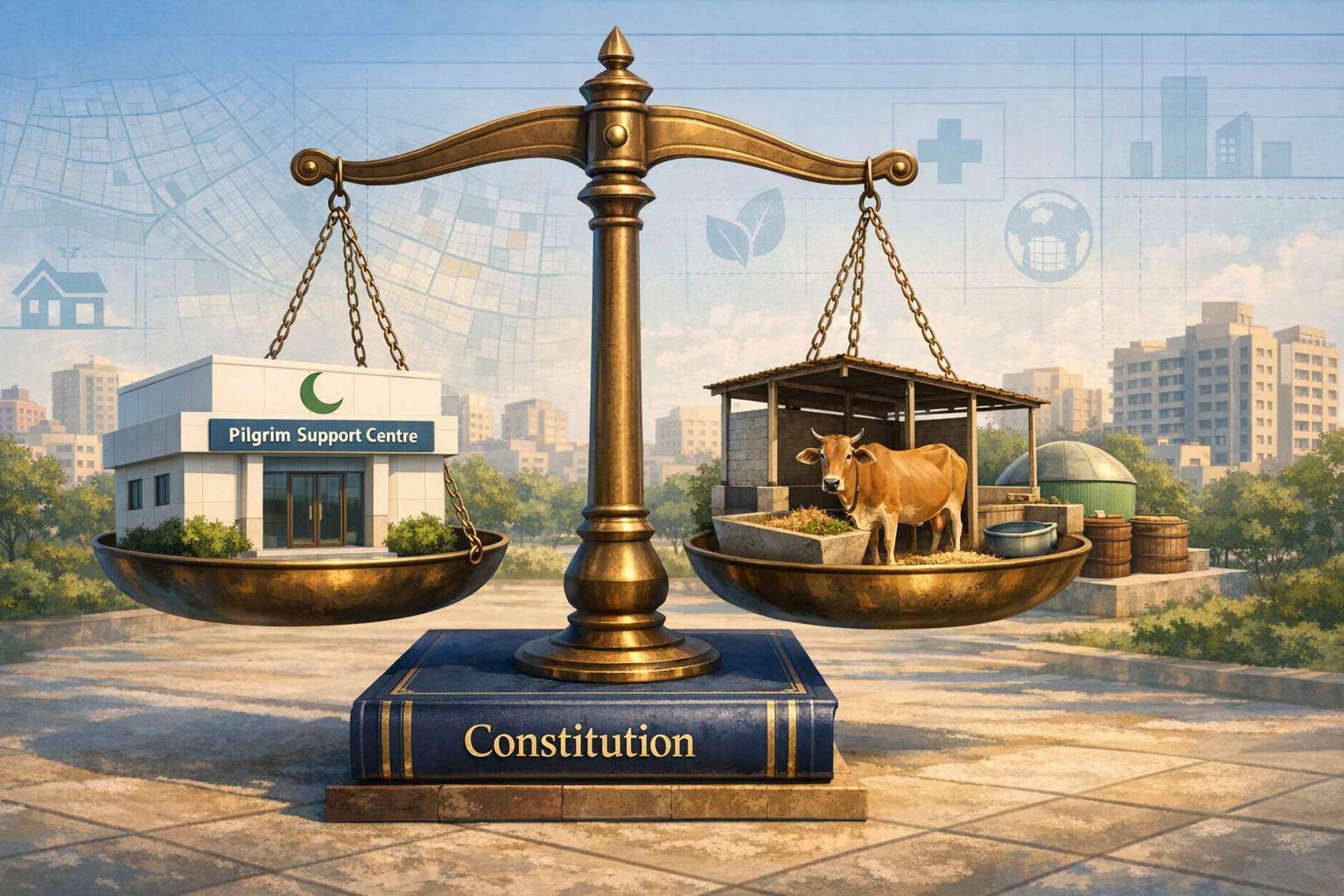
Reports from Ghaziabad, Uttar Pradesh, indicate that a local Hindutva leader has called for the conversion of the state-run Haj House into a gaushala. The demand has reignited a longstanding national discussion on how public assets are allocated, how religious and civic objectives are balanced, and how urban land-use decisions impact both social cohesion and service delivery.
At the center of this debate is a complex, deeply felt question: how should a facility originally established to coordinate pilgrimage logistics and offer temporary lodging be treated in a city that must also manage animal welfare, urban public health, and the equitable use of common infrastructure? For many families, Haj Houses evoke memories of elderly relatives preparing for a once-in-a-lifetime journey; for many animal-welfare volunteers, a gaushala symbolizes compassion and the dharmic virtue of caring for vulnerable beings. Reconciling these sentiments—without escalating polarization—requires a rigorously legal, technically sound, and community-sensitive approach.
Understanding the legal character of the Ghaziabad Haj House is the first step. Across India, Haj Houses are typically developed by state governments under a statutory framework connected to the Hajj Committee of India Act, 2002, and administered through minority welfare departments or state-level Haj committees. In some cases, separate religious endowment laws, such as the Waqf Act, 1995, may apply depending on title, vesting, and endowment deeds. Whether the Ghaziabad asset is government-owned or held under a waqf or other special endowment will decisively shape what is legally permissible.
If the property is government-owned, any repurposing must satisfy constitutional guarantees of equality and secular governance (Articles 14 and 25–28) and demonstrate a legitimate public purpose. The Supreme Court, in directing the phase-out of the Haj subsidy by 2022 (a process completed earlier by the Union Government), also underscored the principle that state policy should be even-handed and purposive rather than promotional of any one faith. That reasoning does not preclude government support for legitimate civic functions; it instead calls for neutrality and fairness in the public use of resources.
If the property is waqf, the Waqf Act, 1995 imposes strict controls on transfer, alienation, and change in purpose. Any attempt to fundamentally alter the nature of such a property would generally require due process involving the State Waqf Board and, where relevant, the state government. Where acquisition or diversion is contemplated for a demonstrable public purpose, the Right to Fair Compensation and Transparency in Land Acquisition, Rehabilitation and Resettlement Act, 2013 (LARR) sets out additional safeguards, including social impact assessments and structured hearings.
Beyond title and endowment law, urban planning controls present additional gatekeepers. The Ghaziabad Development Authority (GDA) master plan, zoning maps, and municipal bylaws govern permissible land use, density, traffic impact, building safety, fire codes, waste management, and public health standards. Transitioning any existing facility to a livestock-centric use inside a dense urban zone typically triggers scrutiny under municipal health regulations, animal housing norms, and environmental safeguards issued by state pollution control authorities and the Central Pollution Control Board.
A functional gaushala requires robust animal-welfare infrastructure: adequate floor area and ventilation per animal, quarantine and isolation bays, round-the-clock veterinary care, fodder and water logistics, manure and urine management through composting or biogas systems, vector control, and provisions for aged and infirm cattle. The Prevention of Cruelty to Animals Act, 1960 and allied rules, along with state animal husbandry guidelines, set expectations that are difficult to meet in congested, mixed-use localities. Experience from several Indian cities suggests that larger, purpose-built shelters at the urban-rural periphery—linked to decentralized fodder banks and veterinary networks—are more humane, sanitary, and cost-effective than retrofitting dense inner-city buildings.
Uttar Pradesh’s own policy efforts to manage stray cattle and promote cow protection have emphasized district-level shelters and dedicated funding streams. In practice, successful models integrate civil society participation (including Hindu, Jain, Sikh, and Buddhist organizations with strong seva traditions), municipal solid waste and bio-waste systems, and transparent public audits of shelter capacity and quality of care. Embedding such models within appropriate land-use zones reduces neighborhood conflict, improves animal outcomes, and aligns with public health mandates.
Public buildings like Haj Houses, meanwhile, often operate as multipurpose civic nodes during non-peak periods: skill-training venues, examination centers, disaster-relief staging points, or dormitory-style lodging for short-duration events. During the pandemic, many state facilities across India were rapidly repurposed for emergency use, illustrating how flexible, secular uses can coexist with faith-linked functions without compromising constitutional neutrality. This adaptive, community-serving approach tends to preserve harmony and deliver high social returns on public investment.
Against this backdrop, the Ghaziabad demand raises four practical questions: is there a documented shortfall in appropriately zoned, well-run gaushalas in the district; does the Haj House building and site meet the technical thresholds for humane animal care; what is the property’s legal status and the exact scope of permissible repurposing; and what configuration of uses would best serve the greatest public need while minimizing friction between communities?
An evidence-led pathway can reduce contention. First, a title and legal audit should clarify ownership, endowment status, and governing statutes. Second, an independent needs assessment—covering pilgrim flows, existing animal-shelter capacity, urban health constraints, and budgetary implications—should be published for public comment. Third, the GDA and municipal health authorities should provide a reasoned view on land-use compatibility, environmental safeguards, traffic and sanitation impacts, and emergency services access. Finally, structured consultations should be conducted with local residents, animal-welfare groups, minority commissions, and interfaith forums, with minutes and decisions placed in the public domain.
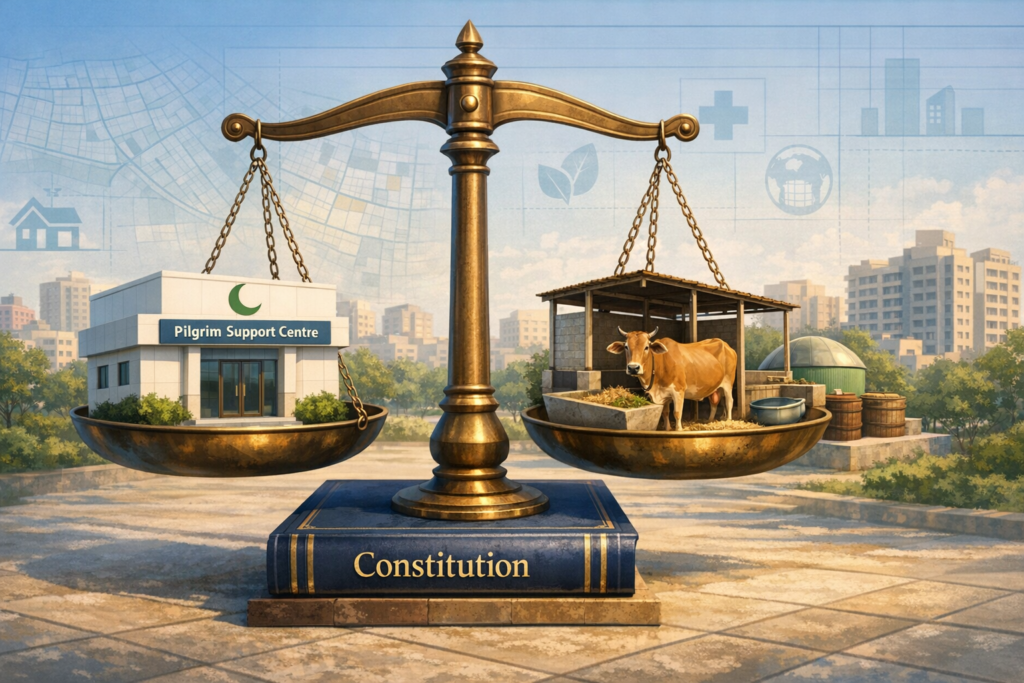
Several outcomes could then be responsibly considered. One option is to retain the Haj House’s core function while expanding high-value, secular community services during off-peak months—digital literacy, competitive-exam coaching, or disaster-relief stockpiling—open to all residents, thereby maximizing inclusion and asset productivity. Another option is to meet animal-welfare goals through a purpose-built gaushala on suitably zoned land at the city’s periphery, integrated with veterinary services and circular-economy systems like biogas and composting. Both objectives—efficient pilgrimage support and compassionate cow protection—can advance in parallel without forcing a zero-sum choice.
A hybrid arrangement could also be explored: keep the Haj House active as a civic and pilgrimage facility while establishing a formal collaboration between municipal authorities and dharmic organizations to strengthen the district’s stray-cattle response elsewhere. This approach acknowledges the emotional salience of cow protection in the Hindu, Jain, Sikh, and Buddhist traditions and, at the same time, respects the legitimate expectations of Muslim citizens who rely on a predictable, dignified infrastructure for pilgrimage logistics and training.
Constitutionally, the lodestar remains secular fairness and public purpose. Articles 25–28 protect religious freedom and conscience while ensuring that the state neither advances nor obstructs any particular faith. Jurisprudence has consistently treated secularism as a basic feature of the Constitution, implying that government action must be even-handed and demonstrably oriented to civic benefit. In that spirit, transparent processes, fact-based deliberation, and participatory decision-making can prevent symbolic disputes from overshadowing substantive governance.
There are also practical communications lessons. Public messaging that affirms shared values—compassion for animals, dignity for pilgrims, cleanliness in cities, and fairness in public spending—can create a common vocabulary across communities. When residents hear how health safeguards, traffic management, and sanitation will be addressed, fear gives way to problem-solving. When animal-welfare advocates see measurable improvements in fodder supply, veterinary coverage, and humane housing, confidence in the system rises. Dialogue framed around these tangible outcomes strengthens unity rather than eroding it.
Urban design considerations should not be underestimated. A gaushala, if pursued, must demonstrate adequate plot size, setbacks, water security, waste-to-energy or compost infrastructure, and stormwater and odor control. The facility must be connected to a veterinary referral network and governed by transparent KPIs: animal intake and exit, health recoveries, mortality rates, and fodder utilization. Equally, a retained Haj House should publish annual usage metrics: occupancy patterns, training cohorts, community events hosted, and emergency deployments. Publishing such data earns public trust and guides better policy.
Fiscal prudence is central. Retrofit costs for an inner-city building to operate as a compliant livestock shelter may exceed the capex and opex of building a greenfield facility in an appropriate zone. Conversely, upgrading a public building for multipurpose community use can be cost-effective, especially if shared across departments (minority welfare, disaster management, education, and skilling). A comparative cost-benefit analysis—factoring externalities like traffic, sanitation, and neighborhood acceptance—will bring clarity to competing claims.
In terms of social impact, interfaith and intrafaith collaboration can convert contention into service. Dharmic institutions across Hinduism, Buddhism, Jainism, and Sikhism have longstanding traditions of langar, panjrapole shelters, and seva-based community care. Involving such institutions, alongside Muslim community representatives and municipal experts, can generate solutions that are simultaneously compassionate, lawful, and sustainable—true to the spirit of Vasudhaiva Kutumbakam and the constitutional ethic of fraternity.
Whatever the final decision, a few guardrails are essential. No lawful existing use should be displaced without due process and a viable, publicly consulted alternative. No new use should be commissioned without demonstrated compliance with land-use, environmental, and animal-welfare norms. No community should feel that public policy is being wielded symbolically against its identity. And no facility should be allowed to underperform in silence; regular audits and published dashboards must become standard operating procedure.
The Ghaziabad episode, viewed through this lens, is less about a single building and more about how Indian cities adjudicate overlapping claims on scarce urban land—claims rooted in faith, welfare, health, and mobility. With legal clarity, sound urban design, and genuinely inclusive consultation, it is possible to preserve the civic value of the Haj House while simultaneously advancing animal welfare through better-suited sites and systems. In doing so, the city can turn a flashpoint into a blueprint for balanced, secular, and compassionate governance.
Ultimately, public assets are strongest when they serve as bridges rather than boundaries. In Ghaziabad and beyond, decisions that honor constitutional neutrality, uphold the rule of law, and foreground humane outcomes—in both pilgrimage infrastructure and cow protection—will deepen trust, reduce friction, and model the unity that dharmic traditions envision for a harmonious society.
Inspired by this post on Struggle for Hindu Existence.









Leave a Reply
You must be logged in to post a comment.