
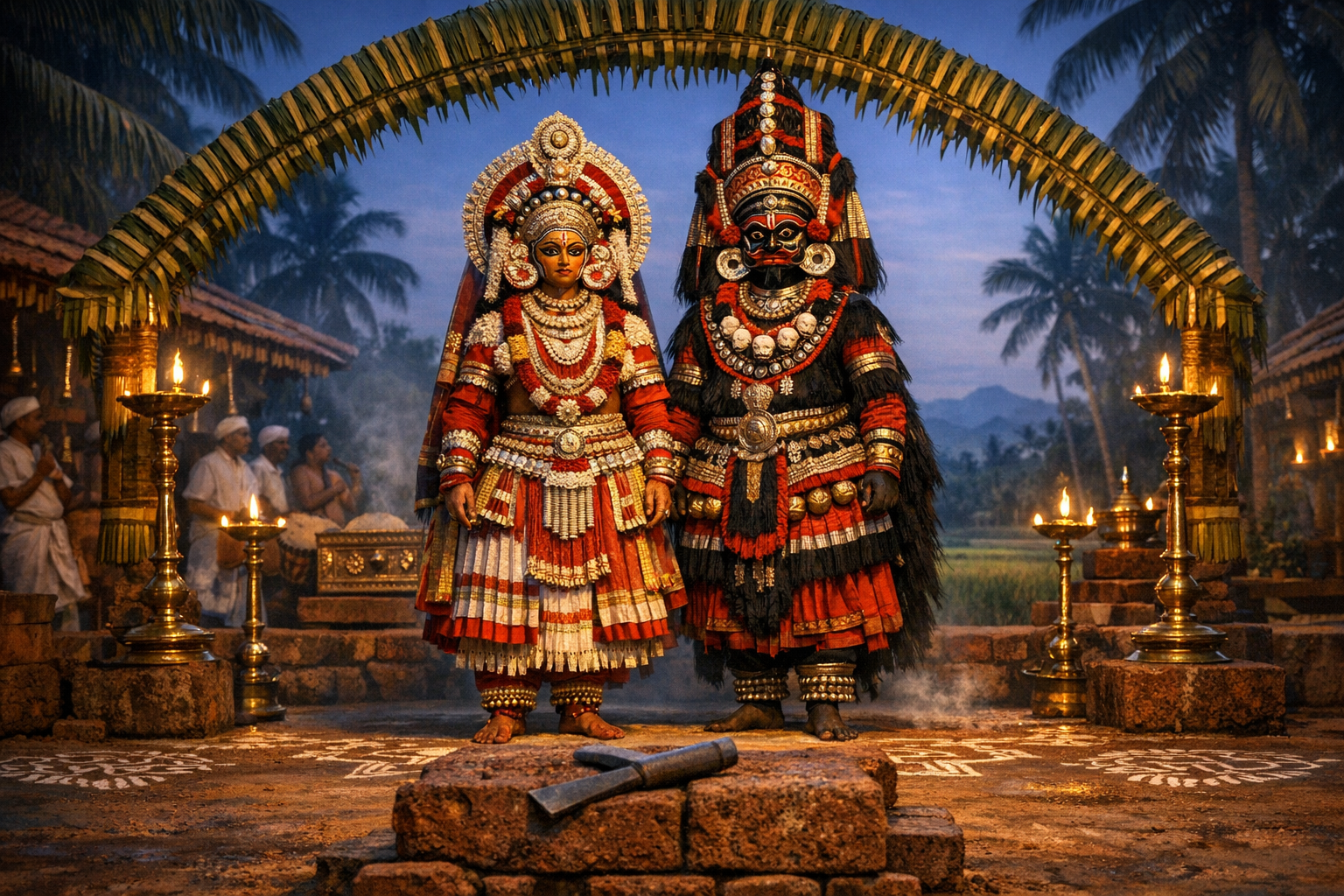
In the coastal belt of Tulu Nadu, where the Western Ghats meet the Arabian Sea, the ritual world of Bhuta Kola preserves an ancient covenant between communities and their guardian spirits, known locally as Daivas. Among the most revered are Kallurti and Kalkuda—twin Daivas whose legend as divine sculptors and moral arbiters continues to shape social memory, ritual authority, and living jurisprudence across Dakshina Kannada and Udupi.
Presented in night-long kola ceremonies, Kallurti–Kalkuda are invoked not only as protectors of place and lineage but also as bearers of neeti (justice). Their narrative—transmitted through Tulu paddanas (oral epics)—depicts artisans wronged by temporal power who return as Daivas to restore dharma. In this sense, the pair embody both the artistry of stone and the durability of ethical order, a synthesis that communities continue to seek in times of conflict or uncertainty.
Tulu Nadu’s ritual ecology is densely woven: sacred groves and daivastanas (spirit shrines) lie along paddy fields, laterite ridges, and estuarine backwaters. Within this landscape, Kallurti–Kalkuda ceremonies function as performative mediation, a culturally sanctioned interface through which disputes are aired, oaths are made, and communal resolutions are enacted under the Daivas’ gaze. For many households, seeking the Daiva’s counsel is as much a rite of belonging as it is an act of faith.
Etymological readings, though tentative, link Kallurti and Kalkuda to regional lexemes for “stone” (kallu/kal), which aligns with their identity as master sculptors in oral tradition. The semantic field of stone—endurance, weight, and the capacity to shape form—harmonizes with their ritual role: upholding obligations, remembering promises, and grounding moral claims in a shared past that is not easily eroded.
Oral variants consistently converge on a core motif: an artisan family of extraordinary skill, commissioned by a ruler for an ambitious work in stone, becomes the target of jealousy, insecurity, or injustice. Betrayed—often through violence, dispossession, or the denial of due wages—the family’s integrity fractures in the temporal world, and their truth returns in the form of Kallurti–Kalkuda. As Daivas, they demand ritual recognition and solemn adherence to ethical norms, transforming private sorrow into a public ethic.
In some paddanas, the siblings’ devotion to craft and dharma collapses the frontier between art and righteousness. The chisel, as an implicit symbol, can be read as a promise to release latent form—the way justice releases truth from confusion or fear. Thus the “family that shaped stone and destiny” becomes a didactic theme: communities recall that skill without justice fails, and power without fairness invites retribution.
Ritually, the moral geography of Kallurti–Kalkuda extends across guttu (landholding houses) and village clusters. Patron families remember vows (harake) made in times of illness, crop failure, or conflict, and fulfill them through kola, during which the Daivas are honored with offerings, songs, and a public hearing of grievances. The kola is not entertainment; it is a binding forum where words carry weight, promises are recorded in collective memory, and restitution becomes sacred duty.
Daivastanas dedicated to Kallurti–Kalkuda typically preserve a sacralized spatial grammar—an open courtyard for performance, a shrine or platform for offerings, ritual implements held in a bhandara (sacred chest), and a threshold designated for counsel. The spatial logic underscores a central theological claim of Bhuta Kola: sovereignty is ultimately moral and must present itself in the open, before drum, flame, and witness.
The kola generally coincides with the dry, post-harvest months, when agricultural rhythms allow communities to assemble through the night. Preparation includes shrine cleansing, raising ceremonial arches from areca and coconut fronds, and consecrating spaces with lamps and bali (offerings). These ritual preliminaries align human time to Daiva time, signaling that a distinct register of truth-telling is about to begin.
Performance unfolds through a precise liturgy. Hereditary singers recite paddanas that narrate the Daivas’ origin, sufferings, and claims. As drummers intensify the tala, the costumed medium enters, adorned with layered textiles, waist-bells (kaggara), anklets, and vivid facial designs executed with mineral pigments and rice paste. What follows is a carefully staged ascent from narrative recollection to embodied presence.
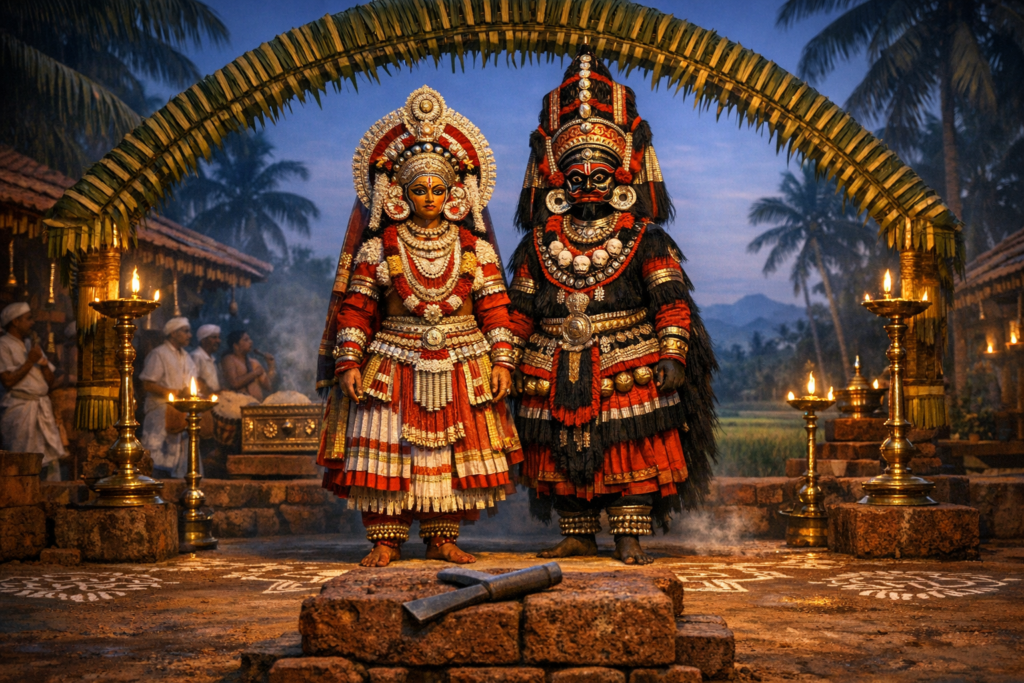
Iconographically, Kallurti–Kalkuda appear as a complementary dyad. Kallurti is commonly presented with the commanding poise of a guardian goddess; Kalkuda, as a vigilant counterpart, mirrors her strength in a masculine register. Their paired presence communicates balance—steadiness and force, containment and action—anchoring the kola’s justice-making in a principle of relational harmony rather than individual will.
When possession culminates, the Daiva speaks. This moment converts a ritual performance into a juridical event. Petitioners present disputes over land boundaries, inheritance, interpersonal injury, or broken vows. The Daiva questions, recasts the narrative, and directs amends—sometimes immediately, sometimes conditionally over time—so that restitution restores relationships rather than merely punishing offenders. In today’s language, this is a form of restorative justice embedded within a sacral frame.
Such “vernacular jurisprudence” has historically complemented village assemblies and household councils. Importantly, Kallurti–Kalkuda kola does not displace court systems; rather, it honors a parallel obligation: to knit social fabric before it tears further. Witnesses often describe the relief of being truly heard and the sobering effect of oath-taking under Daiva sight—a reminder that truth-telling is both a personal and communal virtue.
The living religion of Tulu Nadu is integrative. Bhuta Kola coexists with temple-centered Hindu worship, and Kallurti–Kalkuda are venerated alongside forms of Shiva, Durga, and local gramadevatas. Dharmasthala—where a Jain family of hereditary administrators (the Heggades) oversees the famous Manjunatha temple with Vaishnava priests and an active tradition of Daiva worship—demonstrates how plural lineages of dharma interact without contradiction. This inclusive ethos resonates with the broader values of Hinduism, Jainism, Buddhism, and Sikhism: duty, compassion, truthful conduct, and service.
Historically, Tulu Nadu has been a crossroads of dharmic traditions. Jain basadis at Moodabidri and Karkala, Shaiva–Vaishnava temples along the coast, and Buddhist–Natha resonances at sites such as Kadri form a layered sacred topography. Within this matrix, Kallurti–Kalkuda kola affirms that ethical sovereignty is not monopolized by a single institution; it resides wherever truth, non-harm, and fairness are enacted.
Comparative scholars often place Bhuta Kola in dialogue with Theyyam of North Malabar. While both share a Dravidian performative grammar—night-long rites, elaborate costume, and oracular counsel—Kallurti–Kalkuda kola maintains its own Tulu linguistic, musical, and jurisprudential texture. The paddana repertoire, the role of local lineages, and the specific claims of the Daivas distinguish this tradition as a discrete yet kindred stream within South India’s ritual plurality.
Community roles are clearly defined. Hereditary performer groups—locally associated with lineages such as Nalike and Parava—bear the responsibility of embodiment, song, and ritual precision. Patron families fund offerings, renew vows, and guarantee hospitality. Priests steward shrines and ensure ritually clean spaces. Together, they form an ecosystem in which authority is collaborative and accountability is public.
Material culture deserves attention in its own right. The textiles, metalwork, pigments, body ornaments, and vegetal architecture (arches woven from coconut and areca fronds) encode specialized knowledge passed across generations. Drums, cymbals, and wind instruments shape the rite’s “ethnosonics,” shifting participants from narrative listening to ethical attention, and finally to oracular encounter.
Economically, kola seasons mobilize craft networks, musicians, caterers, and shrine custodians. Patronage is not mere display; it is a reciprocal investment in local welfare. In many villages, fulfilling a vow to Kallurti–Kalkuda includes supporting education, food distribution, or community infrastructure—extensions of the Daiva’s justice imperative into practical, everyday good.
Contemporary transformations introduce both opportunity and strain. Urban audiences, digital documentation, and popular cinema have amplified visibility for Bhuta Kola. With visibility comes the need for respectful representation, consent-based filming, and fair remuneration for hereditary performers. Communities frequently emphasize that without safeguarding the dignity and livelihoods of tradition-bearers, spectacle can eclipse sanctity.
For those wishing to witness a Kallurti–Kalkuda kola, a few norms communicate respect: arrive early; dress modestly; avoid obstructing ritual paths; request permission before photographing; refrain from flash during possession; and, above all, maintain silence when counsel is being delivered. Observing these courtesies aligns the visitor with the rite’s ethical horizon and honors the Daivas’ presence.
From a semiotic perspective, stone is the pair’s master metaphor. Stone holds inscription, resists weathering, and demands skill to shape—properties that mirror how communities handle memory, withstand crises, and reform conduct. Kallurti–Kalkuda thus become an anthropology of virtue in embodied form: steadfast, weight-bearing, and transformative under the right discipline.
The dyadic structure—female Kallurti and male Kalkuda—reinforces a Tulu moral grammar of complementarity. Strength, care, vigilance, and restraint are not partitioned by gender; they are interdependent qualities required for social balance. In kola speech, the Daivas often praise truth-telling and humility as strength, reminding listeners that might without conscience is instability, and zeal without discernment is danger.
Equally telling is the ritual insistence on witness. The kola is conducted publicly, judgments are spoken aloud, and amends are visible. This transparency—rare in private dispute resolution—educates the young and consoles the aggrieved. It also calibrates power: the wealthiest patron and the smallest tenant stand equally under Daiva sight, reminding all that dharma outranks status.
Connections to other Daivas, notably Panjurli Daiva, situate Kallurti–Kalkuda in a wider pantheon of guardians addressing fertility, boundaries, and protection. Each Daiva’s narrative addresses a distinct ethical theme, yet the shared outcome is communal alignment with right conduct. The continuity of this system over centuries attests to its efficacy as a moral technology adapted to agrarian and mercantile life along the Konkan–Kanara littoral.
Educationally, documenting paddanas, costumes, shrine typologies, and performer genealogies supports heritage resilience. Collaborative projects with local custodians—Tulu-language archives, fair-use digital repositories, and school curricula—can strengthen both pride and accuracy. In doing so, stakeholders affirm that Bhuta Kola is not a frozen relic but a thinking tradition conversant with contemporary needs.
From a dharmic unity perspective, Kallurti–Kalkuda kola illustrates how Hindu practice dialogically engages with Jain ethics of non-violence, Buddhist emphases on right speech and intention, and Sikh commitments to truthful living and just action. The shared civilizational grammar is practical: lift the vulnerable, speak the truth, honor promises, repair harm. These are the very vows the Daivas demand and communities uphold.
Ultimately, the continuing authority of Kallurti–Kalkuda rests on lived results: disputes settled without bitterness, families reconciled, and communal memory renewed. As custodians of both artistry and equity, the twin Daivas embody Tulu Nadu’s capacity to translate suffering into wisdom and skill into service. Where stone becomes story and story becomes justice, a people knows it has found its guardians.
Inspired by this post on Hindu Blog.





Leave a Reply
You must be logged in to post a comment.