
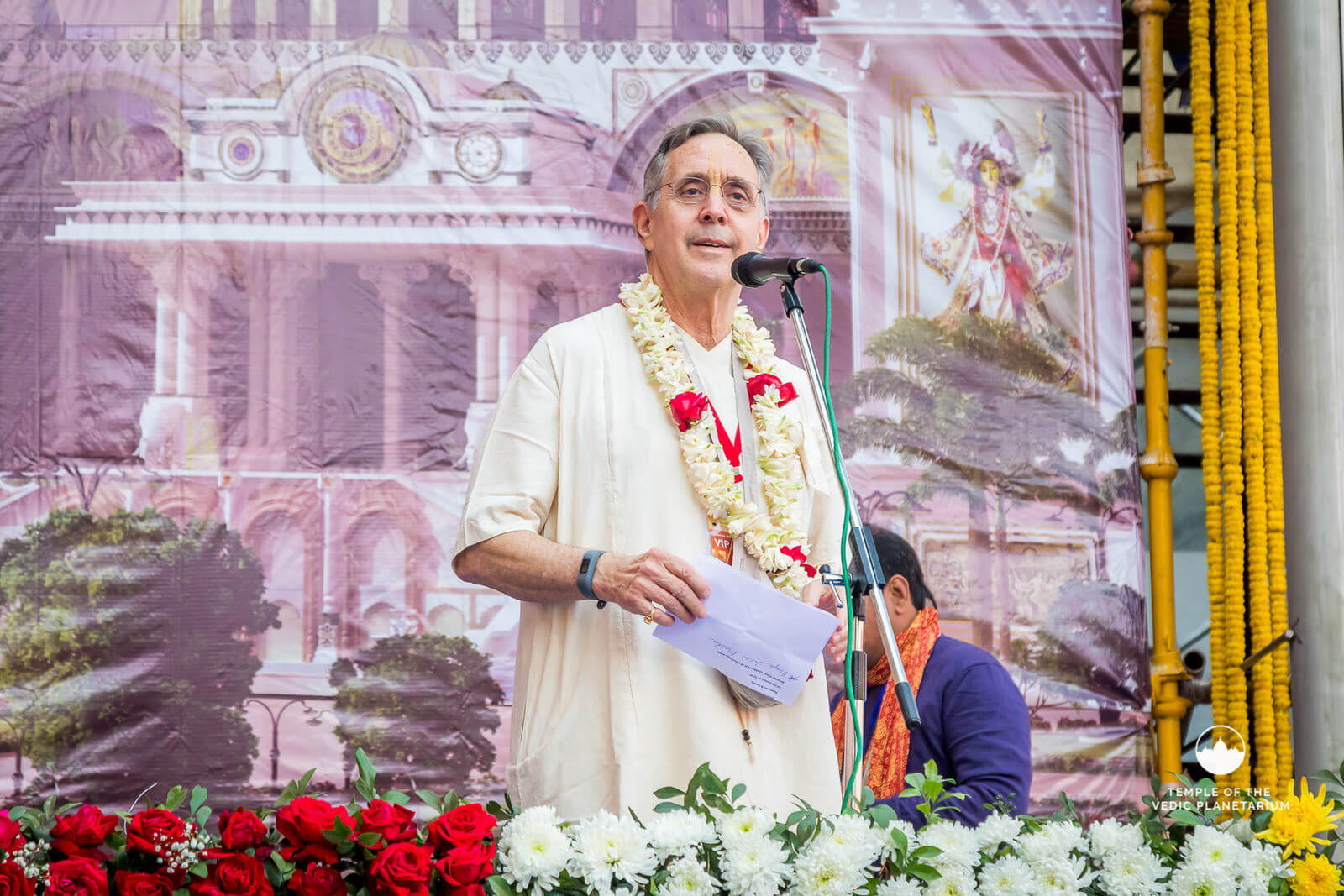
Ambarisa Das’ observation that Srila Prabhupada was a true visionary captures a central historical reality: his leadership consistently coupled theological clarity with institution-building and public education. Among his most ambitious contributions to Vedic culture and the global Hare Krishna Movement was a fully articulated blueprint for the Temple of the Vedic Planetarium (TOVP) at Mayapur, designed to present Vedic cosmology to pilgrims, students, and scholars through an immersive, pedagogical experience.
Srila Prabhupada’s intent was not simply to build a monumental temple; it was to construct a Vedic Planetarium that would offer a rigorous, visual synthesis of the Vedic perspective of life. The concept envisioned a gigantic, tiered display of the material and spiritual worlds as described in the fifth canto of the Srimad Bhagavatam, enabling visitors to apprehend cosmological structure through a sequenced, vertical journey. This approach consciously bridged sacred text, museum-grade interpretation, and modern circulation design to make complex ideas intelligible and memorable.
“Now here in India we are constructing a very large Vedic Planetarium…within the planetarium we will construct a huge, detailed model of the universe as described in the text of the fifth canto of Srimad Bhagavatam. Within the planetarium the model will be studied by onlookers from different levels by use of escalators. Detailed information will be given on open verandahs at the different levels by means of dioramas, charts, films etc.” — Srila Prabhupada
Consistent with the Gaudiya Vaishnava lineage, Srila Prabhupada located this vision within the parampara (disciplic succession), aligning it with the directions of previous acharyas. A large temple at Mayapur had been foreseen by Lord Nityananda, the intimate associate of Sri Caitanya Mahaprabhu, and later narrated by Srila Bhaktivinoda Thakur to Srila Jiva Goswami. The anticipated emergence of a singularly “exceedingly wonderful temple” (adbhuta-mandira) is therefore not merely architectural aspiration; it is the materialization of a historical and theological foresight stretching across centuries of devotional memory.
“When our Lord Caitanya disappears, by His desire, the Ganges will swell. The Ganges water will almost cover Mayapur for a hundred years, and then the water will again recede. For some time only the place will remain, devoid of houses. Then again, by the Lord’s desire, this place will again be manifest, and the devotees will build temples of the Lord. One exceedingly wonderful temple (adbhuta-mandira) will appear from which Gauranga’s eternal service will be preached everywhere.”
In July 1976, Srila Prabhupada specified his preference for the temple’s outer design language during a visit to Washington, D.C. He asked Yadubara Prabhu and Vishakha Mataji to photograph the Capitol Building in detail, noting its pedagogical potential for a planetarium that would communicate successive planetary systems and the relationship between the material and spiritual realms.
“I wanted both of you to take various detailed photographs of that Capitol.” “The Capitol Building.” Yadubara nodded. “For what purpose, Srila Prabhupada?” “We shall have a planetarium in Mayapur,” Prabhupada told him. “To show spiritual world, material world, and so on succession of the planetary systems, everything. A building like that. We are acquiring three hundred and fifty acres of land for constructing a small township to attract people from all the world to see the planetarium. … You take all details, inside, outside. That will be nice.”
From a design perspective, the directive synthesized three priorities: a legible civic silhouette that intuitively invites public learning; vertical circulation that allows structured ascent through interpretive layers; and open verandahs for didactics—dioramas, charts, and films—supporting multiple learning styles. The result is a didactic organism rather than a static building, translating scriptural cosmology into a walkable narrative that harmonizes temple ritual, museum pedagogy, and public science communication.
Technically, the TOVP’s core exhibition interprets the fifth canto’s cosmography in the Gaudiya Vaishnava commentarial tradition. Visitors encounter Bhu-mandala’s planar schema and a vertical mapping of lokas—Bhurloka, Bhuvarloka, Svargaloka, Maharloka, Janaloka, Tapoloka, and Satyaloka—culminating in a conceptual orientation toward the spiritual sky. While distinct from modern astrophysical models, the presentation functions as a coherent internal system: it is a philosophical-cosmological framework that organizes reality by ontological gradation, consciousness, and dharmic purpose.
The interpretive strategy employs layered granularity. Introductory panels foreground core concepts and key terms; intermediate exhibits use dioramas and charts to model relative scales, spatial relations, and cosmographic pathways; advanced sections reference the Srimad Bhagavatam with cross-citations to Vaishnava acharyas, enabling scholarly engagement. Escalator-driven movement and mezzanine overlooks choreograph sightlines, turning each level into a vantage point that reinforces conceptual hierarchy and narrative coherence.
Crucially, the project invites dharmic dialogue. Although grounded in Vaishnava exegesis, its museum method provides a platform for comparative reflection with Buddhist Abhidharma cosmology, Jain models of the universe (loka), and the contemplative cosmic imagery present in Sikh Gurbani. By privileging experiential learning over polemic, the Vedic Planetarium fosters unity-in-diversity across Hinduism, Buddhism, Jainism, and Sikhism, highlighting convergences in ethics, devotion, and the shared quest for higher knowledge.
Situated in Mayapur on the Ganga’s sacred geography, the temple contributes to India’s cultural heritage as both a pilgrimage site and an educational hub. The setting underscores historical continuity—Mayapur as the heartland of Gaudiya Vaishnavism—and amplifies the TOVP’s goal: to make Vedic knowledge accessible to a global, multilingual public while honoring local traditions of seva, kirtan, and scriptural study.
The broader urban vision—spanning several hundred acres—integrates the temple with a small township plan. From a planning standpoint, this enables robust visitor logistics, phased construction, and ecosystem-sensitive development along the Ganga. The township model supports long-term programming: research seminars, interfaith colloquia, curriculum development, and heritage management, all reinforcing the TOVP’s role as a living institution rather than a one-time monument.
As a case study in visionary leadership, Srila Prabhupada’s approach reveals a distinctive method: translate scripture into public pedagogy; align aesthetics with function; and mobilize global participation through clear, repeatable instructions. The TOVP’s emphasis on interpretive clarity, architectural presence, and devotional purpose exemplifies this method, offering a replicable template for cultural projects that serve both faith and scholarship.
In sum, the Temple of the Vedic Planetarium operationalizes a centuries-old prophetic arc into contemporary cultural infrastructure. It demonstrates how Vedic cosmology, presented with methodological rigor and architectural dignity, can deepen spiritual understanding, strengthen cultural memory, and encourage unity among dharmic traditions—precisely the confluence Srila Prabhupada envisaged when he set Mayapur on a path to become an adbhuta-mandira for the world.
Inspired by this post on Dandavats.








Leave a Reply
You must be logged in to post a comment.