
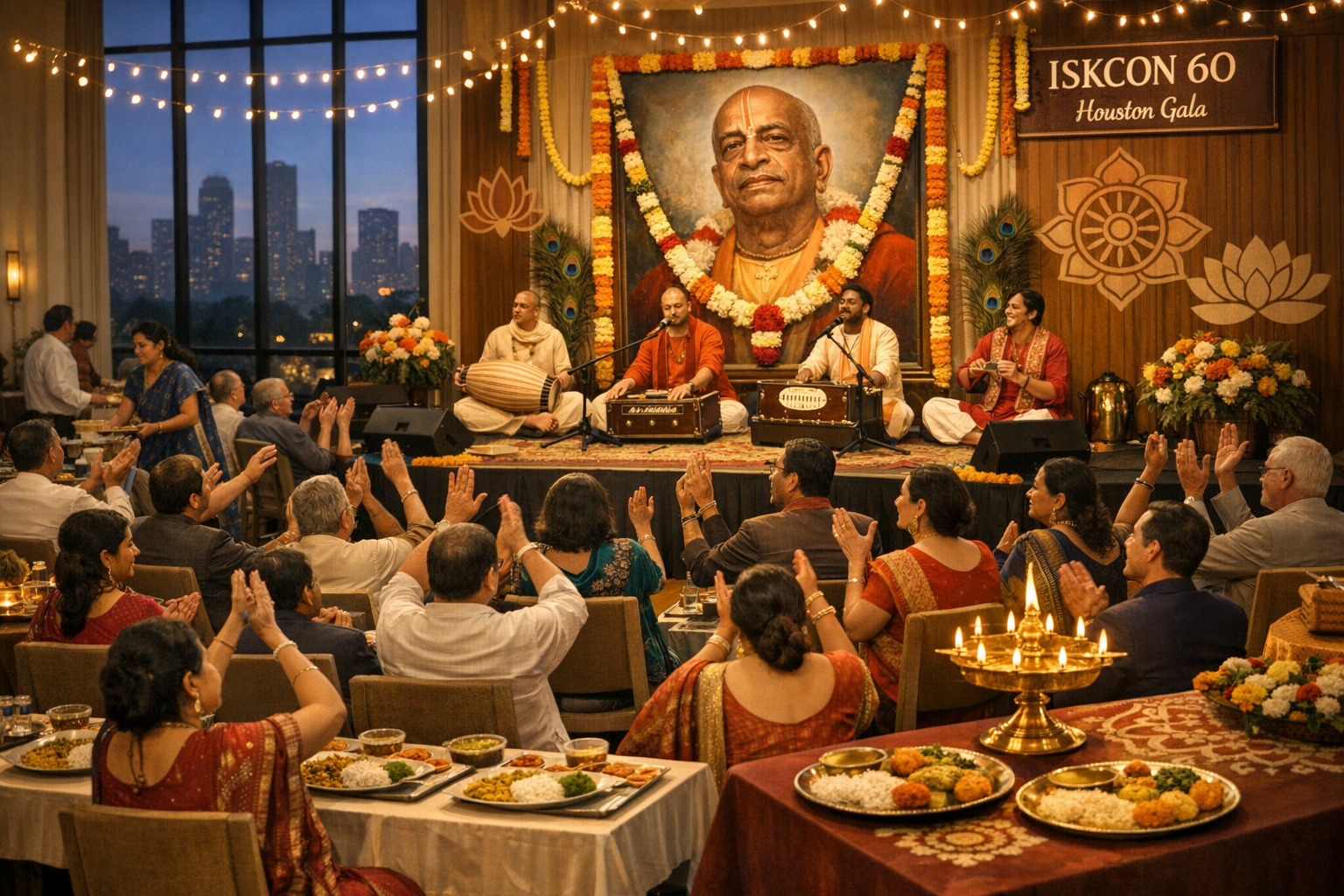
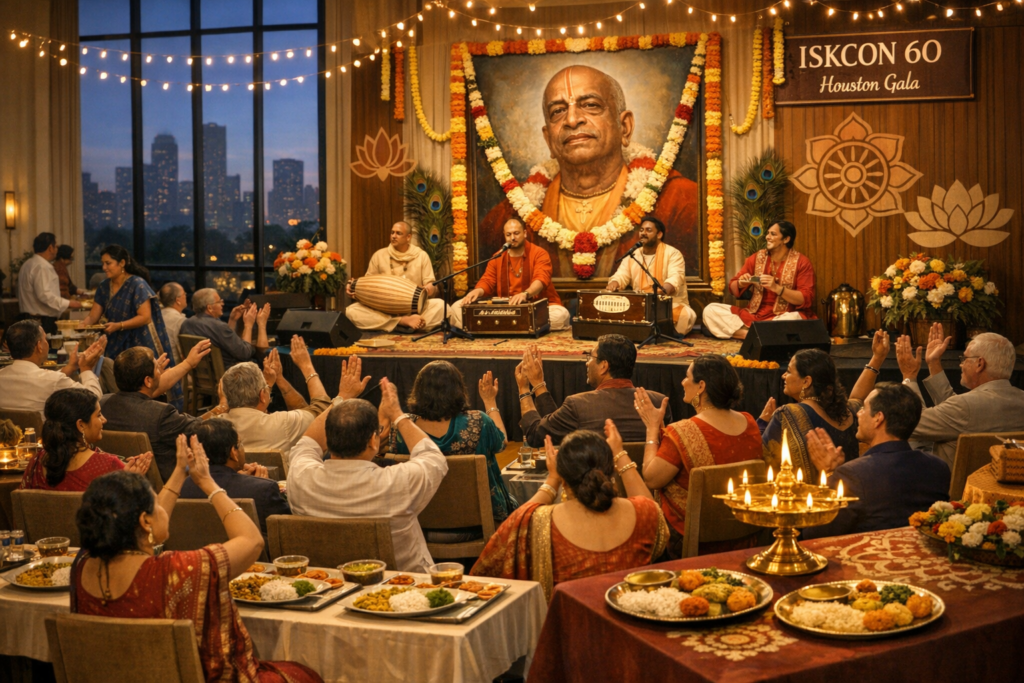
The ISKCON 60 Houston Gala was remembered as a spiritually uplifting celebration and a heartfelt offering to Srila Prabhupada. The evening’s success reflected the sincerity, teamwork, sacrifice, and devotional spirit of many devotees after weeks of meticulous preparation. Gratitude is extended to all attendees, volunteers, performers, and well-wishers whose presence and service shaped the event’s devotional atmosphere.
Framed within the global ISKCON 60 observances commemorating six decades since ISKCON’s 1966 founding, the Houston Gala served as a regional milestone that honored A.C. Bhaktivedanta Swami Prabhupada’s legacy and the living practice of bhakti-yoga. The program foregrounded remembrance (smarana), service (seva), and community solidarity across Houston’s diverse dharmic diaspora.
More than a social gathering, the gala functioned as a collective sadhana. Participants engaged with the principles of Gaudiya Vaishnavism through congregational chanting (sankirtana), reflection on guru-parampara, and practical expressions of compassion and hospitality. These elements conveyed that devotion is most luminous when it translates into cooperation and care.
Musically, the sankirtana sequence guided participants through call-and-response kirtan, steadily intensifying then resolving into contemplative stillness. Traditional percussion and hand cymbals shaped a sonic arc that encouraged attentiveness, humility, and shared joy. The atmosphere made accessible the heart of the Hare Krishna tradition to long-time practitioners and first-time visitors alike.
Educational segments contextualized Srila Prabhupada’s contributions—his translation and commentary of sacred texts, his establishment of temples and communities, and his emphasis on accessible spiritual practice centered on the holy name. Framed in clear, inclusive language, these reflections highlighted how remembrance of Krishna naturally aligns with everyday ethics: truthfulness, restraint, hospitality, and non-harm.
Devotional arts complemented the discourses. Curated performances and presentations illustrated themes of devotion (bhakti), duty (dharma), and grace (kripa), demonstrating how aesthetics and theology converge to cultivate inner refinement. By engaging sight, sound, and emotion, the gala translated philosophical ideas into lived experience.
Prasadam distribution embodied the ethic of equality intrinsic to Vaishnava hospitality. Vegetarian, sattvic offerings, sanctified through ritual, were shared with care and efficiency. Well-organized service lanes, attentive seating assistance, and thoughtful accommodation for elders and families ensured that nourishment was both physical and spiritual.
Behind the scenes, volunteer teams coordinated registration, welcoming, seating, kirtan flow, stage transitions, and prasadam logistics with steady discipline. Weeks of rehearsal and coordination yielded seamless execution, while contingency planning preserved calm when schedules flexed. The event’s reliability was the quiet fruit of countless acts of unnoticed seva.
Community-building remained a central objective. The gala fostered intergenerational participation, inviting children, youth, professionals, and seniors into shared purpose. Attendees commonly reported a renewed sense of belonging, the courage to deepen daily sadhana, and a readiness to serve in forthcoming temple and community initiatives.
The Houston Gala also reflected the broader dharmic ideal of unity in spiritual diversity. While centered in the Hare Krishna movement’s bhakti-yoga, its core commitments—ahimsa, compassion, truthful living, and self-discipline—resonate across Hinduism, Buddhism, Jainism, and Sikhism. Congregational chanting parallels the Sikh tradition of kirtan; disciplined mindfulness echoes Buddhist and Jain practices of contemplation; and seva is a shared dharmic virtue.
This ethos of pluralism is pedagogically significant. The program neither imposed uniformity nor encouraged relativism; instead, it honored Srila Prabhupada’s emphasis on the transformative power of the holy name while acknowledging that dharmic paths share convergent ethical horizons. Such framing advances intercommunity trust and strengthens social cohesion.
From a community-organizing perspective, the gala demonstrated best practices in cultural events: clear roles, concise run sheets, well-briefed stage crews, cue-based lighting and sound, and courteous frontline teams. These operational disciplines freed attendees to focus on spiritual intention, allowing content, not logistics, to command attention.
The spiritual impact of the ISKCON 60 Houston Gala is best measured qualitatively—through softened hearts, mended relationships, and new commitments to daily nama-japa, scriptural study, and service. Moments of shared silence after kirtan, the glow of gratitude during arati, and gentle exchanges over prasadam collectively signaled inner transformation.
By linking remembrance of Srila Prabhupada with tangible community service, the gala reaffirmed a central insight of bhakti-yoga: devotion matures as responsibility. When learning flows into character, and inspiration into action, individual practice uplifts collective welfare.
As part of the ISKCON 60 journey, the Houston community now carries forward renewed momentum—extending warmth to newcomers, deepening care for longstanding devotees, and collaborating with wider dharmic neighbors for shared good. This outward-looking devotion embodies the spirit of Vasudhaiva Kutumbakam: the world as one family.
In sum, the ISKCON 60 Houston Gala stood as a refined, heartfelt tribute to Srila Prabhupada and a living testament to dharmic unity. Its careful design, devotional integrity, and inclusive pedagogy transformed a gala into sadhana and a room of attendees into a community.
Inspired by this post on Dandavats.









Leave a Reply
You must be logged in to post a comment.