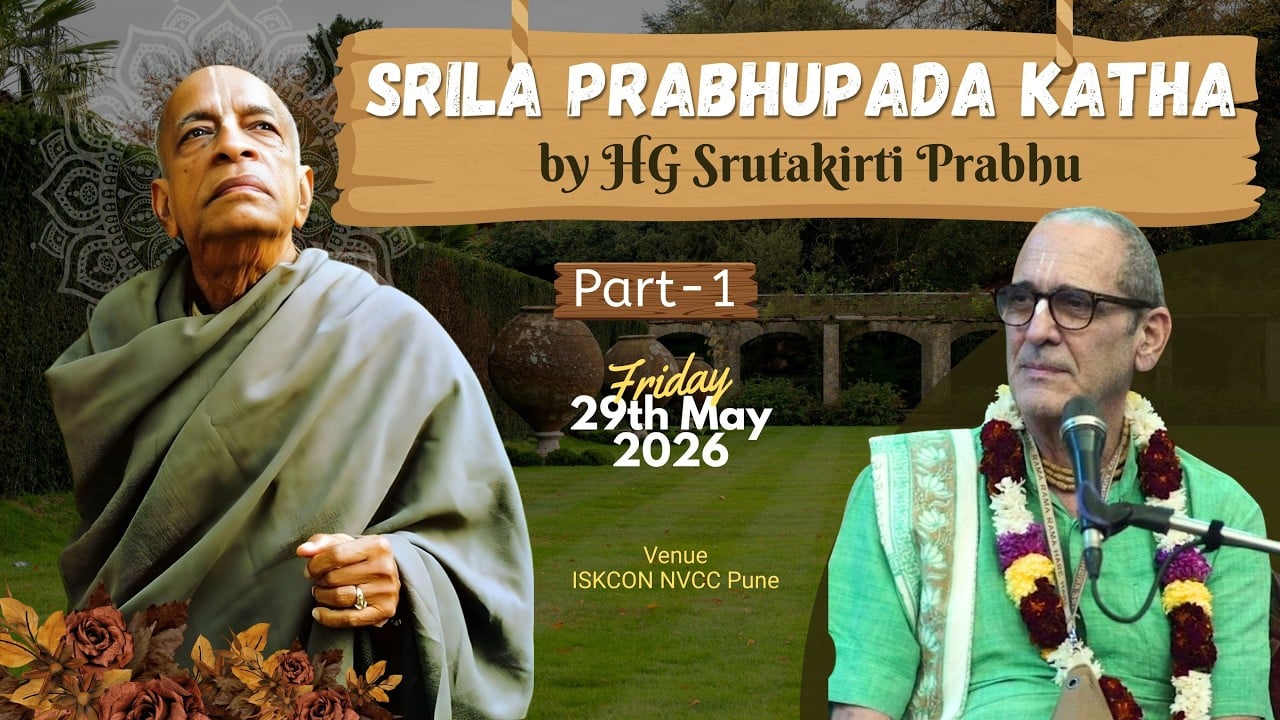
Srila Prabhupada Katha by Srutakirti Prabhu || 29 May 2026- ISKCON – NVCCPune
At ISKCON’s New Vedic Cultural Center (NVCC) in Pune, a special katha by Srutakirti Prabhu on 29 May 2026 invited seekers, scholars, and community members to engage deeply with living memories of A. C. Bhaktivedanta Swami Prabhupada, the founder-acharya of the International Society for Krishna Consciousness. The session balanced historical recollection with spiritual insight, offering a rare, experience-near view of Gaudiya Vaishnavism in practice and the enduring leadership model Srila Prabhupada exemplified for the Hare Krishna Movement.
Srutakirti Prabhu is widely recognized for serving Srila Prabhupada closely in the early to mid-1970s, accompanying him across continents during a pivotal period of ISKCON’s institutional growth. His vantage point is distinctive: it fuses day-to-day observation of Srila Prabhupada’s sadhana-bhakti, discipline, communication style, and decision-making with the larger arc of a global spiritual movement rooted in the guru-shishya parampara.
In the Indian narrative tradition, katha functions as both oral history and spiritual pedagogy. By situating intimate recollections within canonical teachings, it transmits ethos as much as information. The talk at NVCC Pune thus served two complementary ends: it documented Srila Prabhupada’s practices and priorities with historical sobriety, and it illuminated how those practices operationalize core tenets of bhakti-yoga for contemporary life.
Methodologically, such reminiscences are best appreciated alongside published letters, lectures, travel diaries, and the ongoing commentarial corpus of ISKCON’s senior scholars. Triangulation with sources like Bhagavad-gita As It Is, Srimad-Bhagavatam, and Chaitanya-caritamrita helps align lived memory with textual pramana, supporting a rigorous, academically sound account while retaining the human texture that only an eyewitness can provide.
Several recurring themes characterize Srutakirti Prabhu’s reflections across his public kathas. First is the seamless integration of sadhana with mission. Srila Prabhupada’s daily rhythm embodied regulated devotion: early-morning worship, focused japa, study, teaching, writing, and pastoral care, interwoven with management and outreach. The precision of this routine conveyed a principle at the heart of Gaudiya Vaishnavisminternal absorption in Krishna consciousness expressed through external service to society.
A second theme is pedagogy. Srila Prabhupada taught with clarity and compassion, yet with unambiguous fidelity to parampara. He emphasized practical realizations over abstraction: attentive chanting of the maha-mantraHare Krishna Hare Krishna Krishna Krishna Hare Hare Hare Rama Hare Rama Rama Rama Hare Hareregulated lifestyle, sat-sanga, study of scripture, and service as the crucible of transformation. The nine processes of bhakti received concrete, daily-life form rather than remaining merely conceptual.
Leadership forms a third thread. Srila Prabhupada combined spiritual gravitas with institutional acumen, building sustainable systems for education, worship, publication, and community life. The katha highlighted how equanimity, accountability, and a service-first ethos enabled rapid global scaling without compromising philosophical center. For many attendees, this offered a field-tested framework for values-driven leadership in families, organizations, and civic initiatives.
From a technical standpoint, the talk underscored Gaudiya Vaishnava epistemology. Knowledge, in this lineage, coheres around sabda-pramana as preserved and interpreted within the disciplic succession. Personal memories therefore carry significance when they harmonize with scripture, illuminate it, and cultivate transformation in the practitioner. This triadscripture, realized teachers, and sincere practiceensures that oral history strengthens, rather than supplants, foundational teachings.
ISKCON NVCC Pune provided a fitting context for this exploration. As a major cultural and educational hub, the campus integrates traditional temple life with contemporary outreach, hosting festivals, scriptural seminars, and community programs. The architectural and organizational vision of NVCC echoes Srila Prabhupada’s synthesis: make spiritual wisdom accessible, well-organized, and civic-minded.
The session also foregrounded the civic value of devotional culture. Congregational kirtan, prasada distribution, and educational programs represent a living heritage that advances social well-beingcultivating sobriety, cooperation, and compassion. In this light, the katha functioned as cultural conservation and transmission, not merely recollection.
Importantly, the reflections affirmed unity in spiritual diversity across the dharmic familyHinduism, Buddhism, Jainism, and Sikhism. The shared civilizational grammar is evident: disciplined practice, ethical self-restraint, reverence for teachers, and communal uplift. Chanting and kirtan resonate with Sikh shabad-kirtan; mindful attention in japa parallels Buddhist cultivation of samadhi; the ethics of nonviolence and truthfulness mirror Jain dharma; and the guru-shishya parampara is cherished across traditions. The katha encouraged mutual respect, not competitionhonoring many paths while faithfully presenting the Gaudiya Vaishnava way.
Attendees consistently describe a palpable sense of presence in such sessionsan affective pedagogy where humility, responsibility, and hope become tangible. The historical specificity of Srutakirti Prabhu’s memories grounds devotion in accountability: ideals are linked to habits, and habits to outcomes. This concreteness invites practitioners and scholars alike to examine how daily sadhana translates into measurable improvements in character, relationships, and service.
For contemporary readers and practitioners, several practice-oriented insights stood out. Begin with regular japa and sunrise discipline to steady attention. Set a daily appointment with core texts such as Bhagavad-gita As It Is and Srimad-Bhagavatam to internalize principles. Engage in some form of sevateaching, organizing, mentoring, or simple acts of careto transform knowledge into social value. Finally, seek sat-sanga, because community stabilizes effort and refines understanding.
From the lens of intellectual history, Srila Prabhupada’s life demonstrates continuity-with-renewal. He preserved Gaudiya Vaishnava siddhanta with scholarly rigor while rearticulating it in accessible English prose, building institutions that could preserve both doctrine and lived practice. Oral testimony from close associates like Srutakirti Prabhu adds essential granularity to this record, offering micro-histories that illuminate the macro-trajectory of the Hare Krishna Movement.
Scholars of religion and culture will note the relevance for historiography. Eyewitness accounts are context-rich primary sources; when cross-referenced with letters, recordings, and editorial histories, they illuminate decision processes, pedagogical strategies, and community dynamics that formal documents alone cannot capture. This composite method supports accuracy, nuance, and fairness.
The larger civic message is straightforward yet profound: spiritual traditions at their best dignify plural paths while inspiring excellence in one’s chosen discipline. The katha at ISKCON NVCC Pune exemplified this ethoscelebrating bhakti-yoga as a robust, testable way of life and welcoming dharmic consonance with meditation, self-discipline, and service found across Buddhism, Jainism, and Sikhism. It modeled how fidelity to one’s lineage can coexist with generosity toward others.
As the audience dispersed, what remained was a practical blueprint: cultivate inner steadiness through regulated devotion; enact outer service guided by compassion and competence; and nurture inter-traditional harmony as a civilizational duty. In this convergence of memory, method, and mission, the Srila Prabhupada Katha by Srutakirti Prabhu affirmed a timeless propositionwhen remembrance becomes responsibility, personal transformation and social good advance together.
Inspired by this post on Dandavats.