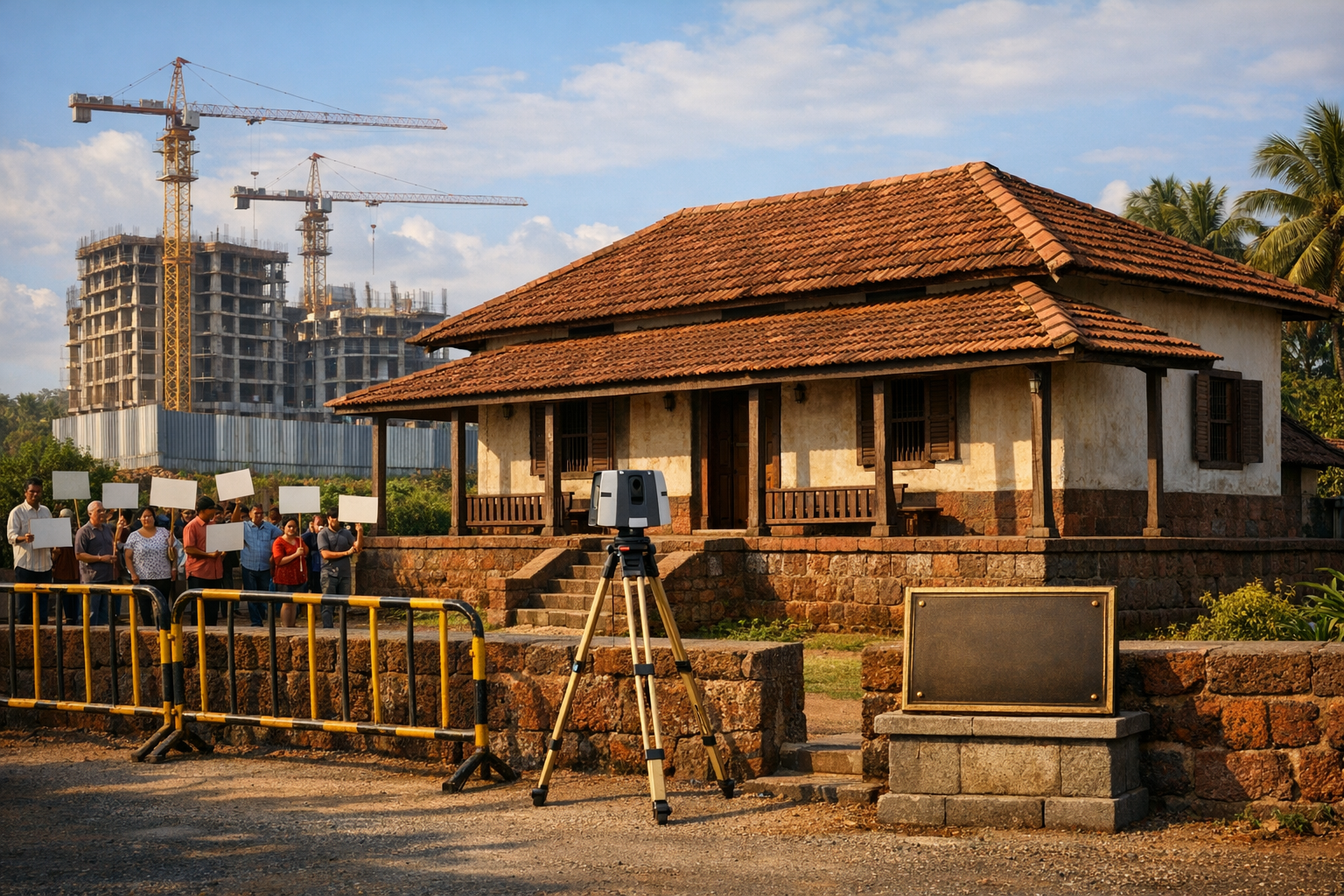
Hindu Janajagruti Samiti (HJS), joined by several pro-heritage and community groups, staged a focused demonstration in Ratnagiri against a reported redevelopment move by the builder lobby that could endanger the historic ‘Savarkar Sadan’. The coalition called for immediate intervention by the Government of Maharashtra to secure the site, halt any demolition or alteration, and initiate the due process for declaring it a Monument of National Importance, or at minimum, a state-protected monument.
‘Savarkar Sadan’ is widely regarded as a site intimately associated with V. D. Savarkar’s years in Ratnagiri, a period marked by intense social reform, prolific intellectual output, and deep engagement with local society. As a lived space tied to a seminal phase in the life of a significant freedom-era figure, the site functions as a tangible anchor for public memorylinking local heritage in Konkan to the broader history of the Indian freedom struggle.
The Ratnagiri period is historically notable for social initiatives such as the establishment of the Patit Pavan Mandir (1931), conceived to welcome all sections of society and challenge entrenched caste practices. Within this socio-cultural landscape, ‘Savarkar Sadan’ acquires layered significance as part of a wider reformist ethos that resonates with India’s constitutional vision of equality and dignity. Preserving the property therefore transcends partisan or sectarian frames and instead speaks to the safeguarding of a shared civilizational legacy relevant to Hindu, Buddhist, Jain, and Sikh communities alike.
From a heritage perspective, the threatened demolition highlights the systemic vulnerabilities of historic landmarks in rapidly urbanizing districts. Coastal towns in Maharashtra, including Ratnagiri, face increasing redevelopment pressures. Without clear interim protections, structures with deep associational value can be irreversibly lost, erasing primary-source environments that enable rigorous historical research, civic education, and intergenerational transmission of memory.
The constitutional framework provides both mandate and direction. Article 49 obliges the State to protect monuments and objects of national importance, while Article 51A(f) enjoins every citizen to value and preserve the rich heritage of India’s composite culture. Invoking these constitutional duties, the demand for urgent state action rests on firm legal and ethical grounds, emphasizing preservation as a non-negotiable public interest.
At the Union level, the Ancient Monuments and Archaeological Sites and Remains Act, 1958 (AMASR), as amended in 2010, offers the legal pathway to declare a site a Monument of National Importance (MNI). Once notified, conservation oversight involves the Archaeological Survey of India (ASI) and the National Monuments Authority (NMA), with statutory bufferstypically a 100-metre prohibited zone and a 200–300-metre regulated zoneto ensure contextual integrity. Although associational sites may require detailed justificationespecially where age thresholds or architectural features are under evaluationthe AMASR framework remains the gold standard for national-level protection.
At the State level, Maharashtra can act under the Maharashtra Ancient Monuments and Archaeological Sites and Remains Act, 1960, and through heritage provisions embedded in regional and town planning statutes. Interim listing as a heritage structure, coupled with a temporary freeze on building permissions, is both prudent and commonly practiced. A dedicated Heritage Conservation Committee at the competent planning authority can advise on grading, conservation norms, and adaptive reuse guidelines to align development with preservation.
Operationally, a three-track response can be instituted. First, issue immediate status quo and stop-work directions for the site and its curtilage to prevent any alteration pending assessment. Second, initiate a rapid title, provenance, and historical-significance verification, drawing on district records, archival sources, and expert testimonies from historians and conservation architects. Third, appoint a nodal officer to coordinate among the State Archaeology Department, the district administration, ASI (for technical inputs), and community stakeholders.
Technical documentation should proceed in parallel. A condition assessment and structural stability auditsupplemented by measured drawings, high-resolution photographic surveys, and 3D laser scanningwill create a digital baseline for any future conservation. Cataloguing movable heritage (letters, photographs, memorabilia, inscriptions) ensures that the site’s tangible and intangible values are documented for scholarly use and public education.
Before finalizing any conservation plan, a Heritage Impact Assessment (HIA) should evaluate possible interventions, traffic and crowd management, accessibility, and landscape design. Adhering to international best practicessuch as minimum intervention, reversibility, and authenticityenables sensitive restoration consistent with charters like the Venice Charter (1964) and the Burra Charter (Australia ICOMOS). These principles help retain the site’s evidentiary value for historians while making it meaningfully accessible to the public.
Adaptive reuse offers a balanced and future-proof strategy. ‘Savarkar Sadan’ can serve as a compact interpretive centre that contextualizes the Ratnagiri years, links to broader freedom-era networks, and curates narratives of social reform across dharmic traditions. A reading room and digital archive can facilitate students and researchers, while curated exhibits illuminate the inclusive reformist thrust of the period, underscoring dignity, equality, and national cohesion.
Equitable solutions for private stakeholders are essential. Transfer of Development Rights (TDR), Floor Space Index (FSI) offsets at alternate locations, and viability-gap support can reconcile redevelopment interests with heritage preservation. Corporate Social Responsibility (CSR) partnerships and public–private collaborations can further defray conservation and programming costs, provided safeguards maintain curatorial independence and conservation integrity.
From an economic standpoint, integrating ‘Savarkar Sadan’ into a Ratnagiri heritage circuitalongside other documented freedom-era and coastal-Konkan cultural assetscan support sustainable tourism and local livelihoods. Wayfinding, guided walks, and community-led interpretation create value chains for artisans, guides, and hospitality services, aligning preservation outcomes with tangible socio-economic benefits.
Comparative precedents in Indiawhere residences and workplaces of national figures have been adapted into research and memorial spacesdemonstrate that timely state action can prevent loss while enabling broad public engagement. Documentation-driven conservation, transparent governance, and stable funding models are common denominators of successful projects.
Given the reported threat, the prudent course is an immediate protective order, a 30–60 day comprehensive significance and condition assessment, interim heritage listing at the state level, and, if merited by the evidentiary record, initiation of AMASR procedures for national-level status. This sequenced approach enables both speed and rigor, minimizing risk to the site while ensuring procedural fairness and technical depth.
The call raised in Ratnagiri reflects a broad civic intuition: that places where national memory resides must be conserved with care, inclusivity, and scholarship. Safeguarding ‘Savarkar Sadan’ not only protects a singular landmark but also advances a unifying, research-ready, and future-facing model of heritage stewardshiphonouring the composite contributions of Hindu, Buddhist, Jain, and Sikh traditions to India’s civilizational journey.
Inspired by this post on Hindu Jagruti Samiti.