
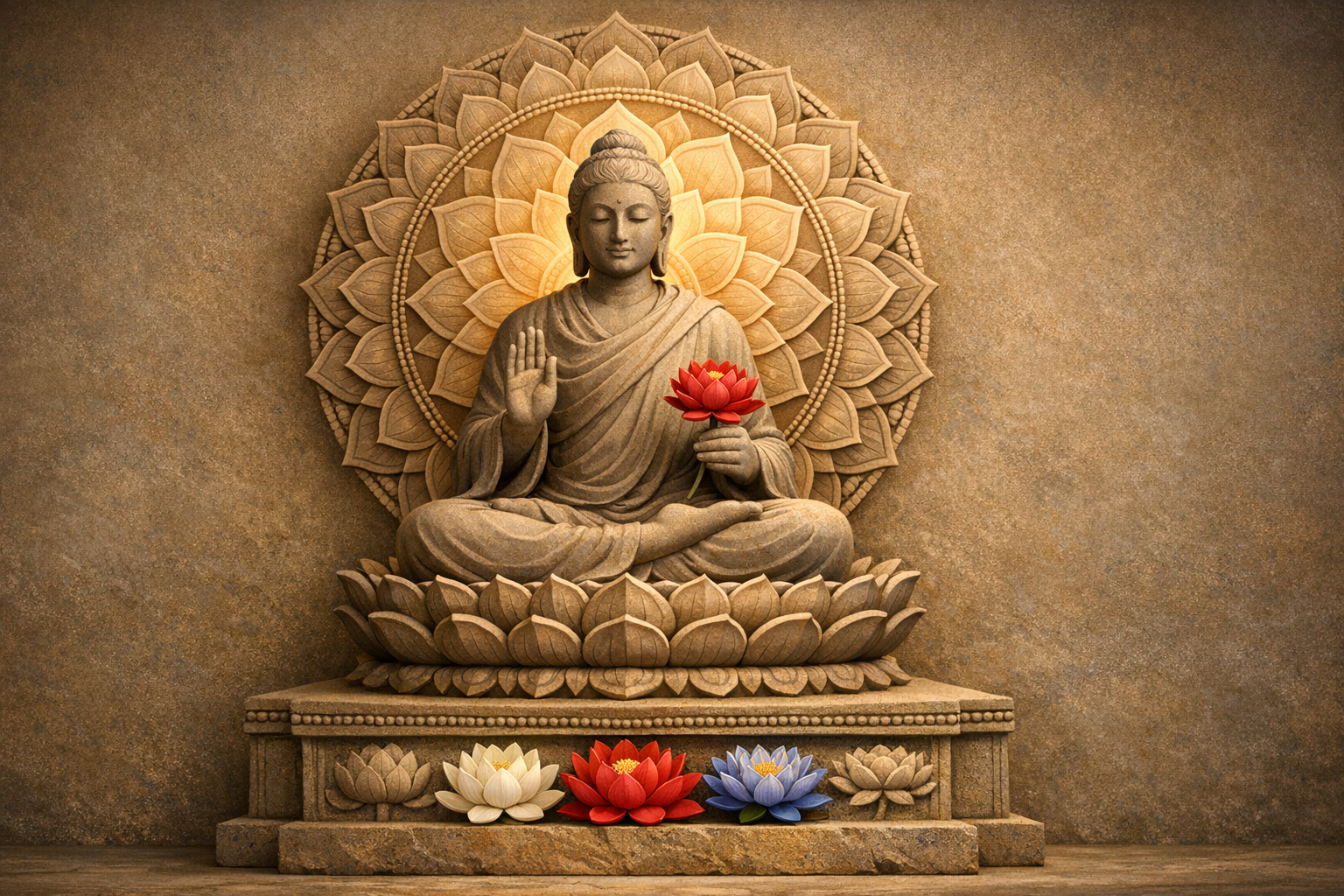
Across South Asia and beyond, the lotus, or padma, is among the most resonant motifs in Hindu sculptures, uniting aesthetics, theology, and philosophy in a single living symbol. As a visual language embedded in sacred art, the padma encodes ideas of purity, detachment, fecundity, and awakening, while anchoring the viewer’s attention through balanced geometry and graceful proportion.
Textual traditions consistently foreground the lotus as a primary sign in Hindu iconography. Vedic and Purāṇic literature praise the padma as the seat of deities and the emblem of auspiciousness, while the Upanishads evoke the hridaya-padma, the lotus of the heart, as a metaphor for inner realization. The Bhagavad Gita’s image of water beading off a lotus leaf becomes a canonical instruction on living unstained by worldly contact.
Shilpa Shastra compendia such as the Vishnudharmottara Purana and the broader corpus of Agamas articulate how the lotus should appear in sculpture and painting. These texts specify petal counts, tiers, curvature, and symmetry, translating theological meaning into reproducible craft rules and ensuring that sacred imagery is both mnemonic and measurable.
In the sculptural grammar of Hindu sacred art, the padma functions in at least four roles: as an attribute held by a deity, as a pedestal or throne, as a patterned halo or nimbus, and as a coded sign in yogic and tantric visualization. Each role carries nuanced meaning that shifts subtly with posture, petal count, and associated deity.
The attribute lotus may appear as a bud, half-blossom, or full flower, commonly called mukula, ardhavikasita, and vikasita padma. A closed bud indicates latent potential and restraint; a half-opened flower suggests becoming; a fully opened blossom signals revelation, fullness, and grace.
Color adds precision to meaning. White lotuses signify clarity and sattva, red lotuses signal abundance and vitality, and the blue lily, or utpala, evokes serenity and depth. Shastric and poetic traditions often distinguish padma or kamala from utpala, reserving padma for the true lotus and utpala for the blue water lily, a difference that careful viewers can sometimes detect in petal shape and stamen treatment in stone and bronze.
As pedestal or throne, the lotus appears as the padma-pitha. Sculptors frequently carve a two-tiered base combining downturned petals below and upturned petals above, creating a visual cushion on which the deity stands or sits. The double-lotus base stabilizes the composition and conveys the idea that the divine rests upon, and rises from, cosmic order.
Padmasana, the lotus posture, frames meditative deities and sages. Whether rendered as full lotus or a gentle cross-legged variant, the pose visually expresses inner equipoise and the disciplined channeling of prana. The still center of the body becomes the still center of the sculpture’s geometry.
Vishnu’s iconography makes the lotus indispensable. Sculptures across periods depict the shankha, chakra, gada, and padma, the lotus signifying fecundity and cosmic order. In Vaishnava cosmogony, Brahma emerges upon a lotus that rises from Vishnu’s navel, a scene carved memorably at the Gupta-period Vishnu Anantasayana panel at Deogarh and in later South Indian and Southeast Asian sanctuaries. The very name Padmanabha immortalizes this image in living worship.
As Shri or Lakshmi’s seat, the lotus broadcasts abundance and auspiciousness. Gaja Lakshmi reliefs show elephants pouring purity over the goddess enthroned on a fully open lotus, a configuration that transmits prosperity, fertility, and sovereign grace into the surrounding built space of the temple.
Saraswati, goddess of learning and music, typically sits upon a white lotus. Sculptors leverage the lotus’s whiteness and symmetry to suggest the clarity of wisdom, the discipline of the arts, and the stillness in which knowledge becomes luminous.
Brahma is frequently represented either seated upon a lotus or emerging from the lotus of Vishnu’s navel, visually articulating the birth of order and speech from the silent depth of the cosmic waters. The lotus here is both vehicle and revelation.
Other deities may carry or be associated with the lotus as a gentle sign of auspicious presence. Ganesha sometimes holds a lotus to indicate perfected intention, Surya can stand upon a lotus to declare radiant sovereignty, and graceful attendants in temple reliefs hold bud and blossom as courtly and celestial offerings.
Regional styles refine these themes. In Chola bronzes of Tamil Nadu, double-lotus pedestals are rendered with crisp, rhythmic petals that support the dynamic stillness of the murti. In Pala-Sena black stone images of eastern India, the lotus base often integrates with beaded borders and scrolls, enriching the silhouette while maintaining iconometric discipline.
Western Indian Maru-Gurjara and Jain temple traditions achieve dazzling complexity in ceiling rosettes, transforming the lotus into soaring stone mandalas. At Delwara and Ranakpur, concentric rings of chiselled petals culminate in thousand-petaled compositions that draw the gaze upward toward transcendence.
South Indian Dravida and Hoysala idioms feature lotus bands along base moldings and pilasters, while elaborating capitals with kalasha-and-lotus ensembles. The Hoysala ateliers carve lily and lotus scrolls with lace-like finesse, revealing how the padma’s curvature governs ornamental rhythm.
Beyond the subcontinent, Khmer and Cham sculptural programs in Southeast Asia incorporate lotus motifs throughout deity pedestals, guardian figures, and dance reliefs. Devatas at Angkor frequently hold lotus buds, translating Indic notions of purity and blessing into local visual dialects while preserving the core semantic field.
Yogic and tantric visualization further deepen the lotus’s meaning. The chakras are conceptualized as lotuses with specific petal counts, a numeracy that reappears in halos and thrones: ashtadala (8), shodashadala (16), dvatrimshat-dala (32), and chatushashti-dala (64). In sculpture, these counts subtly calibrate sanctity, power, and scope, turning ornament into doctrine.
Ritually, the lotus threads temple life. Priests and devotees offer lotuses in archana and pushpanjali, invoke the padma in mantras and stotras, and visualize the deity emerging from or resting upon the cosmic bloom. These embodied practices keep the sculptural symbol experientially alive.
Technically, the lotus invites sculptural virtuosity. Stone carvers articulate layered petals with alternating deep cuts and soft transitions to catch light and shadow, while lost-wax bronze casters thin the petal rims to a whisper to achieve a buoyant effect. The craftsmanship demonstrates how metaphysical light becomes visible as a measured surface.
For viewers engaging Hindu sculptures in temples or museums, three cues reveal meaning at a glance. First, observe the lotus’s state: bud, partial bloom, or full blossom. Second, note color when preserved in paint or polychrome, or infer from context which hue is intended. Third, read the lotus in relation to gesture and attribute: a lotus in the left hand of Vishnu, for instance, builds a different visual sentence than a lotus throne under Lakshmi.
Emotional responses reported by pilgrims and museum visitors often centre on calm, balance, and subtle joy when the gaze settles upon a lotus base or bud. Educators note that once viewers learn to read petal counts and tiers, sculptures become legible texts; understanding breeds intimacy, and the encounter shifts from casual looking to contemplative seeing.
The padma also bridges dharmic traditions. In Buddhist art, Avalokiteshvara as Padmapani, the lotus-throned Buddha, and lotus halos echo Hindu grammar while advancing bodhisattva ideals. In Jain art, Tirthankaras sit in padmasana on lotus pedestals, and Padmaprabha bears the lotus as his emblem. Sikh Gurbani frequently employs the lotus metaphor to teach living in the world without attachment, reinforcing a shared ethical and contemplative horizon across Hinduism, Buddhism, Jainism, and Sikhism.
Case studies illuminate continuity. The Gupta Deogarh panel synthesizes cosmic lotus imagery with narrative clarity; Chola bronzes of Lakshmi and Vishnu demonstrate how lotus pedestals energize poised figures; Maru-Gurjara ceilings translate the lotus into immersive stone mandalas. Each instance preserves the core meaning of the padma while adapting to local materials and aesthetics.
Conservation introduces new questions. As petals erode and pigments fade, conservators strive to stabilize surfaces without dulling the lotus’s geometry. Digital documentation, 3D scanning, and historically grounded restoration help maintain iconometric integrity so that the padma continues to function as sacred sign and cultural memory.
Contemporary ateliers and diaspora temples sustain the lotus language in new media, from cast stone and fiber-reinforced composites to gilded copper. Even as materials change, the canon’s lotus proportions and petal rhythms remain stable, ensuring continuity between ancient sanctuaries and modern shrines.
Ultimately, the lotus in Hindu sculptures is a complete semiotic system. It is throne and attribute, cosmology and ethics, geometry and grace. Learning to read its forms equips viewers to engage temple architecture, ritual practice, and the wider dharmic visual world with confidence and care.
By tracing the padma across regions, materials, and traditions, a shared civilizational conversation becomes visible. The symbol itself models its teaching: rooted in the earth, rising through water, unfolding in air, and opening to light, the lotus demonstrates how purity, wisdom, and compassion can blossom everywhere without contradiction.
Inspired by this post on Hindu Blog.










