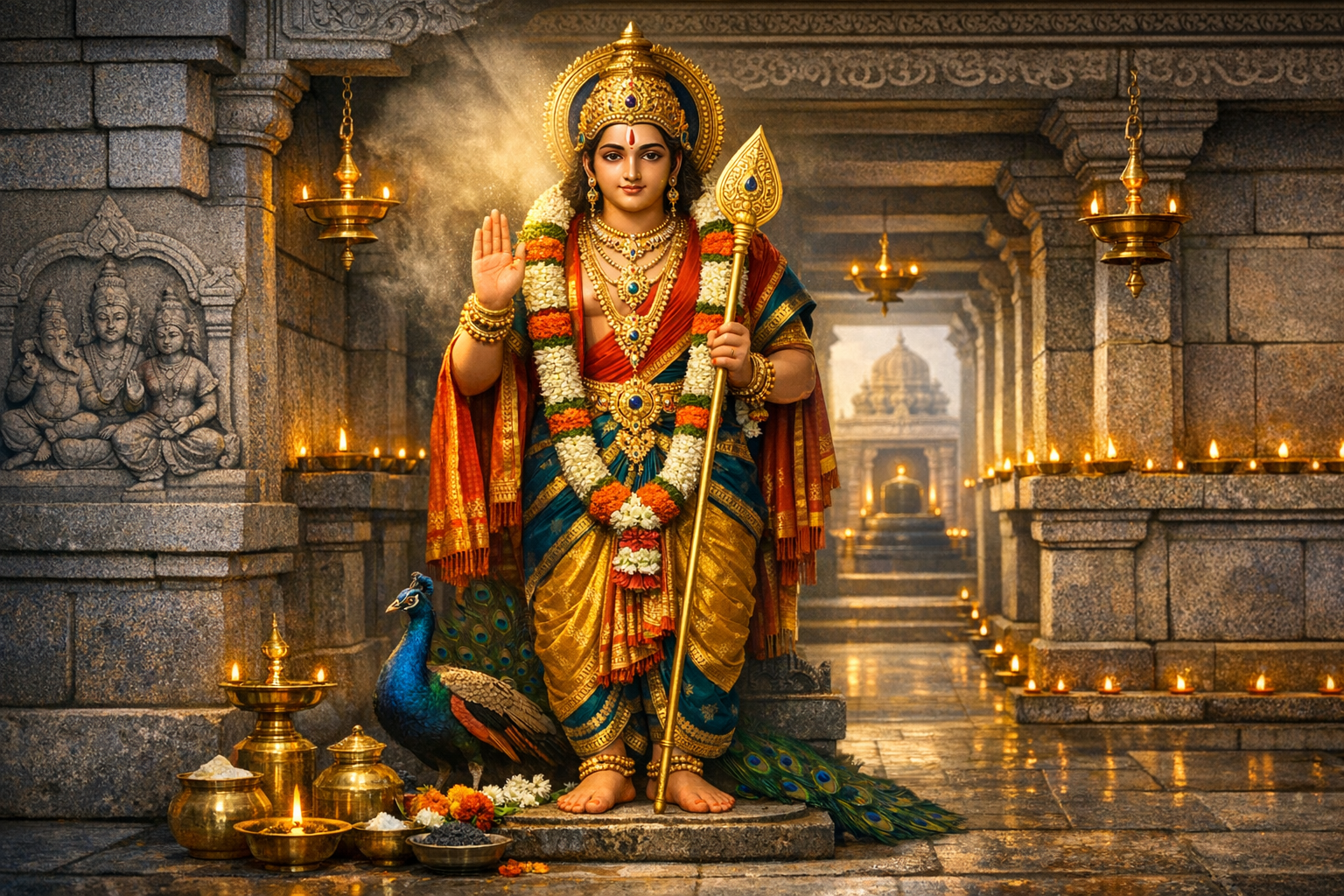
Adhi Kandhanatha Swamy Temple, Erakaram, in Tamil Nadu represents a distinctive Murugan shrine situated immediately behind an adjacent Shiva temple, housed in a separate but harmoniously aligned sanctum. Revered locally as Sri Adhi Kandhanatha Swamy, the deity is installed in a standing form with the characteristic abhaya hastam (fear-dispelling gesture), a visual theology of protection, guidance, and grace. The site’s devotional profile is amplified by its association with Arunagirinathar, whose celebrated Thirupukazh tradition recognizes the shrine’s spiritual magnetism within the Tamil Murugan bhakti landscape.
From the standpoint of temple architecture in South India, the placement of a Subrahmanya (Murugan) shrine along or near the axial spine of a Shiva complex reflects enduring Saiva-Agamic design principles that foreground familial complementarityShiva, Parvati, and Skandaoften encapsulated in the Somaskanda motif. Although precise construction phases at Erakaram require epigraphic study for firm dating, the current spatial dispositionprimary Shiva garbhagriha with a secondary yet independent sannidhi for Adhi Kandhanatha Swamyaccords with patterns documented across Chola–Pandya–Nayaka–period Hindu Temples in the region. Granite plinths, modest prakaras, and a focus on functional ritual circulation collectively support a design ethos that prioritizes continuous worship over monumental scale.
The epithet “Adhi” connotes primordial or original, while “Kandhanatha” evokes Murugan as Kandanthe youthful commander of celestial forces and lord (natha) of wisdom and disciplined energy. Together, the name communicates a theological stance in which timeless protection (adhi) meets dynamic guidance (kandhanatha), aptly expressed through the governing mudra of abhaya hastam. In the ritual imagination of devotees, this synthesis translates into confidence during adversity and clarity in righteous action.
The iconography of the abhaya hastam is central to the temple’s theological message. In classical Hindu iconography, abhaya signifies an assurance of safety and the cessation of fear; as rendered for Murugan, it balances martial prowess (traditionally expressed through the vel) with compassionate guardianship. This duality resonates profoundly with devotees who approach the sanctum for sukha-shanti (well-being and peace), vocational clarity, and inner courage, aligning personal devotion with the broader dharmic ideal of righteous action anchored in compassion.
Arunagirinathar’s Thirupukazh corpus constitutes a pivotal liturgical layer in the shrine’s living heritage. Renowned for complex chanda (metrical) patterns and musicality that invite participatory singing, Thirupukazh kirtanas function as both theology and praxis: they teach while they transform. In keeping with the Murugan bhakti tradition, community rendering of these hymnsespecially on festival daysserves as a powerful vehicle of shared devotion, ethical remembrance, and intergenerational transmission of sacred knowledge.
Consistent with Murugan worship across Tamil Nadu, the ritual calendar at Erakaram is oriented around daily abhishekam and seasonal observances. Among the most significant are Skanda Sashti (celebrating Murugan’s triumph of dharma), Vaikasi Visakam (widely observed as the advent of Murugan), Karthigai Deepam and Karthigai days in Karthigai Masam, and Thaipoosam, each reinforcing core themes of purification, renewal, and devoted service. These events, accompanied by alankaram, deepa-seva, and communal recitation, deepen the site’s identity as a locus of continuity and shared cultural memory within Sanatana Dharma.
Visitors consistently describe a palpable stillness in the inner precinct, heightened by the sight of Adhi Kandhanatha Swamy’s abhaya hastam that appears to meet the gaze with reassurance. The understated scale of the shrine, the cadence of mantra recitation, and the fragrance of vibhuti and sandal together create a sensorial field conducive to meditation and reflective prayer. For many, the experience translates into a renewed commitment to ethical conduct and seva in family and community lifean outcome that aligns with the integrative aims of Hindu spirituality.
Murugan’s significance extends beyond sectarian boundaries and demonstrates the unifying fabric of dharmic traditions. In Sri Lanka, the deity is venerated as Kataragama deviyo by both Hindus and Buddhists; in East Asian Buddhist contexts, the related guardian figure Skanda (Wei Tuo) symbolizes steadfast protection of the Dharma. Such resonances underscore shared valuescourage, wisdom, and compassionate protectionembraced across Hinduism, Buddhism, Jainism, and Sikhism, affirming that sacred spaces like Erakaram can serve as bridges of cultural understanding and spiritual unity.
While local sthala-purana and oral memory are principal conveyors of Erakaram’s identity, the broader figure of Skanda is deeply grounded in textual canons ranging from early Tamil works (e.g., Tirumurukarruppatai) to the Kanda-themed sections of the Skanda Purana and later philosophical hymns including Subrahmanya Bhujangam. The temple’s ritual grammar thus participates in a pan-Indic conversation on dharma, valor, and devotion, interpreting them through a distinctly Tamil lens that privileges musical worship, ethical living, and community solidarity.
Responsible pilgrimage enhances the sanctity and longevity of heritage temples. Observing traditional etiquettecircumambulation in a clockwise direction, respectful attire, silence near the sanctum, and mindful participation in abhishekam and archanasupports collective worship. Documentation of oral histories, careful maintenance of stone and stucco elements, and community-led archival efforts further ensure that Adhi Kandhanatha Swamy Temple, Erakaram remains a vibrant testament to Tamil cultural heritage and the evolving practice of Hindu Temples in South India.
Adhi Kandhanatha Swamy Temple, Erakaram exemplifies how a focused Murugan shrine situated behind a Shiva complex can encapsulate the aesthetic, ritual, and philosophical strengths of Tamil Saiva-Agamic Temple Architecture. Through the combined power of abhaya iconography, Thirupukazh hymnody, and a living festival cycle, the site offers devoteesand all students of culturean accessible pathway to inner steadiness, communal harmony, and dharmic responsibility.
Inspired by this post on Hindu Pad.