
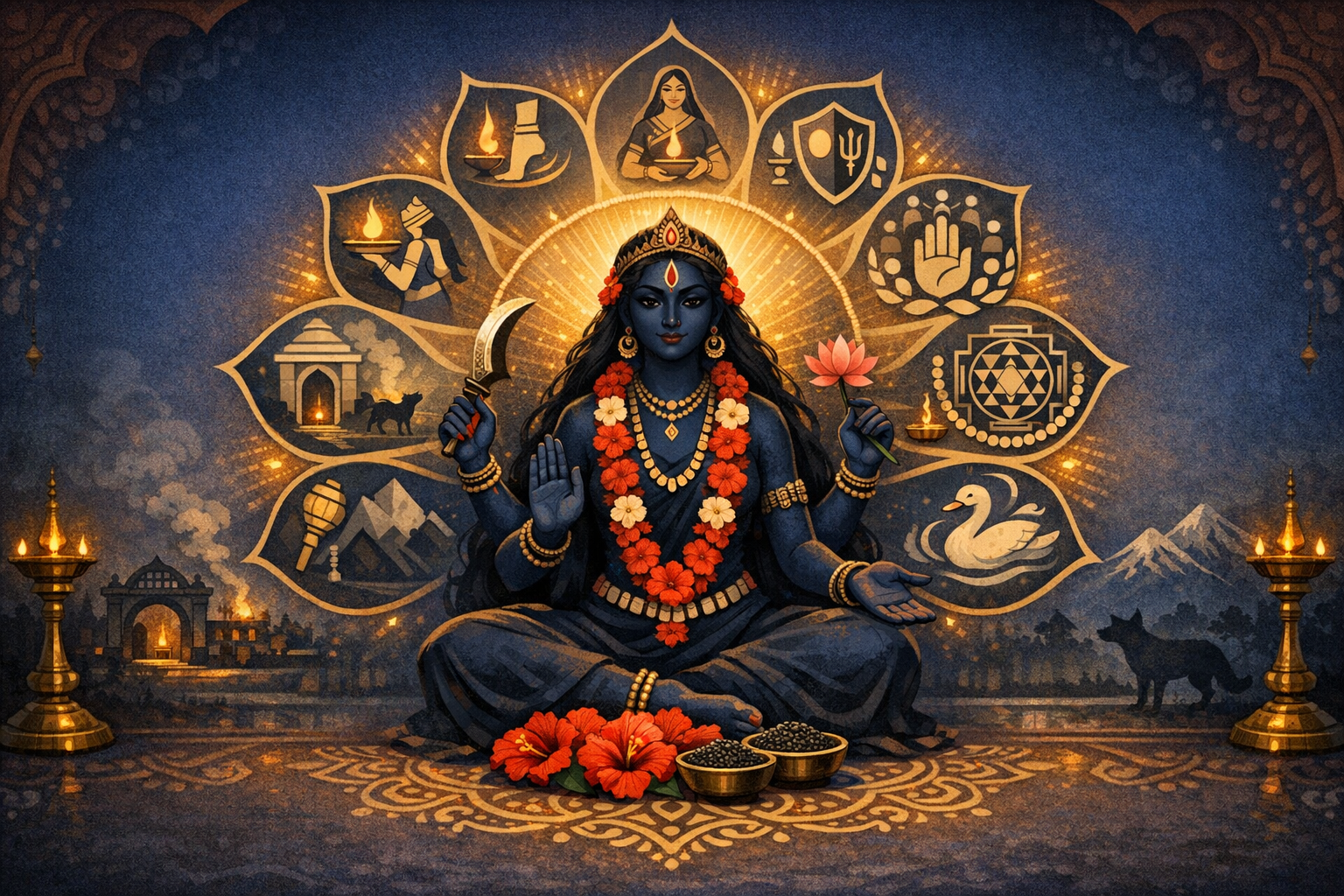
Goddess Kali is celebrated as one and unique, yet tradition also recognizes multiple emanations through which the same undivided Shakti reaches and protects devotees. In eastern India, especially Bengal and Assam, a well-known enumeration speaks of eleven principal forms—often referred to as Ekadasha Kali—each bearing distinct iconography, ritual associations, and soteriological meanings. This plurality never diminishes Kali’s unity; rather, it expresses how the Divine Mother adapts for the well-being of seekers, appearing serene and silent in some contexts and awe-inspiring and terrifying in others.
Shakta literature and regional practice offer several slightly varying rosters of these eleven forms. The list presented here reflects a commonly cited Bengali-Shakta understanding and should be read alongside local sampradaya teachings, temple traditions, and family lineages. In practice, households and temples in Bengal and adjacent regions overwhelmingly venerate Dakshina Kali and Shyama Kali, while cremation-ground associations are central to Smasana Kali. Bhadrakali, Raksha Kali, and Siddha Kali remain prominent in protective and tantric frameworks; Adya Kali, Guhya Kali, and Hansa Kali are important in esoteric contemplations; Bhima Kali and Chamunda anchor fierce-protective idioms. Together, these forms map an arc from intimate maternal care to uncompromising spiritual courage.
From a textual standpoint, the picture emerges across the Kalika Purana (with its early eastern substrate), the Brihad Nila Tantra, Shakta Pramoda, and related Bengali tantras and stotras (such as the Karpuradi-stotra and passages of the Mahanirvana Tantra). These sources, along with local temple sthala-puranas, record iconographic details (hasta-mudras, weapons, vahanas), mantric frameworks (notably the bija kriṁ), and ritual gradients ranging from household puja to cremation-ground sadhana. The historical crucible for much of this synthesis aligns with the Pala–Sena period in eastern India, where Hindu Shakta, Buddhist Vajrayana, and regional folk lineages interacted fruitfully.
Philosophically, the eleven forms articulate two recognizable modalities of the Goddess: saumya (gentle, boon-bestowing) and raudra (fierce, ego-dissolving). Both aspects aim at compassion; one offers comfort, the other compels liberation by cutting through clinging. The iconic image of Kali standing over Shiva symbolizes Shakti as the kinetic principle animating consciousness (Purusha). The distinction between Dakshina (right-foot forward) and Vama (left-foot forward) orientations encodes tempered grace versus unmediated transcendence, not moral superiority.
Across forms, core iconographic features recur: a dark (blue-black) complexion indicating all-absorbing infinity; a lolling tongue that both devours and purifies time; a garland of heads signifying letters/sounds (varna-mala) and the dissolution of egoic identities; a sword or kripan to sever ignorance; a severed head as the end of avidya; and the abhaya and varada mudras offering fearlessness and boons. The cremation ground (smasana) frames impermanence, while companions such as jackals or Bhairava mark liminality and guardianship. Red hibiscus, black sesame, and deep-night worship times further bind these forms to liminal potency.
Devotional calendars localize these dimensions. In Bengal, Kali Puja (Shyama Puja) during Deepavali centers Shyama/Dakshina Kali as the compassionate mother of the household, while nocturnal rites in cremation grounds bring forward Smasana and Guhya currents for qualified initiates. In village and urban spaces alike, musical traditions such as Shyama sangeet help translate highly technical tantric symbols into emotionally resonant devotion accessible to families and communities.
Adya Kali (Ādyā Kālī) is the “primordial” Mother, the undivided Shakti from whom the many forms unfold. In iconography, she is often four-armed with sword, severed head, and gestures granting protection and boons, standing upon Shiva. Adya signifies that the eleven are not separate deities but refracted views of one source. In Kolkata’s Kalighat tradition, the sense of Adya Ma (the primal Mother) permeates daily worship, reminding devotees that every specialized form is a doorway back to first principles—pure consciousness-power beyond birth and decay.
Dakshina Kali is, in living practice, the most widely venerated form in Bengal and eastern India. The right-foot-forward stance signals a compassionate, householder-facing expression of the Goddess; at Dakshineswar, Sri Ramakrishna’s life and worship popularized this form well beyond Bengal. Dakshina Kali’s iconography typically includes a smiling or serene countenance, a garland of heads, and hands bestowing abhaya and varada, integrating fierce symbolism with maternal reassurance. Devotees seeking protection, prosperity tempered by wisdom, and spiritual clarity commonly turn to this form. In many homes, she is addressed in intimate, familial language—Ma—as the nearness of Shakti itself.
Shyama Kali emphasizes the affectionate, approachable presence of the Mother. Though visually close to Dakshina, Shyama often appears with an even gentler expression, blue-black (shyama) hue, and offerings suited to household rites (naivedya, lamps, hibiscus). The songs and poetry of Bengal—particularly Shyama sangeet—encode this devotional intimacy, narrating experiences of solace, moral courage, and the dissolving of loneliness through the nearness of Ma. In ritual terms, Shyama Kali helps devotees harmonize daily responsibilities with spiritual aspiration.
Bhadrakali (Bhadra Kali) places the accent on auspicious protection and the re-establishment of dharma. The epithet bhadra (auspicious, benevolent) coexists with fierce iconography, indicating a protective mother who neutralizes hostile forces to restore societal and inner order. In parts of eastern India, as well as in Kerala’s powerful Bhadrakali traditions, this form safeguards communities against calamity and moral breakdown. Temples and local festivals frequently highlight communal well-being, justice, and resilience under Bhadrakali’s vigilant gaze.
Smasana Kali resides at the cremation ground, where all names and forms are relinquished. Iconographically fierce, she points practitioners toward direct confrontation with impermanence and ego. In tantric sadhana (for qualified initiates under traditional guidance), Smasana Kali breaks habitual fear and attachment. For householders, her meaning translates as moral clarity and acceptance of life’s endings, enabling compassionate action without clinging. The smasana, far from being morbid, symbolizes fearless truthfulness amid change.
Raksha Kali (Rakṣā Kālī) embodies direct protection—raksha—from disease, famine, conflicts, and unseen adversities. Historically, processional worship of Raksha Kali intensified during epidemics and social crises, especially in the nineteenth and early twentieth centuries in Bengal. This form’s rites often stress communal solidarity, vows (sankalpa) for collective welfare, and the safeguarding of children and elders. In ethical terms, Raksha Kali guides communities to pair prayer with responsibility—hygiene, mutual aid, and justice—in the service of life.
Siddha Kali is the bestower of siddhi—accomplishment in both spiritual realization and, when appropriately framed, skillful capacities aiding sadhana. The bija kriṁ and its mantric matrices frequently anchor her worship. In some Bengali centers (for example, Shantipur and other historic sites), Siddha Kali’s rites underscore disciplined practice, scriptural study, and humility before lineage. The aim is not occult display but refinement of attention, character, and deep insight, ensuring that any capability acquired serves liberation and compassion.
Guhya Kali (Guhya = secret, inner) names the esoteric, initiatory dimension of the Mother. Her iconography and mantras are traditionally transmitted within parampara to protect practitioners and preserve integrity. In doctrinal terms, Guhya Kali symbolizes the inmost sanctum of awareness where language recedes and direct realization dawns. Even for householders, the idea of guhya signals reverence for what cannot be reduced to spectacle—discernment, privacy in practice, and sincerity over display.
Hansa Kali links the Mother to the hamsa (swan), a pan-Indic symbol of discriminative wisdom (hamsah/so’ham breath, the capacity to separate milk from water). In the Hooghly district’s Hanseshwari temple tradition, the Goddess is envisioned as a yogic map of subtle channels (nadi), aligning breath and awareness with Shakti. Hansa Kali thus bridges Shakta iconography with yogic anatomy—prana, nadi, and mantra—guiding seekers from devotional feeling to contemplative steadiness. The result is an integrated path where love, breath, and knowledge converge.
Bhima Kali (Bhima = mighty) conveys indomitable strength and guardianship. While the famed Bhimakali temple at Sarahan (Himachal Pradesh) stands outside Bengal, the theological current is pan-Indic: the Mother as steadfast defender of dharma and patron of courage. In daily life, Bhima Kali’s teaching appears whenever ethical backbone is required—speaking truth, protecting the vulnerable, and staying resilient amid adversity. Iconographically, she may hold multiple weapons, each signifying a virtue deployed against a vice.
Chamunda (often integrated as Chamunda Kali in Bengali usage) recalls the slaying of the asuras Chanda and Munda in the Devi Mahatmya. Emaciated or skull-garlanded iconography dramatizes her uncompromising removal of stubborn negativity. Devotees understand Chamunda not as cruelty but as tough love, which refuses to enable the habits that cause suffering. In this reading, Chamunda’s ferocity is ethical surgery—radical compassion that liberates.
These eleven lenses—Adya, Dakshina, Shyama, Bhadra, Smasana, Raksha, Siddha, Guhya, Hansa, Bhima, and Chamunda—compose a spectrum of the same Mother. The household finds warmth and guidance in Dakshina and Shyama; communities lean on Raksha and Bhadra for safety and order; practitioners steeped in tradition revere Guhya and Smasana for penetrating insight; all draw from Adya’s ground, Siddha’s refinement, Hansa’s breath-wisdom, and Bhima–Chamunda’s courage. Regional rosters may swap in closely allied forms without altering the underlying unity.
Ritual and practice vary by form. Offerings commonly include red hibiscus, black sesame, rice preparations, and deep-night lamps. Many communities emphasize vegetarian, ahimsa-aligned offerings and seva (service), reflecting evolving ethical commitments while honoring scriptural tradition. The essential axis is always bhava (devotional mood): reverence, clarity, and sincerity rather than display. Mantrically, the bija kriṁ pervades Kali worship, joined to dhyana verses and kavachas held within sampradaya transmission.
Geographically, Adya/Dakshina/Shyama Kali anchor Kolkata (Kalighat, Dakshineswar) and wider Bengal, while Tarapith—though especially associated with Tara—illustrates the broader Shakta-tantric ecosystem that nurtures these forms. Hanseshwari in Bansberia exemplifies yogic–iconographic synthesis; Bhadrakali lineages extend into Odisha and Kerala; Bhimakali at Sarahan highlights transregional networks. Across eastern India and the diaspora (including Bangladesh and Nepal), community pujas and family altars carry forward both intimate devotion and sophisticated theology.
Comparative perspectives within the dharmic family reinforce unity amidst diversity. In Vajrayana Buddhism, fierce yet compassionate female figures such as Ugra Tara or Nairatmya embody functions akin to Kali’s ego-dissolving wisdom, reflecting historical dialogue across Pala-era Bengal and beyond. Jain and Sikh traditions affirm Shakti’s ethical force in their own ways—Sikh scriptural and poetic materials (e.g., Chandi-related compositions in the Dasam Granth) valorize righteous courage, while Jain emphasis on non-violence illuminates how protective power can be aligned with restraint and compassion. Together, these currents affirm that fierce compassion serves the liberation and welfare of all beings.
In lived religion, devotees often describe a steadying intimacy with the Mother regardless of form: Shyama’s nearness in hard times, Raksha’s felt protection during illness, or Smasana’s truthfulness in the face of grief. Such testimonies connect sophisticated tantric metaphors to everyday life—caring for elders, acting ethically at work, or raising children with both gentleness and firm boundaries. Kali’s eleven forms, in this sense, become an ethical compass: fearless, tender, and incisive all at once.
For study and contemplation, several lenses help: iconography (what each hand, weapon, or ornament teaches), mantra (how sound reshapes attention), ritual timing (twilight, midnight, new moon), and community memory (songs, festivals, family vows). Each lens returns seekers to the same insight: the Divine Mother is not distant. She is present as wisdom in moral choices, as courage when the right path is costly, and as compassion that holds both the fragile and the fierce without contradiction.
In sum, the eleven forms of Kali articulate a complete pedagogy of the heart-mind. Adya grounds non-duality; Dakshina and Shyama teach nearness; Bhadra and Raksha secure social and inner order; Smasana and Guhya cut illusions at the root; Siddha and Hansa refine practice and perception; Bhima and Chamunda insist on courage. The outcome, when approached with humility and guidance, is a life aligned with dharma—strong, compassionate, and awake—affirming unity across Hindu, Buddhist, Jain, and Sikh spiritual visions.
Inspired by this post on Hindu Blog.










Leave a Reply
You must be logged in to post a comment.