Many sincere practitioners across the dharmic familyHinduism, Buddhism, Jainism, and Sikhismobserve that the Divine can feel abstract when approached only through speculation. A complementary pathway emerges in the Krishna-bhakti tradition: a precise, textually grounded portrait of the Divine that offers clarity without denying other legitimate modes of realization. This approach situates a clear vision of God within the rigor of sastra while honoring formless contemplations and non-theistic soteriologies elsewhere in the dharmic spectrum.
In Gaudiya Vaishnavismpresented globally through the Hare Krishna Movementsastra is not an optional ornament but the epistemic core for understanding the Absolute. Rather than asking, “God may be like this or that,” sastra is taken to give verifiable characteristics (lakshana) of the Supreme. This intellectual posture remains non-sectarian: the specificity of Krishna’s form functions as one valid lens among many, compatible with the broad dharmic principle that diverse upayas (skillful means) guide different temperaments toward realization.
Dharmic psychology further holds that clarity of vision correlates with clarity of character. Unwholesome habits (papa, klesha) obscure discernment, while ethical alignment, meditation, and compassion refine perception. Within this framework, bhakti-yoga prescribes practices that purify the heart (citta-shuddhi), enabling a more lucid apprehension of the Divine, just as mindful discipline clarifies insight in Buddhist, Jain, and Sikh contemplative paths.
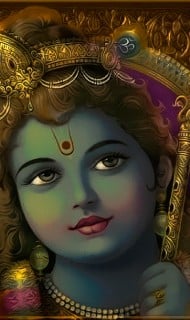
This pathway is encapsulated in a celebrated śāstric description repeatedly invoked in Vaishnava exegesis: Syamasundara Krishna, also known as Muralidhara, appears playing on His flutevenum kvanantam. His eyes resemble lotus petals, and a peacock feather crowns His headBarhavatamsa. He is so beautiful that His beauty eclipses the combined charm of thousands of Cupids. Traditional commentators trace these identifiers to core texts, including the Brahma-samhita and the Bhagavata Purana, which furnish a coherent, relational profile of the Supreme Person.
Each epithet and motif conveys layered theology. Syamasundara signals both radiant beauty and intimacy: the Absolute is not a distant abstraction but a supremely attractive reality drawing the heart toward loving service. Muralidhara, “the flute-bearer,” frames divine love as invitation rather than compulsion. The phrase venum kvanantam evokes an aural theology in which sound (nada) mediates graceresonating with the shared dharmic esteem for sacred sound, from kirtan and japa to Sikh shabad-kirtan.
Barhavatamsa, “peacock-feathered,” encodes an aesthetics of playful majesty. Rather than imperial regalia, Krishna appears adorned with the beauty of nature, signifying sweet sovereignty (madhurya) more than overt grandeur (aisvarya). Lotus-like eyes symbolize awakened compassion and unblinking attentiveness toward all beingsan iconographic grammar that harmonizes with dharmic emphases on karuna (compassion) and ahimsa (non-violence).
The assertion that His beauty outshines thousands of Cupids is not mere hyperbole; it is a theological argument. It distinguishes transcendental attraction from worldly eros, confessing that spiritual love (prema) surpasses material desire (kama). In the bhakti hermeneutic, such depictions recalibrate the heart’s compass: what appears as an aesthetic claim is, in fact, a soteriological invitation to reorient longing from the finite to the infinite.
Philosophically, Gaudiya Vaishnavism articulates the Absolute through a triune schema: Brahman (impersonal effulgence), Paramatma (localized Supersoul), and Bhagavan (the personal Supreme). The person-centered revelation does not negate the other two; it integrates them by positing that fullness (purnatva) includes relation, love, and reciprocation. Thus, a clear conception of God in this tradition is not a concession to anthropomorphism but a metaphysical affirmation that ultimate reality is capable of infinite relationship.
Epistemically, sastra (authoritative testimony), yukti (reason), and anubhava (realized experience) form an integrated pramana-triad. Sastra supplies precise identifiers; reason tests for coherence; practice yields experiential confirmation. In the Krishna-bhakti pathway, sabda-pramana (scriptural testimony) is privileged without dismissing contemplative verificationparalleling how other dharmic paths validate insight through both discipline and transmission.
Rasa-tattva (aesthetics of divine love) adds another technical layer. The flute (venu), the peacock feather, the lotus eyes, and the pastoral milieu of Vrindavan function as semiotic cues guiding the devotee from concept to encounter. The goal is not icon-worship as mere art appreciation but transformation of consciousness through relational aesthetics: the heart is schooled to love what is supremely lovable, thereby becoming what it loves.
From a practical standpoint, bhakti-yoga operationalizes clarity through a cluster of time-tested disciplines: śravaṇa (listening to sastra), kīrtana (sacred singing), smaraṇa (remembrance), arcana (worship), and seva (service). These are readily complemented by cross-dharmic practices such as meditation, mindful breath regulation, ethical vows, and compassionate action. The synergy affirms unity in spiritual diversity: shared virtues and interiority establish common ground while each path preserves its distinctive grammar of realization.
Experientially, practitioners often describe how meditating on Muralidhara’s flute or contemplating lotus-like eyes cultivates serenity, tenderness, and moral courage. The iconography thus bridges emotion and intellect: as the mind reflects on scriptural attributes, the heart softens, and conduct aligns. This mirrors broader dharmic wisdom that transformation unfolds when right view, right intention, and right practice converge.
Importantly, this clarity carries an inclusive horizon. Hindu traditions enshrine the principle of Ishta, legitimizing multiple valid approaches to the same truth. Buddhism emphasizes liberation through insight and compassion; Jainism upholds purification, non-violence, and kevala-jñāna without positing a creator; Sikhism proclaims the formless One (Nirankar) while embracing the salvific power of the Name (Naam) and kirtan. The Krishna-bhakti portrait harmonizes with these paths by affirming that the Divine may be realized as personal, impersonal, or through perfected virtuediverse doors leading into the shared sanctum of liberation and unity.
Read in this light, the Hare Krishna Movement’s insistence on the name, form, qualities, and activities of Krishna is not a rejection of other dharmic insights but a precise cartography for one legitimate route. The specificity of Syamasundara Krishna, venum kvanantam, and Barhavatamsa offers markers that guide contemplative attention; the wider dharmic landscape supplies additional, complementary bearings.
Teaching lineages associated with A.C. Bhaktivedanta Swami Prabhupada stress that sastra gives the name and “address” of the Divine not as a slogan but as theological shorthand: the Absolute reveals personal coordinatesVrindavan pastimes, relationships, and virtuesby which seekers can orient love and life. Just as a pilgrim benefits from a reliable map, the devotee benefits from reliable description.
For those seeking a clear conception of God, a practical synthesis flows naturally: study sastra daily to anchor understanding, chant or sing sacred names to awaken love, sit in silence to stabilize attention, and serve others to translate realization into compassion. Such integrative practice reflects a dharmic consensus: wisdom must be embodied as character, and devotion must mature as care for the world.
Ultimately, this vision invites a generous spiritual citizenship. Some will recognize the Divine Person in the sweetness of the flute; some will dissolve into the vastness of the formless; some will ascend by perfecting non-violence and self-knowledge. Each course, honored rightly, strengthens the whole. Clarity, here, is not a narrowing but an illuminationby seeing Krishna clearly through sastra, one also learns to see the dharmic family clearly, united in its shared aspiration for liberation, love, and the welfare of all beings.
Inspired by this post on Dandavats.