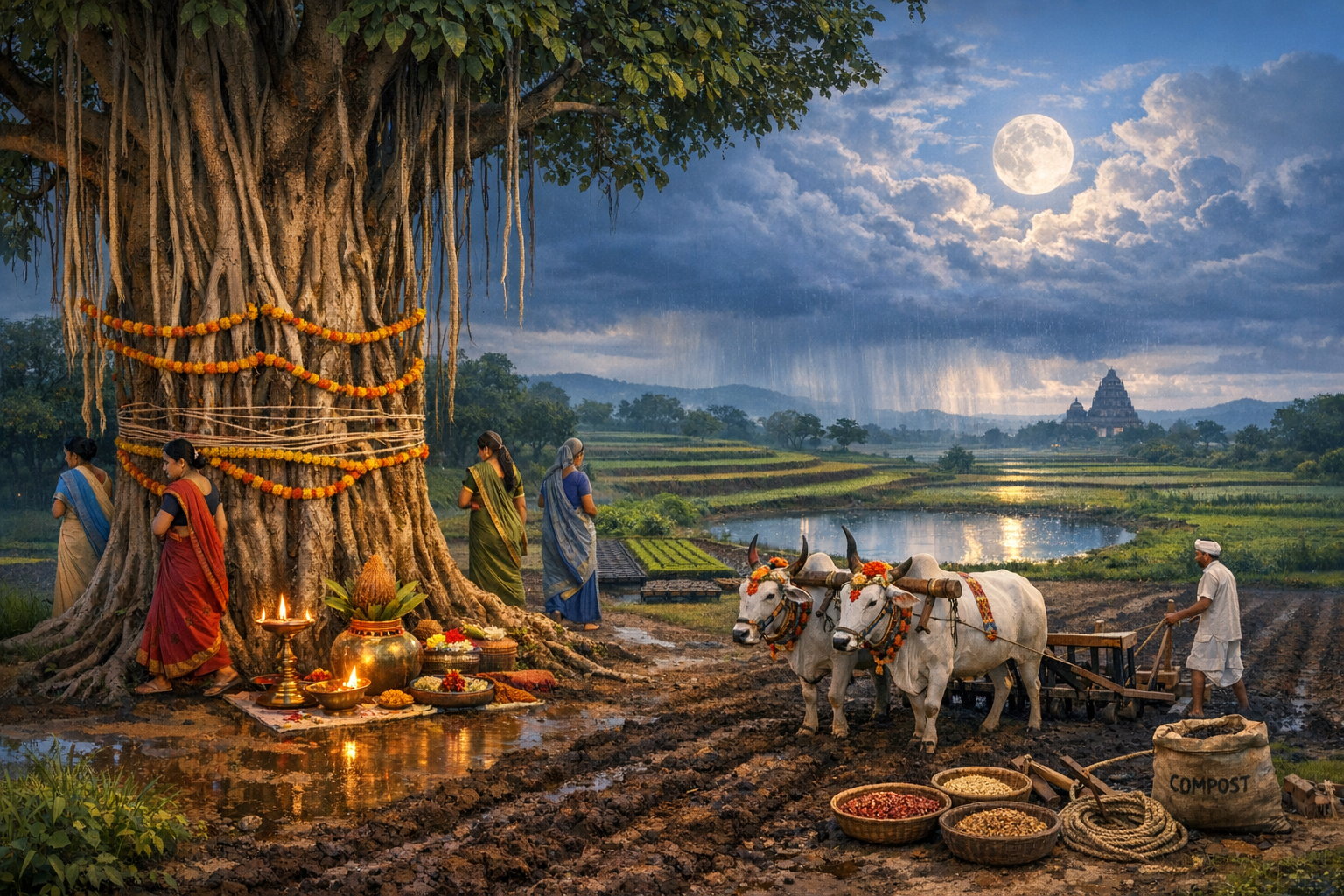
Krushi Purnima is observed across agrarian communities in India as a culturally resonant marker of the monsoon’s arrival and the auspicious start of Kharif-season fieldwork. In 2026, Krushi Purnima falls on 29 June, coinciding with Jyeshtha (Jyeshta) Purnima as per the Hindu calendar. In different regions, this full-moon celebration aligns with observances such as Vata Purnima Vrata (notably in parts of western and southern India), Eruvaka Purnima (Andhra Pradesh and Telangana), and Deva Snana Purnima (Odisha), creating a shared cultural arc that honors the earth, water, seeds, and the life-giving rhythms of the rains.
From a calendrical perspective, the observance rests on the Purnima tithi, the lunar day when the elongation between the Sun and Moon approaches 180 degrees. Traditional panchang computation defines tithis by the longitudinal difference of the luminaries, with each tithi spanning 12 degrees of relative motion. Most dharmic calendars assign festival observance by the tithi prevailing at local sunrise; hence, Krushi Purnima 2026 is kept on 29 June where Jyeshtha Purnima holds at sunrise. Because tithi boundaries are astronomically determined and time-zone dependent, local almanacs may present slight variations; consulting a regional panchang or temple bulletin ensures precision.
Years that contain an intercalary month (Adhik Maas) can introduce naming nuances, including the appearance of Adhik Jyeshtha and Nija (regular) Jyeshtha. Temple traditions and sampradaya rules specify whether a given observance falls in the Adhik or Nija month. In 2026, many regional panchangs list Krushi Purnima on 29 June; however, individual templesespecially those with distinctive liturgical calendarsmay announce observance details aligned to their tradition. This flexibility is intrinsic to the Hindu calendar’s lunar-solar harmonization and reflects the depth of regional practice.
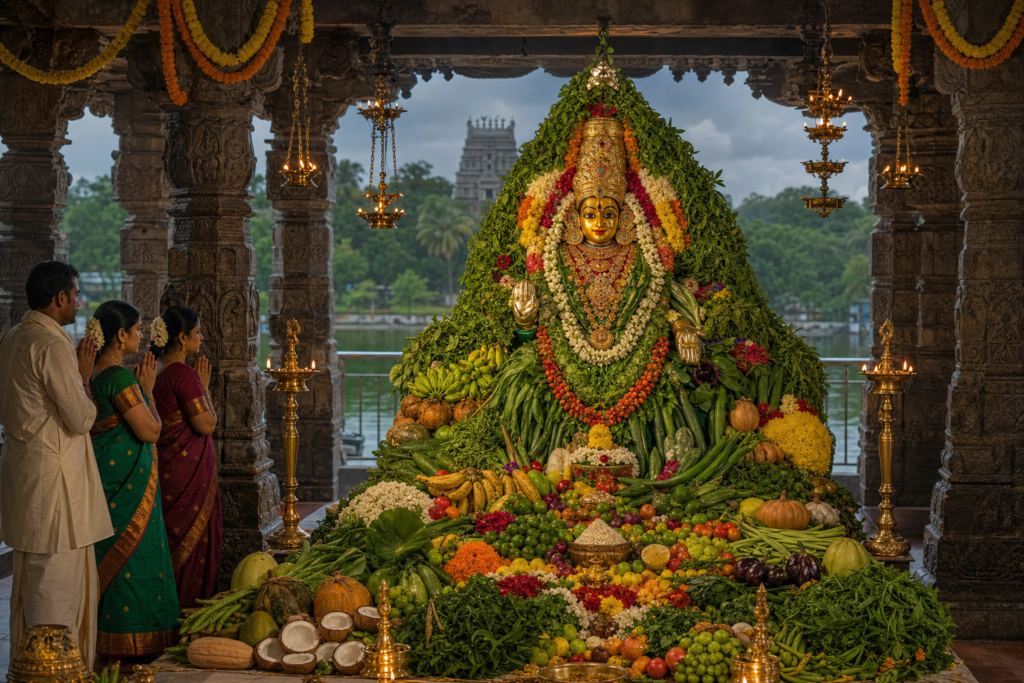
Eruvaka Purnima, synonymous with Krushi Purnima in Andhra Pradesh and Telangana, explicitly blesses agricultural implements, bullocks, and the first tillage after the pre-monsoon showers. Communities decorate ploughs, perform puja for cattle, and ceremonially touch the soil, signaling readiness to begin sowing once reliable rainfall moistens the seedbed. Folk songs, communal meals, and seed-exchange traditions further bind ecology and community welfare to the agricultural calendar.
Vata Purnima Vrata, widely observed on Jyeshtha Purnima in Maharashtra, Gujarat, Karnataka, and beyond, centers on the sacred banyan tree (Vata Vriksha). Married women traditionally perform circumambulations (pradakshina) around the tree, offer water and threads, and recite the Savitri–Satyavan narrative as a vow (vrata) for family well-being, longevity, and stability. The banyan’s aerial roots and canopy symbolize resilience and interdependencequalities farmers also seek in their land, livestock, and livelihoods at monsoon’s threshold.
Deva Snana Purnima in Odisha marks the ceremonial bathing (Snana Yatra) of Lord Jagannath, Lord Balabhadra, and Devi Subhadra. After the public bathing on Jyeshtha Purnima, the deities remain in anasara (a period of seclusion) before the famed Rath Yatra. In a broader agrarian reading, the ritual bathing ritually invokes purificatory rains, linking divine cycles to the seasonal renewal of fields and food systems.
Krushi Purnima also carries practical agro-ecological significance. The Southwest Monsoon typically delivers 70–80% of India’s annual rainfall between June and September. By late June, rainfall onset has usually advanced beyond peninsular India toward central regions, allowing many farmers to complete land preparation and target first sowings for rice, millets, pulses, cotton, groundnut, and soybean as local moisture becomes dependable. The festival thus provides a culturally anchored, meteorologically sensible cue: organize inputs, plan labor, and initiate sowing when soil moisture is adequate and rainfall patterns stabilize.
Timing considerations on the day often incorporate muhurta logic alongside weather windows. Traditional guidance suggests performing puja during shubha muhurta, avoiding Rahu Kaal, and aligning community rites with the Purnima tithi. While exact auspicious windows vary by latitude, longitude, and sunrise, an accessible rule of thumb is to compute Rahu Kaal from local sunrise-to-sunset divisions; for example, on Mondays, the second segment after sunrise often corresponds to Rahu Kaal. In agricultural terms, field operations are ideally synchronized with both safe field conditions (non-sodden soils to prevent compaction) and the availability of family or community labor around the ritual schedule.
A technical pre-sowing checklist pairs well with the spirit of Krushi Purnima: assess field moisture after at least one or two effective rainfall events; complete primary tillage only when soils are friable; calibrate sowing depth to seed size (shallower for small-seeded millets and pulses, somewhat deeper for maize and cotton) to enhance emergence; verify seed quality with a quick germination test; and treat seed appropriatelyusing regionally recommended, crop-specific bio-priming or approved protectantsto minimize early stand loss. Farmers may also reconcile seasonal climate outlooks with risk-spreading strategies, such as staggering sowing dates across plots, intercropping, or selecting early- or medium-duration cultivars suitable for local rainfall distribution.
Sustainability aligns naturally with the festival’s ethos. Water conservation practicessuch as contour bunds, farm ponds, and mulchingimprove infiltration and buffer dry spells. Integrated Nutrient Management (INM) blends composts, green manures, and site-specific fertilizers to protect soil organic matter while meeting crop needs. Integrated Pest Management (IPM), emphasizing field monitoring, habitat management, and judicious inputs only when thresholds are crossed, helps reduce pest risks without undermining beneficial biodiversity. In drought-prone areas, prioritizing resilient crops (e.g., millets and certain pulses) and conserving local seeds support both nutrition and climate adaptation.
Krushi Purnima also resonates with the shared values of the broader dharmic familyHinduism, Buddhism, Jainism, and Sikhismthrough reverence for nature, ahiṃsā-informed stewardship, and community service. Buddhist and Jain monastic calendars, while marking distinct retreats later in the rainy season, underscore mindful engagement with life and landscape. Sikh teachings repeatedly honor honest labor (kirat karni), sharing (vand chhakna), and gratitudeethics that naturally encourage fairness in agricultural work and community food security. The full moon’s message is therefore inclusive: care for the earth, share its fruits equitably, and strengthen the social fabric that sustains rural and urban households alike.
For many households, the festival evokes vivid, lived memories: the petrichor of the first rain, the sight of decorated cattle, elders recounting Savitri–Satyavan under a banyan’s shade, and neighbors exchanging seeds or produce. These narratives cultivate continuitylinking precise astronomical observance with agronomic common sense and communal well-being. They also reaffirm that prosperity is not only a harvest metric but a measure of ecological balance and social harmony.
Regional calendars may differ in month-naming conventions (Amanta vs. Purnimanta), yet Jyeshtha (Jyeshta) Purnima remains the operative tithi for Krushi Purnima in 2026. To avoid confusion, it is useful to distinguish this observance from other full-moon markers in the year: for instance, Guru Purnima falls in Ashadha and honors the guru–shishya parampara, while Sharad Purnima occurs in Ashwin, highlighting autumnal plenitude and devotional practices of another season.
In sum, Krushi Purnima 2026 on 29 June provides an academically grounded, agriculturally sensible, and spiritually uplifting moment to align ritual intention with field readiness. By honoring water, soil, seeds, animals, and community, the observance guides farmers and non-farmers alike toward resilience: measured by timely sowing, mindful resource use, and the inclusive spirit that animates India’s dharmic traditions. May the monsoon be well-timed, the fields abundant, and the bonds of community even stronger.
Inspired by this post on Hindu Pad.