Srimad-Bhagavatam: Timeless Wisdom That Transcends Dharma, Artha, Kama, and Moksha
Srimad-Bhagavatam, also known as the Bhagavata Purana, is revered in the Vedic literature as transcendental scripture that illuminates the true purpose of human life. While āhāra, nidrā, bhaya, and maithuna (eating, sleeping, fearing, and mating) are common to all sentient creatures, human life, it affirms, begins in earnest with dharma. Traditional Hindu philosophy organizes worldly and spiritual aims into four pursuits, the puruṣārthas: dharma (pious living and ethical order), artha (economic development and stewardship of resources), kāma (responsible enjoyment and aesthetic fulfillment), and mokṣa (liberation from material bondage). Srimad-Bhagavatam honors these aims yet presses further, declaring that the highest human flourishing emerges only when life is oriented to bhakti, loving service to the Supreme, which perfects and surpasses all other goals. In this way, the text functions both as a summation of the Vedic canon and a transformative guide beyond it.
As a cornerstone of the Puranas, Srimad-Bhagavatam spans twelve cantos and approximately 18,000 verses. The traditional narrative frame situates the discourse at Naimiśāraṇya, where Sūta Gosvāmi recounts the teaching he heard from Śukadeva Gosvāmi’s seven-day dialogue with King Parīkṣit on the banks of the Gaṅgā. Attributed to Vedavyāsa in the traditional account, the text has been transmitted through a robust commentarial heritage across Vaishnava lineages and beyond, engaging scholars and devotees alike for centuries as both literature and living theology. This layered oral and textual transmission underscores its dual character as history of sacred speech and guide for contemplative practice.
The opening declaration, dharmaḥ projjhita-kaitavo ‘tra, signals the text’s uncompromising position: all forms of self-serving or manipulative religiosity are cast aside in favor of a non-sectarian, pure path for the nirmatsarāṇām satām, persons free from envy. In practical terms, this is a call to test religious life not by ritual display or sectarian affiliation but by its capacity to cultivate compassion, humility, truthfulness, and steady remembrance of the Divine. This evaluative standard has kept Srimad-Bhagavatam dynamically relevant in diverse epochs, from premodern courts and monastic libraries to contemporary study circles and digital platforms.
To clarify its revaluation of human aims, the text treats each puruṣārtha with nuance. Dharma aligns the individual with cosmic order and social responsibility; artha recognizes the legitimacy of prosperity when pursued ethically; kāma acknowledges refined desire, aesthetics, and relational harmony; mokṣa offers freedom from the cycle of birth and death. Yet the Bhagavata insists that even mokṣa, while profound, becomes complete only when suffused with bhakti, for it is unmotivated and uninterrupted devotion that ultimately satisfies the self. This insight is encapsulated in the text’s celebrated thesis that the supreme dharma is that by which bhakti to the transcendental Lord arises, effortlessly and without obstruction.
In contrast to seeing religion as a mere ledger of merits and demerits, Srimad-Bhagavatam presents a relational spirituality. The core experience is not transactional piety but loving service, where the heart’s innate longing finds its object in the Divine. Such devotion does not negate the world but reorders it; ethical conduct, economic justice, and aesthetic refinement become offerings that honor the sacredness threaded through all life. The result is a holistic ideal in which personal liberation and collective well-being are mutually reinforcing.
The text gives practitioners a concrete map of interior cultivation through the nine processes of devotion: śravaṇaṁ (hearing), kīrtanaṁ (chanting), smaraṇaṁ (remembering), pāda-sevanaṁ (service at the Divine feet), arcanaṁ (ritual worship), vandanaṁ (offering prayers), dāsyaṁ (servitude), sakhyam (friendship), and ātma-nivedanam (self-surrender). These practices meet aspirants where they are: the contemplative may begin with study and remembrance, the aesthetic with music and poetry, the service-oriented with ritual and community care. By anchoring devotion in daily disciplines, the Bhagavata turns spiritual aspiration into lived experience.
Narrative exemplars demonstrate how the puruṣārthas evolve under the light of bhakti. Dhruva begins with an intense worldly desire yet, upon divine vision, finds his earlier goal pale beside the joy of devotion. Prahlāda, steadfast in love of the Supreme despite persecution, embodies fearlessness born of remembrance. Ajamila, rescued by the unintentional utterance of the Divine Name at life’s end, illustrates the extraordinary potency of nāma-saṅkīrtana when the heart turns sincerely. Such accounts do not encourage moral complacency; rather, they attest that even faltering steps toward remembrance can catalyze profound transformation.
Gajendra’s surrender from the grip of a crocodile stands as a meditation on existential crisis and grace. Ambarīṣa’s integration of devotion with royal responsibilities models dharma alive in statecraft and civic duty. The teachings of Kapila to Devahūti articulate a Sankhya-inflected analysis of mind and matter that culminates in bhakti-yoga, revealing how philosophical clarity and loving devotion converge. R̥ṣabhadeva’s counsel charts an ascetic royal path that harmonizes renunciation with responsibility, reminding readers that true leadership is impossible without interior mastery.
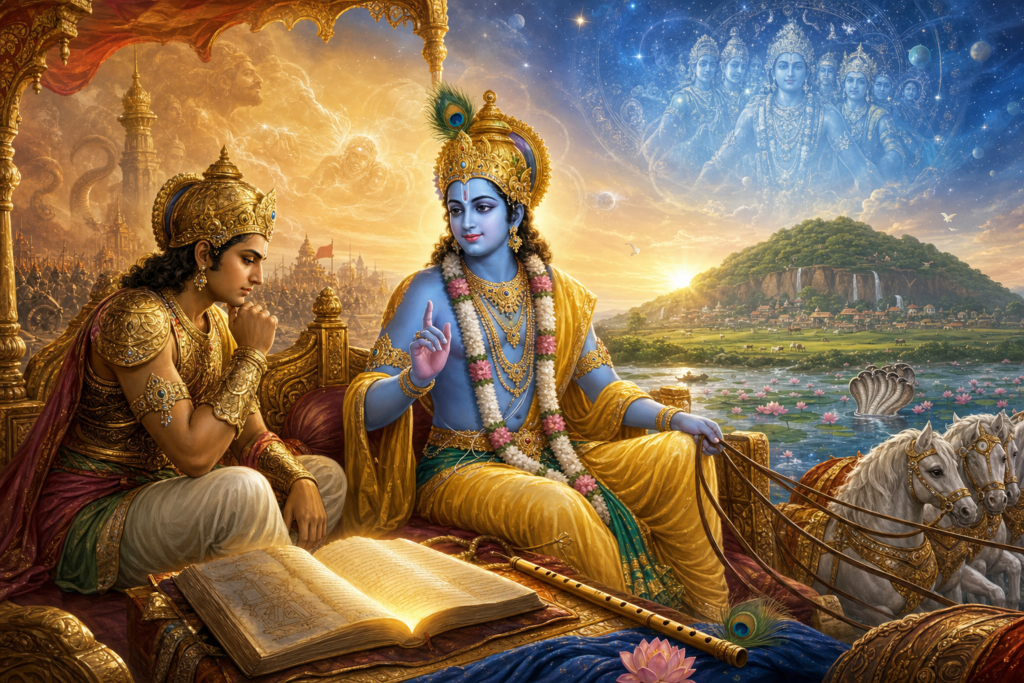
The Tenth Canto, narrating Kṛṣṇa’s līlā, provides the theological and aesthetic summit. Here bhakti is not a concept but a living art in which rasa, sacred emotion, carries consciousness beyond the narrow lanes of ego. Read within the Bhagavata’s own guardrails of purity, humility, and service, these pastimes function as contemplative icons, drawing the mind from sensory fascination to spiritual intimacy. In this culmination, devotion subsumes and fulfills dharma, artha, kāma, and mokṣa by revealing their central telos: to awaken love of the Divine.
Alongside theology, Srimad-Bhagavatam offers a sophisticated cosmology and philosophy of time, situating human history within yuga cycles and cosmic days and nights. Whether approached as sacred mythic mapping, metaphysical symbol, or theological science, this vision widens moral imagination: actions ripple across vast scales, and responsibility extends beyond immediate horizons. Such a perspective encourages ecological care, intergenerational ethics, and steady-mindedness amid rapid social change.
The text’s soteriology often emphasizes that bhakti renders even mokṣa light (mokṣa-laghutā-kṛt), not by diminishing liberation but by revealing a love that regards personal emancipation as a by-product rather than the goal. This priority on love resonates meaningfully with broader Dharmic traditions: the Buddhist cultivation of karuṇā and mettā, the Jain centrality of ahiṁsā and self-mastery, and the Sikh deepening of devotion through Nāma Simran all affirm that ethical purity and loving remembrance transform the seeker and society alike. In honoring these shared aspirations without collapsing real differences, Srimad-Bhagavatam contributes to unity-in-diversity across Sanatana Dharma, Buddhism, Jainism, and Sikhism.
As a living scripture, the Bhagavata prescribes steady engagement: nityam bhāgavata-sevayā points to daily hearing, reflection, and application. Communities find that consistent study softens habitual reactivity, strengthens compassion in family and civic spaces, and supports ethical economic life consonant with artha and dharma. In workplaces and homes alike, practitioners report that even brief, regular immersion in the text reorients attention from anxiety and impulse toward clarity, gratitude, and duty performed in a spirit of offering.
Reading strategies can reflect these aims. Many begin with the First Canto to absorb the text’s frame and purpose before proceeding through the creation accounts, teachings of sages, royal narratives, and finally the Tenth Canto’s theological apex. Others interleave narrative sections with didactic passages such as Kapila’s teachings for balance between heart and head. In all approaches, the text invites a dialogical method: question, contemplate, compare commentarial insights, and then test conclusions in lived practice.
A brief note on reception history enriches understanding. Sridhara Svāmī’s Bhāvārtha-dīpikā established a classical line of interpretation widely honored across traditions; Madhvācārya’s Bhagavata-tātparya-nirṇaya, Vallabhācārya’s Subodhinī, Jīva Gosvāmi’s Ṣaṭ-sandarbhas (including the Bhagavata-sandarbha), and Viśvanātha Cakravartī Ṭhākura’s Sarārtha-darśinī represent major Vaishnava contributions. Their convergences and respectful debates exemplify how rigorous scholarship and realized devotion can coexist, generating a rich hermeneutic culture still accessible to contemporary readers.
By reframing the puruṣārthas through devotion, Srimad-Bhagavatam transforms life from a struggle for survival into an art of remembrance. Dharma gains interior luminosity; artha becomes stewardship; kāma is refined into sacred aesthetics; and mokṣa opens as spacious freedom made fragrant by love. The result is a moral and contemplative architecture that sustains households, institutions, and communities with clarity and compassion.
The text’s ethic of non-harm and truthfulness fosters social harmony and mutual respect across Dharmic paths. Because it locates spiritual excellence in humility and service rather than in uniformity of belief, it encourages intertradition dialogue and shared action for the common good. In plural societies, this orientation proves especially timely, offering a way to balance principled conviction with deep hospitality.
In contemporary practice, accessible disciplines aligned with the nine processes of bhakti support steady growth. Hearing and chanting nurture contemplative focus in the digital age; remembrance and worship quiet restlessness; prayer and service cultivate empathy; friendship with the Divine stabilizes identity; and self-offering integrates purpose. Together, these disciplines reshape the nervous system toward calm alertness, the mind toward clarity, and the heart toward lasting joy.
Ultimately, Srimad-Bhagavatam validates the fourfold aims of human life while revealing their consummation in bhakti. It invites seekers from all walks to test its promises by daily practice: study a little, sing a little, serve a little, and let the puruṣārthas align themselves naturally. In doing so, human life steps beyond the cycle of appetite and fear into a freedom characterized by wisdom, compassion, and love that embraces all beings.
What is the central teaching of Srimad-Bhagavatam in this article?
The article presents Srimad-Bhagavatam as a scripture that honors dharma, artha, kāma, and mokṣa while showing that they are fulfilled and surpassed through bhakti. It emphasizes loving service to the Supreme as the highest orientation of human life.
How does Srimad-Bhagavatam reinterpret the four puruṣārthas?
Dharma becomes ethical order illuminated by devotion, artha becomes stewardship, kāma is refined into sacred aesthetics, and mokṣa becomes freedom suffused with love. The article says bhakti reorders these aims rather than rejecting them.
What are the nine processes of devotion mentioned in the article?
The article lists hearing, chanting, remembering, service at the Divine feet, ritual worship, offering prayers, servitude, friendship, and self-surrender. These practices are presented as daily disciplines that turn spiritual aspiration into lived experience.
Which figures from Srimad-Bhagavatam are used as examples of bhakti?
The article highlights Dhruva, Prahlāda, Ajamila, Gajendra, Ambarīṣa, Kapila, Devahūti, and R̥ṣabhadeva. Their stories illustrate transformation, remembrance, surrender, responsible leadership, and the union of philosophical clarity with devotion.
How can modern readers engage with Srimad-Bhagavatam?
The article recommends steady engagement through daily hearing, reflection, chanting, remembrance, service, and self-offering. It also suggests beginning with the First Canto or balancing narrative sections with philosophical teachings such as Kapila’s instruction.
How does the article connect Srimad-Bhagavatam with wider Dharmic traditions?
It connects the Bhagavata’s emphasis on love, purity, humility, and remembrance with Buddhist karuṇā and mettā, Jain ahiṁsā and self-mastery, and Sikh Nāma Simran. The article frames this as unity-in-diversity without erasing real differences.