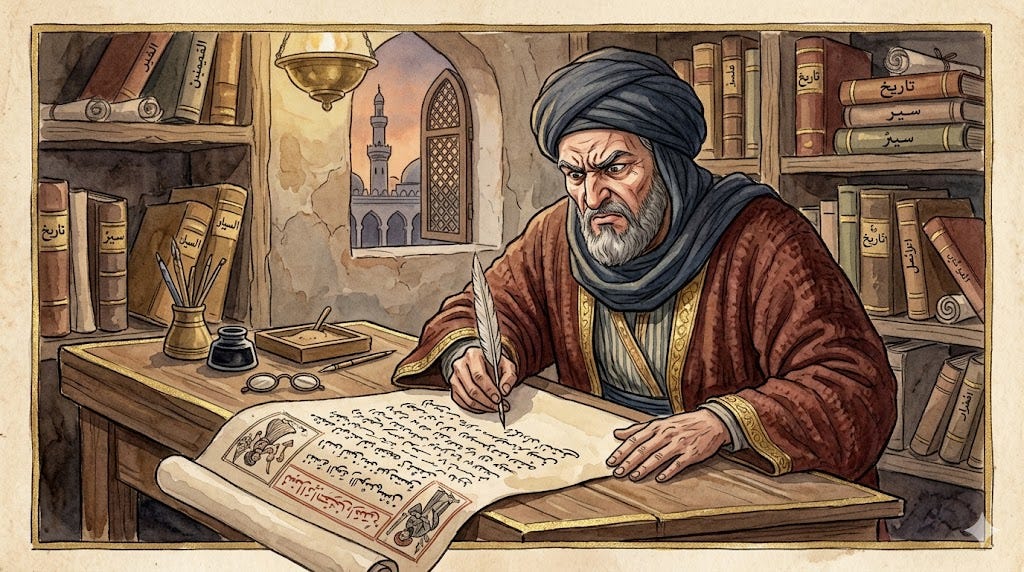
A classical aphorism describes history as “philosophy teaching by examples.” Few source traditions illustrate that proposition more vividly than the Islamicate court chronicles of medieval India. These texts, produced across the Delhi Sultanate and the Mughal Empire, were crafted in sophisticated courtly settings and calibrated to legitimate rule, codify memory, and frame conquest and governance in religious, legal, and political terms. Read with care, they illuminate the intellectual world of their authors and patrons while also revealing the biases and rhetorical habits that shaped how events were recorded.
Understanding these chronicles begins with time itself. The Islamic calendar pivots on the Hijra (622 CE), the migration of Muhammad from Mecca to Yathrib (Medina). Dated as 1 AH, this moment inaugurates the Hijri era, a strictly lunar system that orients sacred time and historical narration alike. In classical Islamic discourse, the period before the Hijra is often termed Jahiliyahan “age of ignorance”a moralized category that marks a before-and-after in salvation history and, by extension, in historical storytelling.
Because of this theological and temporal scaffolding, linear chronology is integral to many Islamicate narratives. Court historians meticulously recorded lunar dates for reigns, campaigns, and embassies, measuring the progress of rule and the consolidation of justice and order against the benchmark of the Hijra. Precision in dating was not a mere clerical habit; it functioned as a proof of legitimacy and an index of the ruler’s success in stabilizing domains conceived, in ideal-typological terms, as Dar-ul-Islam.
This temporal logic intertwined with doctrinal stakes. Islam’s claim to universal guidance, rooted in revelation and the mission of the final Prophet, made the historicity of events profoundly consequential. Exegesis of the Qur’an and Hadis required a grasp of the Prophet’s life (sira) and the evolving legal tradition (fiqh). In parallel, court chronicles in India functioned as the historical ledger through which rulers and scholars narrated the extension of law, order, and learning‘ilminto new spaces, while also framing conflicts with opponents in the conventional language of the time.
As a genre, these works sit at the intersection of panegyric, jurisprudence, political theory, and administrative record. The boundary between “religious” and “secular” in this ecosystem is anachronistic; chroniclers composed texts that were at once literary and legalistic, rhetorical and archival. Their prose drew on shared topoipraise of the sovereign, laments over disorder, celebration of victorythat recur across the Islamicate world and across centuries.
The qualifications expected of a court chronicler were exacting. Mastery of the Quran, Hadis, and Fiqh was foundational. Proficiency in Persian, the chief language of high administration and literature in North India, was essential, as was rigorous training in adab (belles-lettres) and rhetoric. Beautiful handwriting and command of calligraphic canons mattered because manuscripts were both instruments of governance and objects of aesthetic prestige. Beyond style, the chronicler’s craft involved assembling information from courtiers, commanders, envoys, and local officials, then arranging episodes with dates, place-names, and chains of transmission that conformed to courtly expectations of accuracy and decorum.
Chroniclers often held multiple roles. A munshi could also be a jurist (qazi), a mufti advising on law, a political counselor, or a diplomat. The Sufi scholar Shah Abdur Rahim, for example, contributed to Aurangzeb’s Fatwa-i-Alamgiri, a major compendium of jurisprudence. Such overlaps between legal scholarship, mystical networks, and the apparatus of the state were commonplace, reminding readers that Islamicate intellectual life was embedded inand helped to shapegovernance.
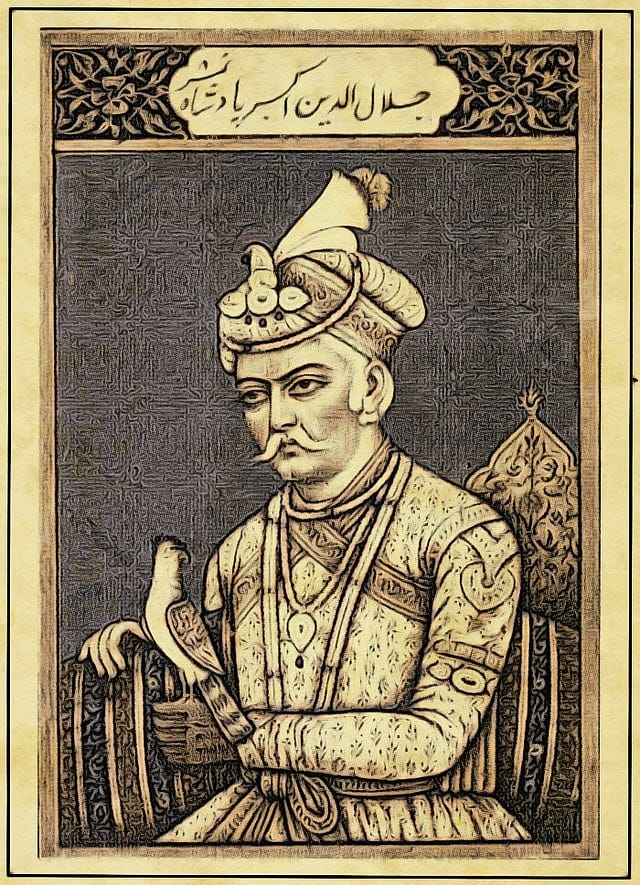
Some learned figures were soldiers and poets as well as historians. Amir Khusrau, famed for his Persian verse and musical innovations, also wrote historical works within a courtly idiom that praised patrons and celebrated victories. Passages attributed to him and to his contemporaries sometimes employ triumphal rhetoric about the subduing of idolatry or the security of law under Islam. Modern readers should recognize these as conventional tropes of legitimation in panegyric genres rather than take each line as a literal policy statement. Attributions, moreover, can be contested in manuscript traditions; responsible use demands cross-checking editions and scholarly commentary.
Abd al-Qadir Bada’uni offers a different lens. His Muntakhab-ut-Tawarikh chronicles the reign of Akbar with a critical eye, especially on religious innovations and debates at court. Like many writers of his milieu, Bada’uni’s language reflects the polemical vocabulary of his day. Rather than recycle hostile phrases from the period, a critical reading situates such rhetoric within the genre’s conventions and then compares it with other witnessesepigraphy, revenue documents, regional narratives, and later synthesesto separate normative posture from administrative practice.
Not all major voices were court insiders. Al-Biruni, writing earlier in the eleventh century, produced an extraordinary ethnographic and scientific study, Kitab fi Tahqiq ma li’l-Hind, that sought to understand Indian knowledge systems on their own terms. Ibn Battuta’s fourteenth-century Rihla preserves the perspective of a traveler and qadi moving through the Delhi Sultanate’s cosmopolitan world. These texts foreshadow the range of Islamicate writing on Indiafrom panegyric chronicles to travelogues and encyclopedic inquirieseach with distinctive aims and constraints.
Reading medieval Islamicate chronicles of India critically benefits from a set of practical heuristics. First, identify the patron, audience, and political moment of composition: was the text addressed to a new sovereign consolidating authority, or to a later ruler seeking to memorialize a predecessor? Patronage shapes praise, omissions, and emphasis. Second, place the work within its genrevictory literature (futuh), universal history (tarikh), biographical dictionary (tazkirah), or administrative manualso that rhetorical conventions are not mistaken for empirical reportage.
Third, triangulate across sources. Pair Persian chronicles with inscriptions, copper-plate grants, temple and monastery records, Jain prabandhas, Sikh janam-sakhis, Buddhist historical notes, regional vernacular ballads, and material culture (coins, architecture, archaeology). Convergences and contradictions across these corpora clarify what is likely descriptive fact, what is ideology, and what is literary flourish. This multi-archive approach aligns with the civilizational breadth of the subcontinent and fosters a shared, dharmic spirit of inquiry across Hinduism, Buddhism, Jainism, and Sikhism.
Fourth, attend to calendrical conversion. Hijri dates (AH) are lunar; converting them to Common Era requires awareness of lunar-solar drift and regnal-year counting. Small errors can compound into large chronological misunderstandings, especially when comparing events across different calendrical systems preserved in Sanskrit, Prakrit, Persian, and regional records.

Fifth, practice lexical care. Terms such as Jahiliyah, Hijra, ‘ilm, jizya, ghazi, and kufr are not mere glosses; they are nodes in legal-theological debates with long intellectual histories. Understanding how a given chronicler deploys themnormatively, descriptively, polemicallyprevents translation from laundering meaning or amplifying misunderstanding. The same principle holds for dharmic termsdharma, rajadharma, yuddha, and otherswhen cross-reading Hindu, Buddhist, Jain, and Sikh sources alongside Persian chronicles.
Finally, scrutinize transmission. Many celebrated passages survive in multiple recensions. Later editors and copyists sometimes interpolated clarifications, sharpened rhetoric, or abridged episodes. Modern translations can also import nineteenth- or twentieth-century assumptions. A careful historian weighs manuscript witnesses, consults critical editions where available, and is transparent about uncertainty in attribution.
The historiography surrounding these texts has evolved. Early colonial translators prized the chronicles for their chronological detail but often framed them within Eurocentric theories of “Oriental despotism,” which can caricature both Islamic and Indic political thought. In the twentieth century, influential academic schools emphasized socio-economic structures and material forces, sometimes bracketing religious language to counter communal readings. Each corrective brought gains and losses. A balanced approach neither absolutizes theology nor evacuates it; instead, it integrates the chronicles’ religious vocabulary with institutional, regional, and cultural histories to produce a fuller picture of medieval India.
Such balance serves a larger civic purpose. The subcontinent’s historical archives preserve pain and resilience across communities. Acknowledging the triumphalist rhetoric common to medieval war-writingacross many polities and traditionsneed not inflame division. Rather, it can prompt a more humane engagement with the past: one that honors the cultural heritage of Hindu, Buddhist, Jain, and Sikh communities; recognizes the literary and legal sophistication of Islamicate scholarship; and invites solidarity in the shared work of understanding, conserving, and learning from history.
In practical terms, this means pairing chronicles from the Delhi Sultanate and Mughal court with inscriptions from temples and mathas, studying Jain and Buddhist scholastic traditions alongside Persian administrative manuals, and reading Sikh narrative and ethical literature in dialogue with contemporaneous court records. When undertaken with empathy and methodological rigor, this cross-reading strengthens unity among dharmic traditions while deepening comprehension of Islamicate intellectual life in India.
The next installment will apply these methods to case studies from the Delhi Sultanate and Mughal periodsexamining Ziya’ al-Din Barani’s Tarikh-i Firoz Shahi, Isami’s Futuh al-Salatin, Nizam al-Din Ahmad’s Tabaqat-i Akbari, Abu’l-Fazl’s Akbarnama, and selective legal and epigraphic materials from Aurangzeb’s reignto illuminate how genre, patronage, and vocabulary interact to shape what is remembered as the “history” of medieval India.
To be continued.
Inspired by this post on Dharma Dispatch.