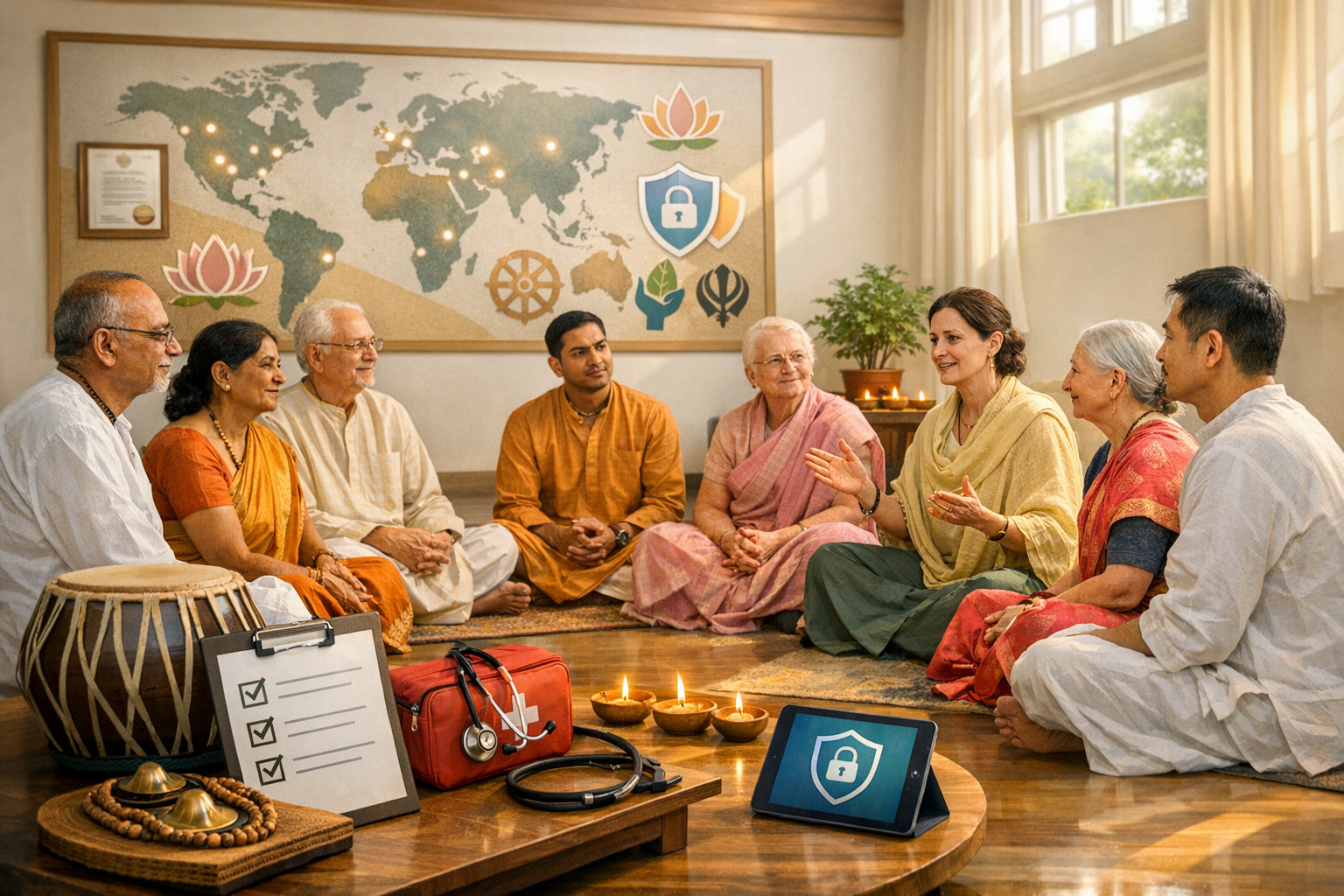
Devotee Care is emerging as a defining feature of contemporary ISKCON community development, foregrounding compassion, safety, and sustainable seva as non-negotiable priorities. Recent gatherings in Auckland and structured trainings in Fijiwhere Damodar Das presented Devotee Care Course certificatesillustrate how Vaishnava communities are professionalizing support systems while retaining devotional heartfulness. These efforts reflect a maturing institutional ethos: spiritual excellence is inseparable from the well-being, dignity, and protection of every devotee, volunteer, and visitor.
Conceptually, Devotee Care in ISKCON aligns pastoral care and community well-being with core Vaishnava values of daya, karuna, satsanga, and seva. The approach recognizes that sadhana thrives when devotees feel seen, safe, and supported across the spectrum of life experienceswhether navigating health challenges, resolving interpersonal tensions, sustaining marital harmony, or transitioning between ashramas. In this model, compassion is not episodic charity; it is a culture codified through governance, training, and measurable practice.
These values resonate across dharmic traditions. The ISKCON focus on seva and sanga parallels Buddhist sangha-care, Jain commitments to ahimsa and aparigraha in community life, and Sikh traditions of seva and sangat. Emphasizing unity in spiritual diversity, Devotee Care actively seeks shared vocabulary and transferable toolsconflict resolution practices, safeguarding norms, and compassionate listening skillsthat serve Hindu, Buddhist, Jain, and Sikh communities alike without diluting distinctive theological commitments.
A globalized landscape has intensified the need for structured care. Diaspora communities face cross-cultural pressures, precarious housing or employment, and shifting family structures. Temples and centers often run on the dedication of volunteers at risk of burnout. Additionally, the moral imperative of safeguarding children and vulnerable adults demands institutional clarity, including background checks, boundary policies, incident reporting, and survivor-centered responses. Devotee Care directly addresses these realities while honoring devotional authenticity.
In practice, Devotee Care rests on interlocking pillars: spiritual support (personal sadhana guidance, mentorship, and group kirtan-based resilience); psychosocial support (listening circles, peer counseling, referrals to licensed professionals); physical well-being (health check-ups, nutrition guidance during vratas, and medical referrals); safeguarding (child protection, anti-harassment policies, and safe-temple protocols); life-stage transition support (brahmacharya guidance, grihastha mentorship, vanaprastha planning, and sannyasa community interfaces); and conflict transformation (structured mediation, restorative processes, and grievance redressal).
Lifecycle mapping clarifies care needs by ashrama and life-stage. Brahmacharis benefit from study skills, nutrition, and sleep hygiene within rigorous seva schedules. Grihasthas often need relationship enrichment, financial literacy consistent with dharmic ethics, and parenting support in multicultural settings. Vanaprasthas value purposeful service design aligned with changing capacities, while sannyasis and senior preachers may need travel safety protocols, peer supervision, and confidential debriefing to protect spiritual and mental health. Each stage receives tailored pathways without one-size-fits-all prescriptions.
Governance provides the backbone for culture change. Effective Devotee Care frameworks define clear terms of reference for local care committees, designate trained coordinators, and establish reporting lines to temple councils or regional bodies. Documented standard operating procedures set expectations for confidentiality, data protection, mandatory reporting (where legally required), conflict-of-interest avoidance, and periodic quality reviews. Committees integrate with existing temple roles to avoid duplication and ensure accountability.
Safeguarding stands at the center of credibility. Robust policies cover background checks for volunteers working with minors, chaperoning and transport rules, safe digital communications, and protocols for responding to disclosures of harm. Survivor-centered practices prioritize safety, autonomy, and privacy while ensuring compliance with local laws and institutional commitments. Annual refreshers, unambiguous signage, and easy reporting channels build trust and normalize safety as shared devotion in action.
Professional standards lift care beyond good intentions. Training tracks typically include active listening, crisis triage, suicide prevention gatekeeping, trauma awareness, cultural humility in diaspora settings, and referral mapping to local medical, legal, and counseling resources. Role claritywhat a temple listener can and cannot doprevents scope-creep and protects both volunteers and recipients. Supervision sessions, peer case reviews (with anonymity safeguards), and continuing education embed learning in daily service.
Structured course offerings have accelerated adoption. The Fiji certifications acknowledged by Damodar Das exemplify how a competency-based curriculum can spread a consistent care vocabularyterms like intake, assessment, safety planning, boundaries, documentation hygiene, and escalation pathwaysacross geographically diverse communities. In parallel, Auckland’s collaborative dialogues demonstrate how local realities inform curricula through lived experience, ensuring relevance and dignity for all participants.
Sound processes turn values into reliable help. A typical pathway includes confidential intake, needs assessment, consent-based service planning, time-bound goals, referrals where specialized services are required, and planned closure with feedback. Clear thresholds determine when to escalate to senior leadership or external professionals. All records are minimal, secure, and purpose-limited, following data-protection best practices and the principle of least privilege.
Technology can empower without overwhelming. Lightweight case logs, encrypted messaging, a volunteer roster with competencies, and a knowledge base of local service providers build efficiency and continuity. A discreet helpline, office hours for walk-ins, and multilingual materials increase accessibility. Data minimization and role-based access protect privacy while allowing aggregate, de-identified insights for program improvement.
Measurement and evaluation keep Devotee Care evidence-informed. Key performance indicators may include volunteer retention, training completion rates, time-to-response for care requests, resolution timelines, safeguarding incident reductions, beneficiary satisfaction, and qualitative narratives of spiritual resilience. A simple logic model links inputs (training hours, volunteer time), activities (listening circles, mentorship), outputs (sessions delivered), and outcomes (increased well-being, reduced conflicts, safer environments), enabling iterative improvement.
Program design benefits from pilots and real-world learning. In Auckland, teams that instituted weekly check-ins reported stronger volunteer continuity and fewer last-minute cancellationssuggesting that predictable support stabilizes seva rosters. In Fiji, newly certified caregivers described improved empathy and boundary-setting, which reduced misunderstandings and improved coordination with temple leadership. These observations are context-specific but offer scalable insights: care consistency and role clarity strengthen both morale and mission.
Diaspora contexts call for nuanced supports. New arrivals may need guidance on immigration processes, accommodation, vocational pathways, and intercultural communication. Multilingual signage, hospitality teams that understand local sensitivities, and orientation sessions on temple etiquette help bridge gaps. Community kitchens and prasadam distribution continue to anchor belonging, while attention to dietary needs, allergies, and health conditions affirms safety alongside devotion.
Inclusivity requires deliberate practice. Gender-sensitive protocols, accessible spaces for elders and persons with disabilities, and respectful engagement with diverse family structures should be spelled out. Mental health support is normalized through education that frames help-seeking as satvik responsibility rather than stigma, aligning with the Vaishnava principle that the body-mind is a sacred vehicle for service. When care honors both the individual and the mission, communities flourish.
Inter-tradition collaboration deepens impact. Buddhist sangha-care models for compassionate communication, Jain ethics for non-harm in organizational choices, and Sikh seva traditions in disaster relief offer complementary wisdom. Shared workshops on safeguarding, volunteer management, and conflict transformation nurture mutual respect and practical skill exchange, strengthening unity in spiritual diversity across Hindu, Buddhist, Jain, and Sikh communities.
A practical implementation roadmap can follow phased horizons. The first 90 days establish governance, appoint coordinators, compile local referral resources, and launch foundational training. By 180 days, pilot programslistening circles, grihastha mentorship, and newcomer orientationbegin with simple KPIs and feedback loops. At 360 days, scale what works, refine SOPs, publish an annual Devotee Care summary, and schedule next-cycle training, ensuring continuity rather than one-off enthusiasm.
Ethics and risk management protect trust. Clear boundaries avoid dual relationships where pastoral helpers also hold evaluative power over beneficiaries. Conflict-of-interest disclosures, rotating case assignments, and external supervision for complex situations prevent subtle coercion. Communication protocols discourage rumor and encourage constructive, confidential resolution pathways, preserving both dignity and cohesion.
Sustainable operations balance resources and ambition. Budgeting for training, basic technology, and occasional professional consultations keeps programs credible. Volunteer recognition policies, reasonable seva rotations, and rest periods prevent burnout. Partnerships with local clinics, counseling centers, legal aid groups, and social services expand capacity without diluting spiritual identity.
Future directions include comparative research across regions and traditions, development of multilingual toolkits, and rigorous evaluations of specific interventions (for example, bereavement support outcomes or newcomer integration success metrics). Sharing findings in open forums invites collective wisdom and continuous refinement, reflecting the dharmic commitment to learning and compassionate action.
Ultimately, Devotee Care makes the theology of compassion operational. By systematizing kindnessthrough governance, training, safeguarding, and measurementISKCON centers and allied dharmic communities cultivate environments where devotion deepens, conflicts soften, and every individual can contribute sustainably. The experience in Auckland and Fiji underscores a simple truth with profound organizational consequences: when people feel safe, supported, and spiritually nourished, seva becomes not only joyful but enduring.
Inspired by this post on Dandavats.