
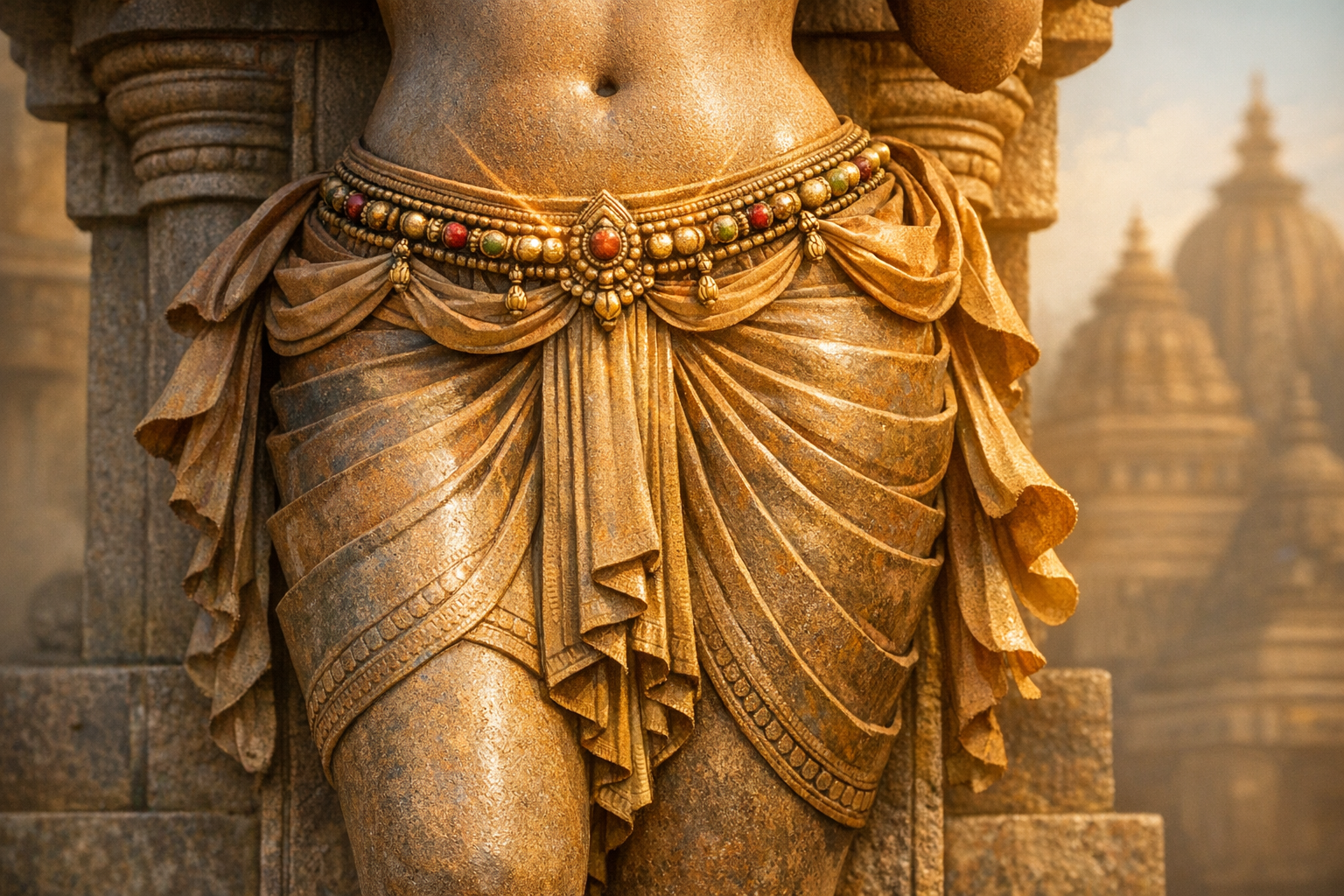
Antariya, the foundational lower garment in Hindu iconography, is a continuous unstitched drape wrapped around the hips and thighs and secured by the mekhala. Preceding later dhoti forms, the antariya establishes the canonical base layer of divine attire in temple sculpture, bronze icons, and sacred imagery across the Indian subcontinent. Its disciplined folds, tactile surfaces, and luminous contours anchor the body’s silhouette and choreograph the sense of movement and grace so central to Hindu sculptures.
In technical terms, the antariya is a length of cloth worn from the waist downward, often tucked between the legs (a kachcha variant) and held by a girdle. The mekhalarendered as a jeweled belt, a bead-strand, or a plain cordsecures the drape, while subsidiary waist elements such as the kayabandh (cloth sash) and the kati-sutra (waist-string) add structure and ornament. In paired ensembles, antariya is complemented by uttariya (upper drape) and stanapatta (breast-band) in female figures, composing a coherent sartorial language visible in sculptural programs from early historic to medieval periods.
The preference for unstitched cloth reflects ritual values shared across Hinduism, Buddhism, and Jainism, where purity, simplicity, and continuity are prized in sacred contexts. As a result, the antariya functions not merely as clothing but as a sign of ethical discipline and liturgical propriety. Its presence in figurative programs signals continuity with Vedic ideals while remaining adaptable to regional aesthetics and evolving workshop practices.
Reading the antariya in sculpture begins with a few diagnostic cues. A fan-shaped cascade of frontal pleats, a side or central knot, V-shaped fold rhythms across the thighs, and the distinctive kachcha tuck between the legs are among the clearest indicators. These features distinguish antariya from stitched skirts or trouser-like garments and serve as reliable markers for style, date, and regiona practical toolkit for students, museum-goers, and conservators decoding Hindu sculptures and bronze icons.
Early historic exemplars (Maurya–Śuṅga–Sātavāhana) foreground a succinct, often knee-length antariya tied with a mekhala. At Bharhut and Sanchi (2nd–1st century BCE), male figures display short wraps with neat frontal pleats, while female yakṣīs wear clinging textiles whose diaphanous quality is suggested by polished surfaces and incised hems. The famed Didarganj yakṣī, though noted for luminous polish, also illustrates the waist-girdle and lower drape as sculptural anchors for posture and poise.
Under Kushan and Mathura ateliers (1st–3rd century CE), the antariya becomes gauzier and more body-conforming, its transparency rendered through subtle contouring and calibrated polish. Concurrently, the Amaravati school in the eastern Deccan elaborates low-slung mekhala belts, longer falls, and intricate pleating. These developments amplify the garment’s kinetic rolepleats appear to flutter in stone, conveying the vitality of processions, dance, and ritual.
Gupta classicism (4th–6th century CE) codifies an authoritative antariya: generally longer, with a pronounced, fan-like frontal fall and elegantly tiered folds, all cinched by a refined mekhalaoften beaded or gem-set. This canonical ensemble, seen at Sarnath and elsewhere, symphonizes with the serene physiognomies and gentle tribhaṅga postures that define the period. Manuals referenced in atelier cultureincluding portions of the Vishnudharmottara Purana and allied śilpa traditionsaffirm the centrality of harmonious drapery to divine form, grace, and symbolic legibility.
From the early medieval into the Pallava–Chola horizon (7th–13th century CE), South Indian bronzes transform the antariya into a rhythmic device that articulates dance and devotion. In the Nataraja corpus, the forward-flaring pleat fan and fluttering sash-ends accentuate circular motion, while mekhala variantsjeweled plates, bead-ropes, and pendant clustersprovide scintillating counterpoints to the bronze’s soft, living sheen. Here antariya is inseparable from embodied energy, mapping the dancer’s axis and radiating shakti through draped geometry.
In Odisha’s sculptural programs and the Pāla–Sena ateliers of eastern India, antariya configurations emphasize weight, texture, and ornamental belts. Chevron-like pleat patterns, thick waist-girdles, and emphatic lower hems lend a tactile gravity to figures, complementing the robust physiognomies and elaborate jewelry suites prevalent in these regions. Such regional signatures, consistently observed, help distinguish eastern idioms from the more attenuated, undulating folds of the western or southern schools.
Both male and female divinities wear antariya, but gendered nuances are evident. Male deities and donors often adopt a kachcha variant for mobility, with pleats or a compact front knot articulating the thighs. Female deities and attendants favor longer, softer cascades, sometimes registering textile borders and patterning through incised lines. Together, antariya with uttariya and stanapatta yield a complete sartorial grammar that communicates status, decorum, and rasa without textual explanation.
Shared drape conventions span dharmic traditions. Bodhisattvas in Buddhist reliefs and śālabhañjikā-type attendants often wear antariya variants similar to those in Hindu iconography, while Śvetāmbara Jain images and attendant yakṣa–yakṣī figures adopt comparable lower drapes and mekhala arrangements. This cross-traditional consistency offers a unifying visual lexicon of sacred dress, underscoring the cultural continuum that links Hinduism, Buddhism, and Jainism in the subcontinent’s artistic heritage.
Symbolically, the antariya’s unstitched nature evokes ritual purity and ethical self-restraint, values integral to dharmic practice. The mekhala, encircling the waistthe body’s center of balanceoften reads as a metaphor for disciplined containment of energy, aligning with ideals of yama–niyama and the cultivation of sattva. Color and textile suggestions in polychromed sculptures or painted reliefs further refine meaning, with light or luminous tones conventionally associated with clarity, purity, and auspiciousness.
Materially, antariya in life was woven in cottons, silks, and exceptionally fine muslins; sculptors made these tactile differences legible through distinct surface strategies. Incised lines trace borders and pattern; polished planes imply translucency; crisp undercutting sharpens pleat edges; and stippled textures hint at thicker weaves. Jeweled mekhala are carved with granular beading or cabochon-like bosses, while cloth sashes undulate to project motion and softnesseach decision a crafted semiotic choice.
For dating and attribution, drapery analysis is highly instructive. Short, above-knee wraps and simple belts point to early historic idioms; clinging translucency and low-slung belts suggest Mathura–Amaravati innovations; extended lengths with highly ordered frontal fans are hallmarks of Gupta classicism; and the sculptural choreography of flared fronts and pendants commonly signals Chola bronze ateliers. Regional belts, pleat geometries, and hem treatmentswhen read together with physiognomy and ornamentstrengthen stylistic diagnosis.
Workshop canons from śilpa literature emphasize proportion (pramāṇa), pose, and drapery as interdependent. Texts preserved under titles such as Manasara, Mayamata, and allied śilpa-śāstras do not prescribe a single uniform garment but rather a principled approach to how cloth should stabilize, animate, and sanctify the divine body. In practice, sculptors balanced textual ideals with regional taste, available materials, and patronage preferences, yielding the rich plurality evident across India’s Cultural Heritage.
The antariya’s living legacy endures in contemporary dhoti, veshti, pancha, and mundu traditions, where unstitched lower drapes remain emblems of cultural continuity and sacred propriety. This continuity is not merely antiquarian; it sustains embodied knowledgehow cloth guides posture, how a knot organizes movement, how a belt centers breaththat viewers can intuit in temple sculpture and ritual today.
For many viewers, noticing the antariya becomes a key to unlocking a sculpture’s silent narrative: a tightening of the mekhala before dance, pleats gathering toward a forward step, or a relaxed fall that suggests repose. Such readings do not replace textual exegesis; they ground it in the visual logic that artisans entrusted to stone and bronze. In this way, antariya mediates between theology and touch, transforming abstract symbolism into a physically intelligible language.
In museum and conservation settings, attention to the lower garment helps verify authenticity, assess restoration, and reconstruct missing elements. Where frontal fans or side-knots are damaged, comparative drapery typologies can guide ethical infill; where surface polish has thinned, incised borders may still signal the original textile character. Properly read, the antariya is both evidence and meaning, a datum for scholarship and a vessel of sacred significance.
Taken together, form, grace, and symbolism converge in the antariya to articulate a distinctly South Asian vision of sanctified embodiment. From Bharhut to Sanchi, Mathura to Amaravati, Sarnath to Chola foundries, and Odisha to Pāla–Sena ateliers, its varied yet intelligible language fosters a shared dharmic visual culture. Recognizing this garment within Hindu sculptures illuminates deep continuities with Buddhist and Jain art and cultivates a unified appreciation for the subcontinent’s sacred traditions.
Inspired by this post on Hindu Blog.







