Aghora Shivaoften rendered as the Aghora murtiembodies a profound paradox at the heart of Hindu iconography and philosophy. The Sanskrit name itself, a-ghora, means “not terrible” or “non-fearsome,” asserting at the outset that what appears fearsome to the uninitiated is, in essence, a protective and compassionate force. In this form, Shiva is not the origin of dread but its dissolver; not the cause of darkness but the light that renders darkness transparent.
Within the Shaiva framework, Aghora is celebrated among the pañcabrahma (fivefold) revelations of ShivaSadyojāta, Vāmadeva, Aghora, Tatpuruṣa, and Īśāna. Aghora is typically correlated with the southward face and the function of saṁhāra (dissolution), a cosmic act that clears the ground for renewal. Rather than suggesting negation, dissolution here is transformative: the removal of ignorance (avidyā), fear (bhaya), and constriction (mala) that obscure innate consciousness.
Classical sources reinforce Aghora’s role as the remover of fear. The widely revered Aghora mantra“Om Aghorebhyo’ghorebhyo ghoraghoratarebhyah Sarvebhya sarva sarvebhyo namaste astu rudrarupebhyah”venerates Shiva across the spectrum from the non-terrible to what seems most terrible, culminating in salutations to all Rudra-forms. In temple liturgies inspired by the Āgamas and Tantras, this mantra commonly accompanies panchamukha-Śiva worship, nyāsa (ritual installation), and abhiṣekam (ritual bathing), articulating the theological truth that fear loses its foothold when subsumed into the Absolute.
Aghora’s place within the pañcabrahma is often taught through layered correspondencesdirections, elements, cosmic functions, and subtle processes. While regional and textual traditions vary, a widely transmitted schema aligns Aghora with the southern direction, the fire principle (agni), and the power of transformative dissolution (saṁhāra). This matrix underlines why Aghora imagery gravitates toward cremation-ground symbolism: what is impermanent returns to its source, and what is essential shines unafraid.
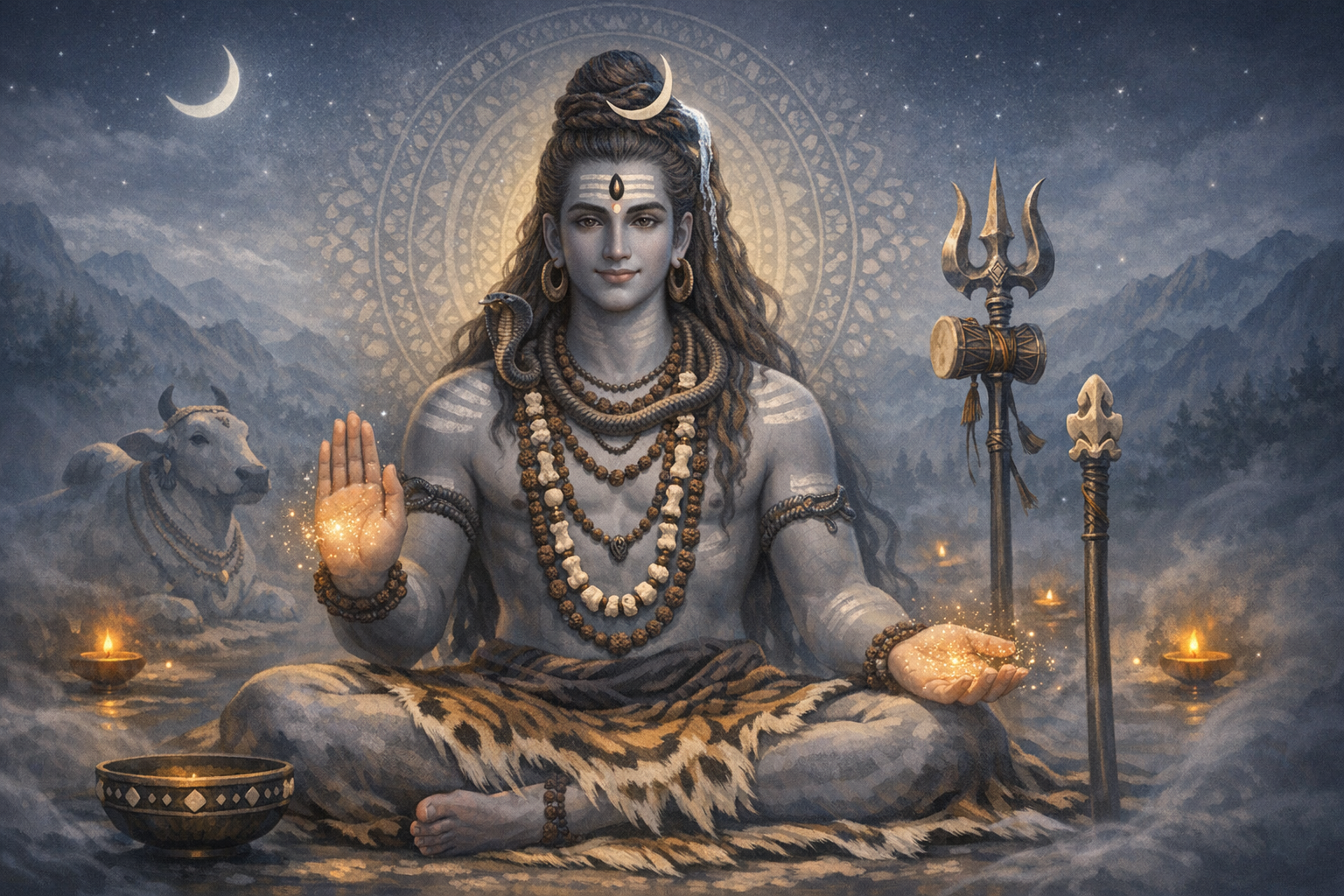
In sculptural and painted iconography, Aghora presents hallmark Shaiva features that both scholars and devotees recognize at once. The body is ash-smeared (vibhūti), signaling the insight that all forms end in ash and that this realization can be a source of abiding freedom. The third eye embodies supra-rational awareness, while matted locks (jaṭā) crowned by the crescent moon and the descending Gaṅgā affirm mastery over time and the purifying stream of grace.
Weaponry and emblems reinforce Aghora’s non-terrible protection. The triśūla (trident) asserts sovereignty over the three guṇas and the three temporal divisions; the ḍamaru (hourglass drum) intimates creation’s pulse and dissolution’s quiet; the khaṭvāṅga (skull-topped staff) and kapāla (skull bowl) symbolize a fearless embrace of finitude and a wisdom that digests even death’s finality. Gestures frequently include abhayamudrā (gesture of fearlessness) and varadamudrā (boon-bestowing assurance), succinctly expressing that Aghora is, above all, the antidote to dread.
Ornamentation carries philosophical intent. Serpents as armlets and garlands denote awakened kuṇḍalinī and sovereign control over primal energies; the tiger-skin drape represents mastery over instinct; and the skull-garland (muṇḍamālā) dramatizes the transience of identities that consciousness wears and sheds. Such elements do not glorify the macabre; rather, they elevate mortal limits into contemplative gateways.
Setting is iconographically meaningful. Aghora is often contextualized by cremation-ground motifsfuneral pyres, jackals, or a darkened skyyet typically accompanied by Nandi, the bull, who conveys steadfast devotion, dharma, and the positive strength to face life’s thresholds. The assemblage teaches that steadfast devotion stabilizes the heart while insight turns endings into portals.
Distinguishing Aghora from related forms clarifies practice and meaning. Aghora is a benign, grace-laden pañcabrahma aspect, while Bhairava (including Kālabhairava) is generally presented in more explicitly guardian and kṣetra-pāla (protector-of-the-sacred-precinct) roles, often with the dog as vahana. Contemporary discourse also confuses Aghora with the Aghori ascetic path; yet Aghora, as a theological and ritual category, does not require cremation-ground praxis. Household worship, temple rites, and contemplative study are all authentic avenues to Aghora’s fear-dissolving presence.
Shilpaśāstra traditions guide the iconometry of Aghora murtis, with proportions (tāla), stance (āsana), and hand-implement combinations codified to convey metaphysical truths through visual ratios. While regional schools differChola bronzes, Central Indian stone works, Himalayan thangkasthe shared aim is soteriological: correct form aids correct seeing (darśana), and correct seeing aids liberation-oriented living.
Ritually, Aghora thrives in both domestic and temple contexts. Abhiṣekam with pañcāmṛta, water, and bilva leaves is accompanied by mantras from the pañcabrahma corpus. Vibhūti is applied to the murti and the devotee’s forehead, reminding practitioners to hold lightly to perishable identities. Many communities invoke Aghora during Rātri-kāla segments of Mahāśivarātri, where darkness becomes a teacher and vigilance a lamp.
In nyāsa practices circulated through Śaiva Āgamas, the pañcabrahma mantras are installed across the body as sanctified loci of Shiva’s functions. Aghora’s seed is placed in specific locations according to lineage, but the shared intention is unambiguous: to internalize the fear-dissolving fire so that the practitioner encounters challenges from a center of equanimity. The embodied ritual thus mirrors the icon: both are pedagogies of fearlessness.
Philosophically, Aghora expresses a key insight: what seems “terrible” is rendered non-terrible when recognized as inseparable from consciousness. Avidyā amplifies fear by projecting separation and finality; jñāna softens fear by revealing unity and continuity. Aghora stands for that turn from contraction to spaciousness. Hence the frequent association of Aghora with anugraha (grace) in lived practicedissolution is not an annihilation but a licensed letting-go that makes grace tangible.
Yogically, Aghora imagery functions as subtle pedagogy. Vibhūti is not mere ash but a teaching: the ego’s residues can be reduced to trace if offered to the inner fire of viveka (discernment). The khaṭvāṅga dramatizes a life lived without denial, the kapāla a mind spacious enough to hold difficulty without panic. Practitioners routinely report an inner shiftfrom apprehension to poisewhen meditating on these emblems with rhythmic breath awareness and mantra.
Psychologically, Aghora anticipates what modern depth approaches call “shadow integration.” The cremation-ground signals a willingness to witness endings and grieve without collapse, to metabolize fear by contact, and to discover that what is faced directly loses its tyrannical outline. Communities from Varanasi to Kathmandu to Tamil Naduspanning rural shrines and metropolitan templesdescribe Aghora darśana as an encounter after which ordinary anxieties feel newly negotiable.
Aghora’s resonance extends across the dharmic family. In Vajrayāna Buddhism, Mahākāla iconography integrates charnel-ground motifs with compassionate protectorshipdemonstrating how fierce forms can embody ultimate kindness. Jain sculptural language, while different in tone, shares the centrality of abhayamudrā (fearlessness) as a civilizational ideal. Sikh tradition enshrines Nirbhau, Nirvair (without fear, without enmity), echoing Aghora’s conquest of inner dread. These convergences illuminate a shared dharmic ethic: fear is not a foundation for wisdom; courage wedded to compassion is.
Such interconnections invite a unifying hermeneutic. Aghora’s “non-terrible” vow honors spiritual diversity, encouraging seekers in Hinduism, Buddhism, Jainism, and Sikhism to meet intensity with steadiness and to regard the so-called fearful as an invitation to insight. The cremation-ground and the city street, the meditation hall and the home altar, all become viable sites where fear gives way to clarity.
In contemporary life, Aghora’s teaching addresses burnout, uncertainty, and grief with unusual precision. The triśūla may be read as a commitment to balance cognition, emotion, and action; the ḍamaru as a reminder to include both work and rest in the day’s cadence; vibhūti as a cue to declutter repeatedly. Practitioners who weave these symbols into daily routinesshort mantra periods, conscious exhalation practices, and mindful bilva-offeringsoften report heightened resilience.
Responsible engagement with Aghora is straightforward and dignified. A simple altar with a Śiva-linga or Aghora image, fresh water, a lamp, and bilva leaves suffices. One may softly recite the Aghora mantra or the Rudra Gāyatrī, maintain a moment of silence for those who have passed (honoring the cremation-ground teaching), and close with abhayamudrā visualized at the heart. Temple participationespecially during Mahāśivarātricomplements home practice and connects the individual to community rhythms.
Clarifications frequently sought include the relationship between Aghora and fearsome aesthetics. Iconography is a language: the same forms that startle the senses are precisely those that unstartle the heart when understood. Aghora does not cultivate dread; Aghora cures it. Nor is contemplation of Aghora limited to monastics or advanced practitioners; the form invites all seekers to discover steadiness in the presence of life’s thresholds.
Scholarly perspectives point to the coherence of Aghora across textual, ritual, and visual domains. The Śaiva Āgamas and Purāṇas locate the pañcabrahma mantras at the core of worship; temple design and sculpture code these mantras into stone and bronze; ritual sequences like abhiṣekam and nyāsa render doctrine experiential. When seen together, theology, architecture, and practice harmonize into a single, fear-dissolving transmission.
For students of iconography, a synthesis is helpful. Aghora’s southward orientation (in pañcamukha contexts), dark or smoky palette, cremation-ground setting, triśūla–ḍamaru–khaṭvāṅga–kapāla ensemble, and abhayamudrā–varadamudrā pairing together narrate the journey from constriction to courage. Each attribute is a glyph; the murti is a sentence; the experience is a whole teaching.
Ultimately, Aghora Shiva articulates a civilizational promise: nothing that appears terrible need remain so when held in wisdom. Fear is educated by truth, and endings are rendered into beginnings by grace. In honoring Aghora across Hindu temples and householdsand in recognizing the shared dharmic valorization of fearlessnesscommunities nurture a culture where inner steadiness becomes the common heart of diverse paths.
Inspired by this post on Hindu Blog.