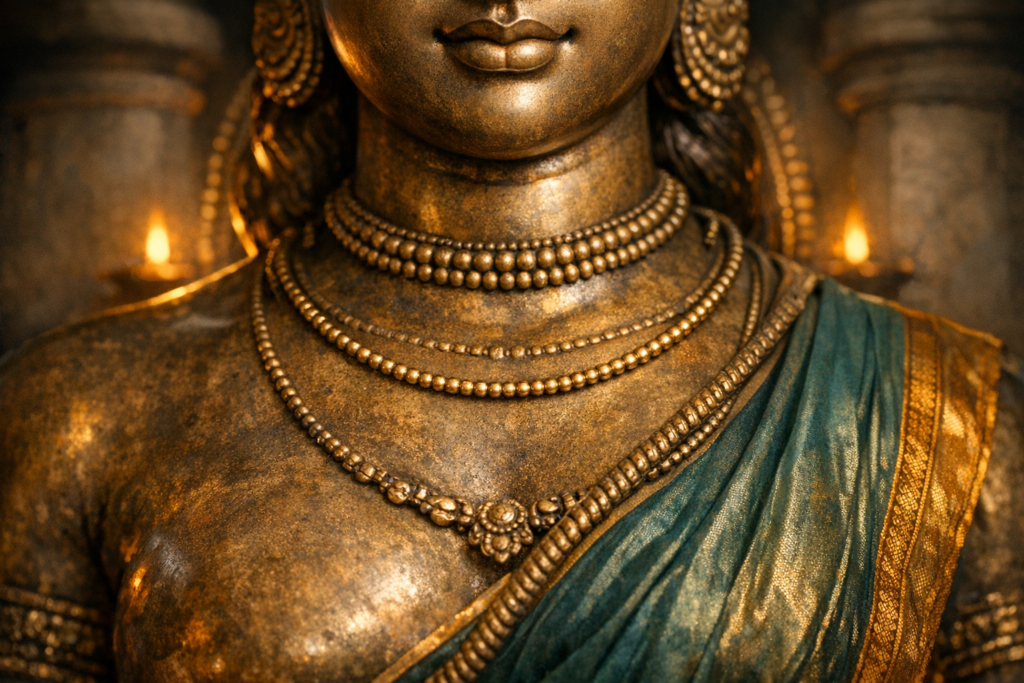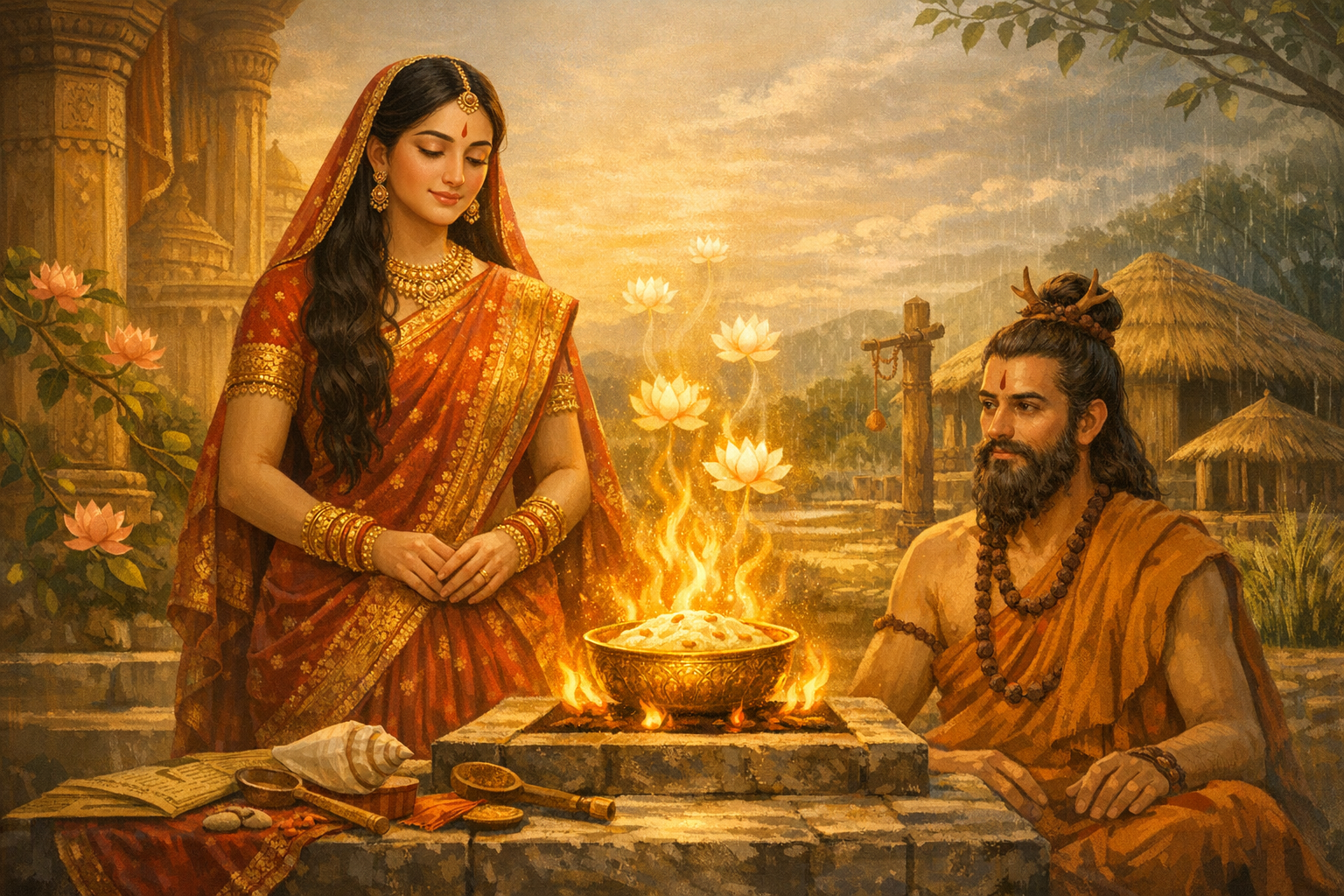
Śāntādevī (often known simply as Śāntā) rarely occupies center stage in popular retellings of the Ramayana, yet the epic’s lineage and ritual architecture pivot on her life. In widely accepted traditional accounts, she is remembered as the daughter of King Daśaratha of Ayodhyā, and her story forges the vital link between the royal house of Kosala, the ascetic power of the sage Ṛṣyaśṛṅga, and the eventual birth of Sri Rama and his brothers. By bringing into view this overlooked princess, the Ramayana’s familial, ritual, and political dynamics become strikingly coherent.
Valmiki’s Ramayana (Bala Kanda) foregrounds the episode of Ṛṣyaśṛṅga and the kingdom of Aṅga under King Romapāda (also styled Lomapāda), introducing Śāntā as the princess of Aṅga. Later Purāṇic and regional recensions, however, preserve a complementary and widely circulated tradition in which Śāntā is Daśaratha’s biological child, ceremonially given in adoption (dattaka) to Romapāda. Rather than a contradiction, this variation exemplifies the Ramayana’s pan-Indic textual ecology, where genealogical memory, ritual function, and political alliance are harmonized across recensions to illuminate different facets of dharma.
Within the political grammar of early dharmic polities, adoption could serve both familial continuity and inter-kingdom amity. By giving Śāntā in adoption to Romapāda, Daśaratha consolidated bonds between Kosala (Ayodhyā) and Aṅga (in the eastern Gangetic plains). Dharmashastra literature recognizes adoption (dattaka) as a legitimate institution for preserving lineage, fulfilling duties, and safeguarding the realm, and Śāntā’s placement in Aṅga exemplifies rajadharma understood as compassionate stewardship extending beyond one’s own borders.
The kingdom of Aṅga is cast as undergoing ritual crisis, marked by drought and distress among subjects. In this setting, Ṛṣyaśṛṅga—the forest-reared son of the sage Vibhāṇḍaka, famed for austere tapas—becomes the hoped-for restorer of balance. Romapāda’s court orchestrates the arrival of the secluded ascetic to Aṅga, and his presence and rites are said to alleviate the drought. In many tellings, Śāntā’s marriage to Ṛṣyaśṛṅga both symbolizes and secures this restoration, intertwining royal duty with brahminical ritual expertise.
This matrimonial alliance becomes the hinge upon which Ayodhyā’s own destiny turns. Invited by Daśaratha, Ṛṣyaśṛṅga presides over the royal sacrifices—most notably the Putrakāmeṣṭi (Putrakameshti Yajna), the progeny-granting iṣṭi within the śrauta framework, often narrated alongside the Aśvamedha. From the sacrificial fire arises the divine pāyasa that Daśaratha distributes among his queens—Kausalyā, Kaikeyī, and Sumitrā—leading to the births of Sri Rama, Bharata, Lakṣmaṇa, and Śatrughna. Without Śāntā’s alliance with Ṛṣyaśṛṅga, this ritual chain—and thus the epic’s central genealogy—would not unfold in the manner preserved by tradition.
From a technical perspective, the Putrakāmeṣṭi occupies a defined niche in Vedic ritual science. It is not a generic prayer for heirs but a purpose-specific iṣṭi (kāmyayajña) conducted with precise offerings, mantras, officiants, and temporal sequencing. Ṛṣyaśṛṅga’s role as a qualified ṛtvik aligns the rite with the śrauta tradition of the Yajurveda, while its outcome—the begetting of sons—expresses a quintessential aim of statecraft under dharma: the stable continuity of rajya, ensuring both social order and the protection of subjects.
The philology of this narrative cluster offers additional insight. Sources alternate between Śāntā and Śāntādevī; Romapāda and Lomapāda; Ṛṣyaśṛṅga and Ṛiṣyaśṛṅga. Aṅga’s political geography points to the lower Gangetic region (portions of present-day Bihar), while Ayodhyā anchors the narrative in Kosala. These shifts in orthography and locale reflect the Ramayana’s diffusion across linguistic zones and ritual communities, where transliteration conventions and local memory shape emphasis without erasing core motifs.
Reception history across regional Ramayanas amplifies Śāntā’s profile. Tamil, Bengali, and later Sanskritic retellings—such as Kamban’s Iramavataram and Purāṇic compilations—often elaborate her parentage, education, and role in preparing Ṛṣyaśṛṅga for household life beyond the hermitage. Some explicitly name Kausalyā as Śāntā’s mother; others vary in emphasis yet converge on her marriage to Ṛṣyaśṛṅga and its catalytic effect on Ayodhyā’s fortunes. This plurality of voices, far from diluting authority, illustrates the compositional richness characteristic of itihāsa.
Śāntā’s story also clarifies a frequently overlooked theme: the quiet, decisive statecraft of women in the Ramayana. While epic memory rightly celebrates queens such as Kausalyā, Kaikeyī, and Sumitrā, Śāntā embodies a subtler diplomacy—adoption across courts, marriage that bridges āśramas, and the socialization of a great ascetic into reciprocal duties. Contemporary families navigating adoption or inter-household alliances may recognize in her arc a resonant pattern, where care, consent, and community welfare converge in the service of a larger good.
Viewed through a dharmic-unity lens, Śāntā’s narrative foregrounds values cherished across Hindu, Buddhist, Jain, and Sikh traditions: seva (service), tyāga (self-giving), compassion for suffering communities, and the harmonization of renunciation with household responsibility. The convergence of kṣātra (royal duty) and brāhma (ritual learning) in her marriage affirms a civilizational ideal: diverse paths cooperating for loka-kalyāṇa—the well-being of all—without erasing their distinct disciplines.
A historically sensitive reading also avoids flattening differences between texts. In the Bala Kanda of the Valmiki Ramayana, emphasis rests on Ṛṣyaśṛṅga’s ritual role and the obligations of Romapāda and Daśaratha, whereas later traditions integrate the adoption motif to clarify why the princess of Aṅga is intimately tied to Ayodhyā’s lineage. Both strands agree on what matters most: Śāntā’s presence renders possible the sacrificial choreography that begets Sri Rama and secures the epic’s genealogical arc.
Genealogically, then, Śāntā functions as the epic’s unseen hinge—an axial figure guiding the transition from a king’s anxiety over succession to the joyous advent of heirs. Ritually, she is the conduit by which the austerities of Ṛṣyaśṛṅga enter royal space. Politically, she embodies inter-kingdom solidarity enacted under dharma. Philosophically, her very name—Śāntā, “peaceful”—signals the means by which order and abundance return to realms afflicted by scarcity.
Re-centering Śāntā in Ramayana studies deepens understanding of the epic’s design. It highlights the synergy of personal virtue and public duty, clarifies the logic of Bala Kanda’s sequencing, and invites readers to honor the connective labor—often performed by women—that sustains families and polities alike. In affirming her place, the Ramayana’s inclusive spirit becomes clearer: diverse actors, vows, and vocations harmonize to manifest dharma and to ensure unity in diversity.
Taken together, the textual testimony, ritual logic, political context, and civilizational values compose a coherent portrait of Śāntādevī. Though briefly mentioned in many recitations, her role remains indispensable to the lineage of Sri Rama and to the sacred economy of sacrifice that animates the epic. Remembering her restores balance to the narrative and offers a shared, dharmic point of inspiration for communities seeking wisdom, continuity, and harmony.
Inspired by this post on Hindu Blog.