
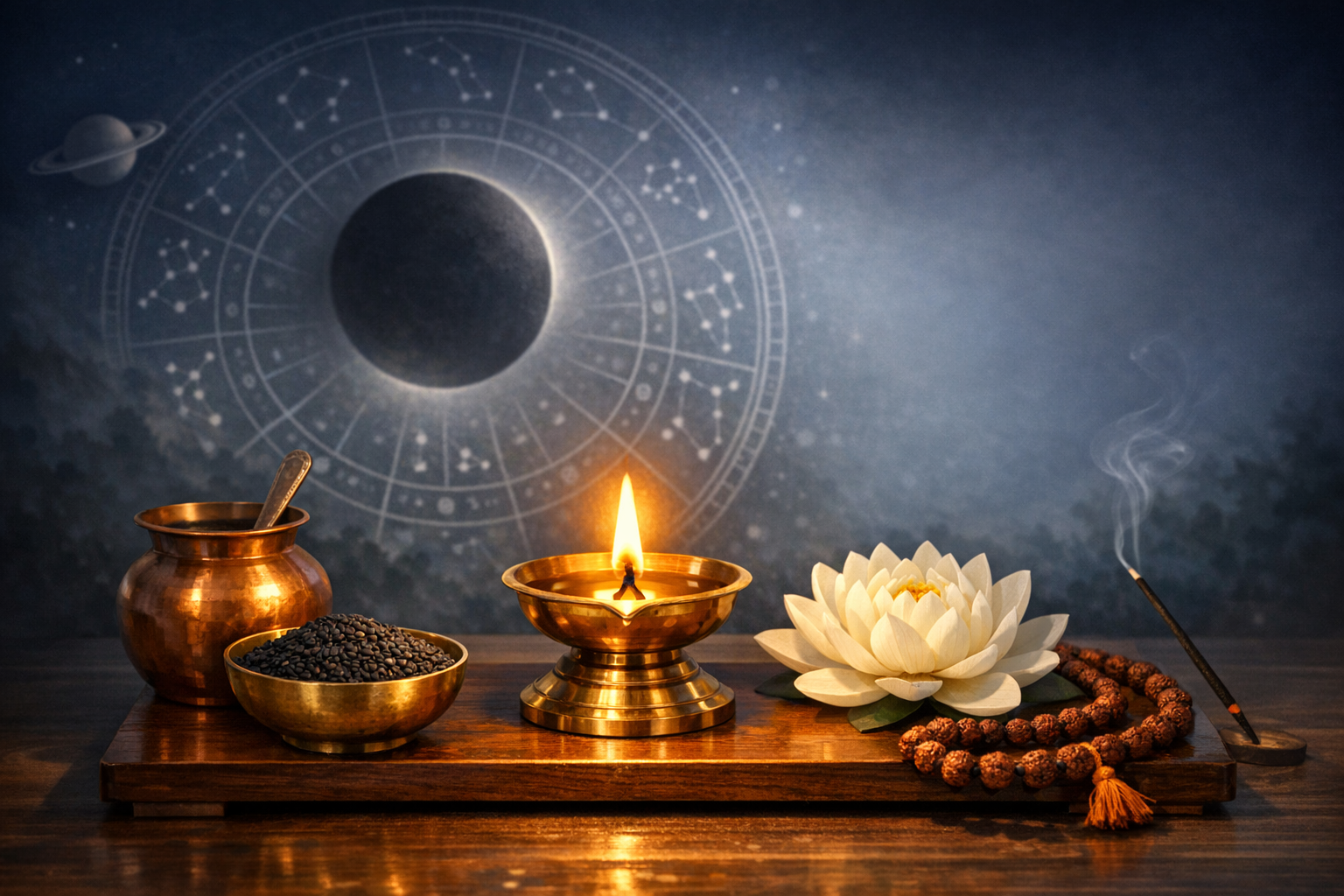
On Saturday, May 16, 2026, the Hindu Calendar (Panchang) records Krishna Paksha Chaturdashi (the fourteenth lunar day of the dark fortnight) until 03:51 AM IST. From that moment, Amavasya (no-moon day) commences and continues until 01:37 AM IST on May 17, 2026. These timings are provided in Indian Standard Time and, in practice, are broadly applicable across India for standard observances. The date is thus dominated by Amavasya, a period traditionally set aside for quietude, remembrance, and inner renewal.
Amavasya is widely regarded as a powerful juncture for reflective practices—particularly pitṛ-kārya (ancestral observances), meditation, and satvika charity. Because a significant stretch of Amavasya falls within the daylight hours of May 16, many households will find the conditions propitious for Darsha Shraddha, tarpana with tila (sesame), and calm sadhana at home or in temples, aligning spiritual intention with the lunar stillness.
For practical planning, Krishna Paksha Chaturdashi ends at 03:51 AM IST on May 16. Thereafter, Amavasya spans the day, culminating at 01:37 AM IST on May 17. Traditional guidance prioritizes performing Amavasya-specific rites when Amavasya prevails during the daylight window; hence, those planning pitru-tarpana, japa, or quiet puja can schedule these after sunrise on May 16, while the Amavasya tithi is active.
In month reckoning, most regional almanacs will align this date with Vaishakh Amavasya (Amanta system), while Purnimanta listings treat it as the Amavasya concluding Vaishakh. Either way, the day stands at a threshold: the lunar cycle is resetting, inviting resolution of the past and clarity for the coming Śukla Paksha (bright fortnight).
Across dharmic traditions, the no-moon juncture carries a shared spirit of introspection and compassion. Hindu households may emphasize pitru-smarana, daan, and vrata. Many Buddhist communities worldwide recognize new-moon Uposatha for heightened mindfulness. In Jain practice, Amavasya is often embraced for pratikraman, fasting, and vows of ahiṃsa. Sikh families—while following the Nanakshahi solar framework—may still observe familial customs around new-moon quietude. This convergence around restraint, service, and remembrance embodies unity in spiritual diversity.
The weekday overlay matters: Saturday (governed by Shani) on an Amavasya often directs attention to discipline, patience, and corrective action. Traditional observances on such a day frequently include lighting a sesame oil lamp, offering heartfelt prayers for resilience, and undertaking acts of steadiness—such as assisting elders or supporting those in need. Many households report that grounding activities—cleaning one’s puja space, reciting mantras with measured breath, and maintaining a calm routine—tangibly settle the mind on a Saturday Amavasya.
Shubh Muhurat selection for new initiatives on Amavasya tends to be conservative in many lineages; yet families still schedule practical tasks using established Panchang frameworks. Abhijit Muhurat (the midday window) is historically cited for general success-oriented undertakings, though Amavasya’s contemplative tenor leads many to reserve major auspicious beginnings for the waxing fortnight. For time-sensitive activities on May 16, practitioners can consult Choghadiya (Amrit, Shubh, Labh are often preferred) and avoid the inauspicious segments. As always, local sunrise and day-length determine exact starts and ends of these windows.
Rahu Kalam, Yamaganda, and Gulika Kalam are traditionally avoided for auspicious undertakings. The canonical method divides the daylight span (sunrise to sunset) into eight equal parts; each weekday maps these doshic intervals to specific parts. On Saturdays, Rahu Kalam falls in the second part of the day after sunrise. Because these intervals shift with local sunrise/sunset, exact times should be computed for one’s city using the eight-part division rather than relying on a fixed clock value.
Nakshatra and Rashi details, which further nuance the day’s quality, vary with the Moon’s position and the observer’s location. While this Panchang note centers on the confirmed Tithi span, practitioners can enhance precision by checking the prevailing Nakshatra, Moon’s Rashi, and the Yoga–Karana set for their locality. These factors refine choices such as mantra selection (e.g., aligning with the presiding Nakshatra deity), devotional focus, and the tone of meditative practice.
A balanced home-ritual blueprint for Amavasya typically includes: preparing a clean, quiet space; simple pranayama to settle the breath; dhyana on Ganesha for obstacle-clearing; a sesame oil lamp; mantra japa suited to one’s Ishta Devata; pitru-tarpana with tila and pure water (for those who customarily perform it); and satvika daan (food, grains, or clothing) directed to the vulnerable, reflecting compassion without ostentation. Many families conclude with collective silence or shared recitation, nurturing harmony within the household.
Well-being practices amplify the day’s promise of clarity. Gentle pranayama (such as nadi shodhana), quiet reading from the Bhagavad-Gita or Upanishads, and mindful meals reinforce sattva. On a Saturday Amavasya, simple restraints—reduced screen time, moderated speech, and uncluttered schedules—often make the mind more receptive to introspective insight. These habits resonate with the shared dharmic ethic of self-mastery and non-harm.
From an astronomical and calendrical perspective, a Tithi is defined by the angular distance between the Moon and the Sun. Chaturdashi ends as this elongation approaches conjunction, after which Amavasya (near-conjunction) prevails until the angular threshold for Pratipat (the first Tithi of the waxing phase) is crossed. Because the Moon’s motion is variable, Tithis do not map to fixed clock durations and can begin or end at any time of day or night—explaining why May 16, 2026 sees Chaturdashi end at 03:51 AM IST and Amavasya continue well into the following night.
For those fasting, a satvika approach—warm water on waking, light and fresh preparations through the day, and early supper—maintains steadiness. If health or age suggests caution, partial fasting or simple dietary moderation is entirely appropriate. The shared dharmic principle is intent (sankalpa) over extremity: clarity of purpose outweighs the rigor of austerity.
In professional or travel planning, Choghadiya and Panchang filters help sequence tasks. Even when major inaugurations are deferred, routine duties, study, and quiet strategic work benefit from Amavasya’s focus. Many teams find value in using the day for review, documentation, and system clean-up—activities harmonizing with the lunar reset and Shani’s call for orderliness.
In sum, Saturday, May 16, 2026 offers a full-bodied Amavasya suited to remembrance, restraint, and renewal. The confirmed Tithi window—Chaturdashi until 03:51 AM IST, followed by Amavasya until 01:37 AM IST on May 17—supports pitru-kārya, meditative practice, and measured action. Approached with unity of purpose and respect for diverse dharmic lineages, the day becomes a shared occasion to cultivate serenity, gratitude, and compassionate service.
Inspired by this post on Hindu Blog.







Leave a Reply
You must be logged in to post a comment.