Srila Prabhupada once provided a rare, direct lesson in sacred art when he asked Yamuna Devi to prepare a set of Radha‑Krishna Deities destined for installation in Hamburg during ISKCON’s early European expansion. Acknowledging her hesitation about not being an artist, he personally demonstrated the procedure, seating the Deities on a small desk and painting while imparting step‑by‑step instruction. The episode, preserved in Yamuna Devi’s recollection, has since become an instructive case study in Gaudiya Vaishnavism on how devotional aesthetics, technique, and theology converge in service (seva) and in the Hare Krishna Movement’s approach to Hindu iconography.
He identified the process as “Anga-Raga”—with “Anga” denoting “body” and “Raga” signifying “painting of.” In temple practice, Anga-Raga belongs to the broader alankara tradition, in which the murti is adorned in ways that honor the Deity’s transcendental personality while conforming to sampradaya standards of iconography and rasa. Properly understood, Anga-Raga is not cosmetic embellishment but a liturgical act of reverence, performed to facilitate darshan and deepen bhakti.
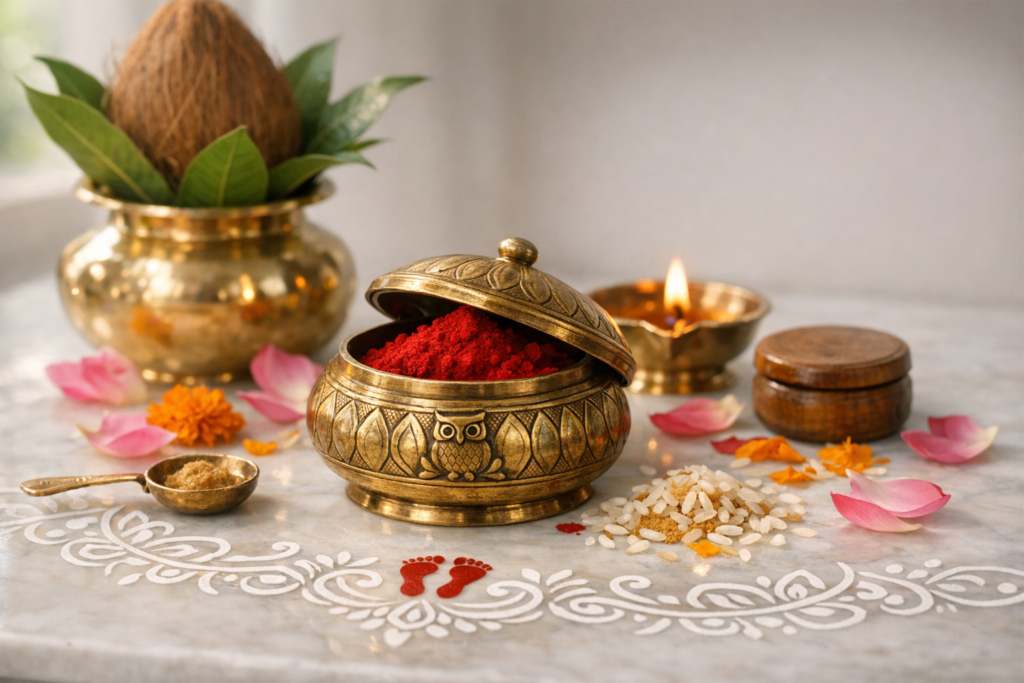
In this lesson, Srila Prabhupada requested a focused palette of black, white, and red. Within Vaishnava visual language, these hues carry layered meanings and practical purposes: black enables articulation of Krishna’s shyama tonality and fine features; white refines highlights, the whites of the eyes, and auspicious markings; red adds warmth and auspicious vitality to lips, palms, and soles traditionally associated with shringara and mangala. The restricted palette also disciplines the artist, foregrounding form, proportion, and expression over excess color.
Contemporaneous notes indicate that, as the work progressed, the Deities’ lovely forms appeared to manifest progressively through the painting. That devotional perception aligns with a key principle of Hindu iconography: form (rupa) is an instrument for apprehending presence (sannidhya). When executed under guru‑guidance, each measured stroke becomes both technique and sadhana, orienting attention toward seva‑bhava rather than artistic self‑assertion.
Srila Prabhupada also addressed hand gesture, observing that Srimati Radharani’s fingers may be shown in a “mudra”—in this instance with forefinger and thumb together. He frequently employed the same gesture while emphasizing philosophical points, illustrating how a mudra can function as both communicative sign and contemplative prompt. In iconographic analysis, such micro‑gestures shape narrative, establish bhava, and guide the devotee’s gaze to a specific locus of meaning.
The semiotics of mudra is a shared civilizational resource across dharmic traditions. Buddhist images employ, for example, Dharmachakra, Bhumisparsha, and Abhaya to encode teaching, realization, and refuge; Jain Tirthankara iconography emphasizes dhyana and kayotsarga to express equipoise and renunciation; Sikh sacred art, while eschewing deity images, communicates devotion and ethics through potent symbols such as the Khanda and narrative painting traditions. Recognizing this common visual grammar fosters mutual respect and unity among Hindu, Buddhist, Jain, and Sikh communities.
From a technical standpoint, Anga-Raga requires stable, non‑toxic media compatible with the murti’s substrate (stone, wood, metal, resin, or marble). Traditional workshops have used lampblack, conch‑derived whites, and plant or mineral reds; contemporary practice may adopt archival‑quality pigments where appropriate. Key conservational principles include surface preparation, reversibility where feasible, minimal intervention, and deference to the temple’s shilpi, pujaris, and sampradaya guidelines.
Radha‑Krishna iconography follows canons that safeguard theological accuracy: Krishna’s shyama complexion and peacock‑feathered crown suggest sweetness (madhurya) and play; Sri Radha’s posture, glance, and wrist articulation convey grace and compassionate authority. Proportions, ocular lines, and subtle facial modeling must avoid caricature, since even millimetric deviations can shift perceived rasa. Accordingly, Anga-Raga prioritizes clarity, serenity, and inner radiance over dramatic stylization.
The Hamburg commission exemplifies a pedagogical constant in bhakti traditions: the acharya teaches by doing. By modeling Anga-Raga personally, Srila Prabhupada integrated doctrine, method, and humility, showing that the sanctity of service outweighs artistic pedigree. The instruction also underscored accountability: when the Deities travel for installation, visual integrity must remain consistent with parampara expectations, ensuring that darshan in a new locale communicates the same siddhanta.
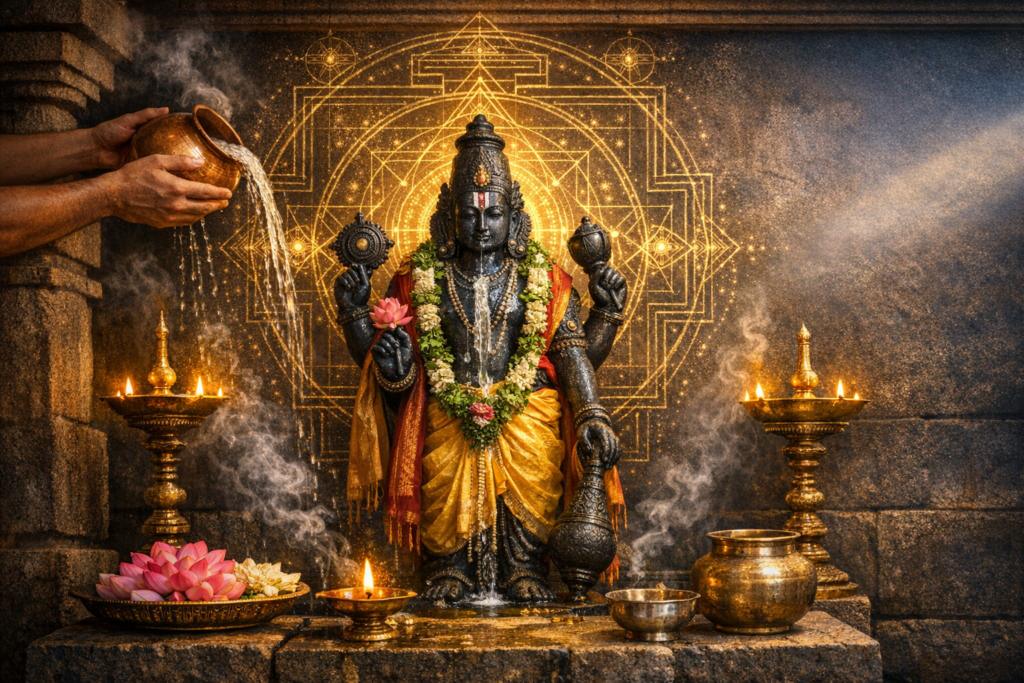
For communities caring for Deities today, several practice guidelines follow from this episode: consult qualified gurus and shilpis before intervention; document each step and material; favor gentle cleaning and routine maintenance over drastic repainting; and align aesthetic choices with the temple’s liturgical calendar, ornaments, and garments, so that Anga-Raga harmonizes with abhishekam, alankara, and daily arati.
Scholars of Hindu Art and Culture may also read the event as a compact treatise on applied aesthetics: a triadic palette functions as a controlled experiment in value, contrast, and focal hierarchy; mudra serves as a semantic key linking gesture to doctrine; and the guru’s presence ensures that technique is tethered to telos—seva and remembrance. Comparative study with Pancharatra and Agama prescriptions, as well as regional Rath, Pattachitra, and Tanjore traditions, can further illuminate how Anga-Raga negotiates local style with universal Vaishnava tenets.
In sum, the Hamburg Anga-Raga lesson demonstrates how sacred painting operates as embodied theology—where color, line, and gesture become instruments of devotion. Appreciated in this light, the practice strengthens cultural heritage, deepens spirituality, and contributes to a shared dharmic vocabulary that invites Hindus, Buddhists, Jains, and Sikhs to recognize convergences in art, ethics, and contemplative intent.
Inspired by this post on Dandavats.