Devantaka’s defeat stands as one of the most striking episodes in the Yuddha Kanda of the Ramayana, a turning point where the disciplined valor of Hanuman unseats a formidable pillar of Lanka’s war machine. Framed within the larger moral architecture of the epicdharma confronting adharmathe encounter resonates beyond battlefield spectacle, revealing how clarity of purpose, self-mastery, and righteous courage overcome raw ferocity and militarized pride.
Across classical and regional Ramayana traditions, Devantaka is widely identified as a rakshasa prince of Lanka and frequently described as a son of Ravana. Many lists specify Dhanyamalini as his mother. Some retellings add that Dhanyamalini was associated with the household of Mandodari; others treat Dhanyamalini as another consort of Ravana. Grouped in several sources alongside Narantaka, Trisira, and Mahodara, Devantaka is consistently portrayed as part of the elite cohort entrusted with shock-assault dutiesan ensemble meant to break the Vanara lines and restore Lankan initiative at a critical phase of the war.
The very name “Devantaka” (often glossed as “ender of devas”) encodes a grim martial aspiration: to terrorize the forces standing on the side of cosmic order. The irony is deliberate and potent. In the climactic exchange, Devantakarenowned for his rakshasa mightis felled not by complicated stratagems but by Hanuman’s single, thunderous blow, aligning poetic justice with narrative momentum.
The scene is set after a relentless sequence of engagements in the Lanka War. The Vanara army, commanded by Sugriva and guided by Sri Rama and Lakshmana, had already absorbed and answered successive waves of rakshasa offensives. In this tense equilibrium, Ravana dispatches a strike force drawn from his most trusted warriors. Devantaka, alongside Narantaka, Trisira, and Mahodara, emerges to shatter morale and push the Vanaras back to the shoreline. The charge is described in many recensions as fierce, fast, and multi-prongedprecisely calibrated to overwhelm the Vanaras’ distributed command.
Devantaka’s battlefield profile draws from the rakshasa idiom of warfare in the epic. His combat repertoire includes brute-force grappling, rapid chariot or mounted maneuver (depending on the recension), and violent strikes with club or mace. The rakshasa school he represents emphasizes shock, surprise, and terrorharrying opponents with speed, launching concentrated thrusts at perceived weak spots, and relying on bodily strength amplified by occult prowess. In this frame, Devantaka is not a lone duelist but a critical component in a synchronized assault.
Hanuman answers this assault in a manner consistent with his established epic persona: energy anchored in restraint, strength governed by purpose, and speed tactically modulated by situational awareness. Where Devantaka embodies the aggression of command, Hanuman personifies the stability of service (seva) and devotion (bhakti) to Sri Ramaa psychological and ethical orientation that the Ramayana persistently elevates above muscle and menace.
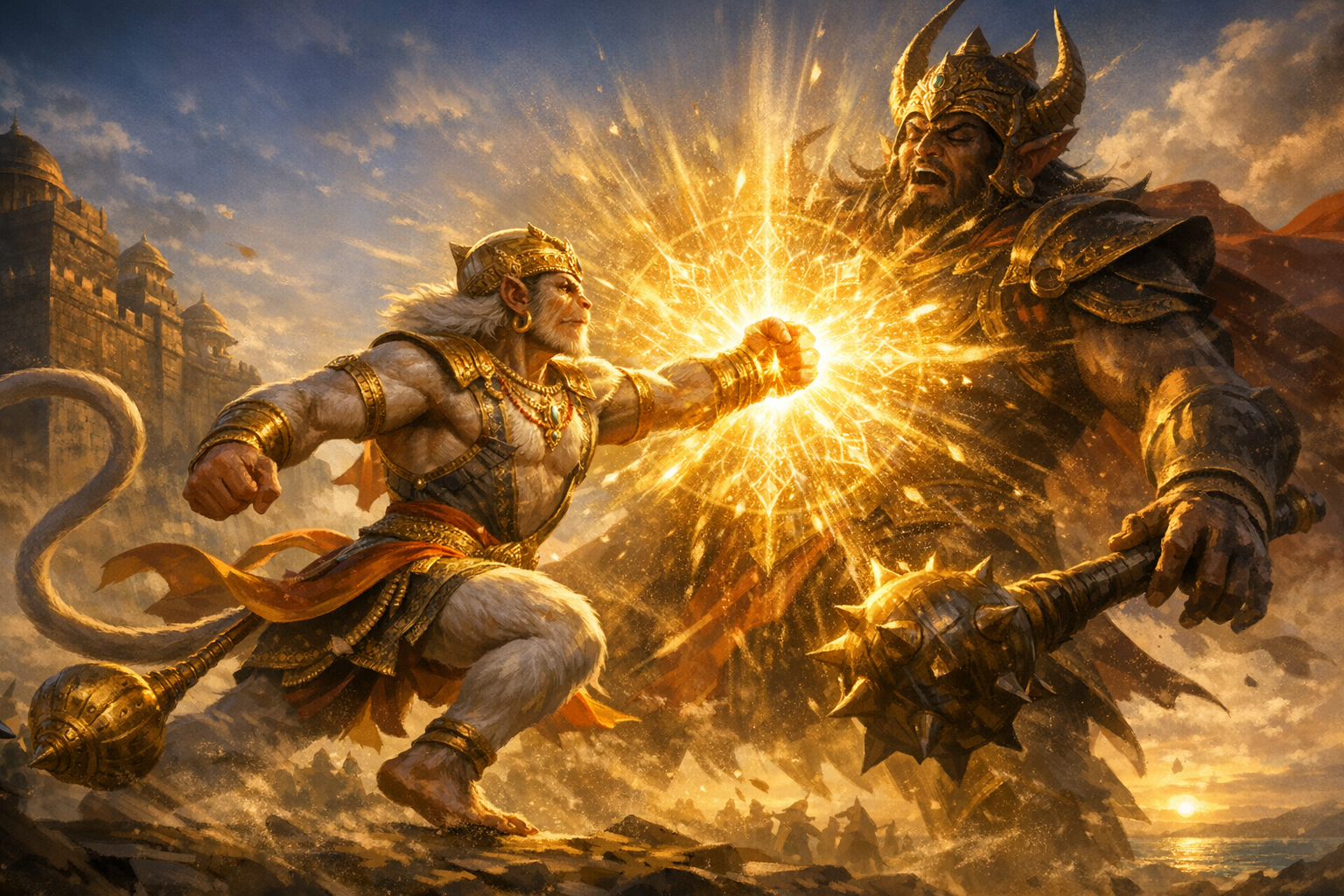
The duel’s pivot arrives quickly. In several narrations, Devantaka closes with brutal intent, attempting to smash Hanuman with a heavy weapon or to grapple for a decisive throw. Hanuman permits no extension, collapsing the range in a surge and delivering a vajra-like fist strike to Devantaka’s head. The imagery in many tellings is vivid: the impact is catastrophic, teeth shatter, the giant frame reels, and the overwhelming momentum that once defined Devantaka turns into a terminal fall. It is less a contest of endurance than a surgical demonstration of timing, economy, and absolute concentration.
In the broader choreography of the battle, traditions commonly record parallel encounters: Narantaka is brought down by Angada; Trisira is slain by Sri Rama; and Mahodara is eliminated in the meleesome Valmiki-aligned accounts attribute Mahodara’s end to Sri Rama, while other retellings nuance the engagement amidst multiple Vanara commanders. These paired outcomes matter because they highlight a strategic pattern: Lanka’s shock corps, designed to fracture the Vanara center, is met not only with might but with layered leadershipSri Rama, Lakshmana, Hanuman, Angada, and otherseach absorbing and reversing a segment of the offensive.
Source traditions converge on the essentials while allowing for narrative color. The Valmiki Ramayana (Yuddha Kanda) provides the canonical backbone of the episode. The Kamba Ramayanam in Tamil amplifies the poetic intensity of the clash, maintaining the key assignment of adversaries. The Ramcharitmanas, as a devotional retelling, compresses sequences while preserving the moral arc in which Hanuman’s disciplined devotion serves as the engine of victory. The Adhyatma Ramayana and several regional performancesYakshagana, Kathakali, and Ramlilaretain the central motif: Devantaka’s fall by Hanuman’s decisive strike.
Symbolically, the encounter maps clearly onto the epic’s ethical grammar. Devantaka’s epithet evokes the annihilation of protective order, yet he is undone by the Vayu-putra whose force is inseparable from self-knowledge and service. In dharmic terms, it is not raw energy that triumphs, but energy rightly yoked. Hanuman’s blow is therefore more than kinetic power; it represents integrated will, the union of intention and action in alignment with dharmaan insight celebrated across Hindu, Buddhist, Jain, and Sikh wisdom streams that honor courage tempered by ethics and strength harnessed to the welfare of all.
For many readers and listeners encountering the Ramayana through family recitation, temple discourse, or school performances, this episode often leaves a lasting impression: what appears invincible from a distance may collapse in an instant before disciplined awareness. The emotional cadence of the sceneanticipation, impact, and the stunned quiet that followsmirrors life experiences in which clarity and integrity, rather than sheer size or noise, decide outcomes. That accessibility of feeling sustains the narrative’s presence in memory and ritual.
From a technical perspective on epic warfare, the duel also illustrates the Ramayana’s consistent attention to tempo and initiative. Devantaka’s tactical edge lies in speed and intimidation; Hanuman denies him extended tempo by preferring a decisive close, striking at the precise moment that cancels the rakshasa’s longer sequence. This “tempo compression” is a classic counter to shock assault, and the Ramayana repeatedly shows its heroes using timing, terrain, and moral focus to unmake superior mass or magical advantage.
The cultural memory of Devantaka’s fall persists in performance traditions. Ramlila stagings dramatize the immediacy of Hanuman’s strike; Yakshagana and Kathakali explore the psychological profiles of antagonist and hero through music, gesture, and costume; and textual commentaries across languages draw attention to the economy of meansone blow, precisely deliveredemphasizing that right action does not always require elaborate apparatus.
Placed within the larger theology of the Ramayana, Hanuman’s victory over Devantaka underscores a recurring truth: devotion is not passivity but power rightly directed. The fusion of bhakti and kshatra (the disciplined protection of order) is not sectarian; rather, it speaks to a broader dharmic consensus that valor is virtuous only when it safeguards life and justice. That consensus, shared in different accents by Hinduism, Buddhism, Jainism, and Sikhism, points toward unity of purposecompassionate strength in defense of the common good.
In sum, Devantaka’s fall by Hanuman’s hand is both a historical-poetic event within the Ramayana’s narrative world and a timeless moral lesson. It dramatizes how integrity-centered power dissolves predatory force, how attention defeats aggression, and how unity around ethical aims overcomes the loudest engines of disorder. In remembering this episode, communities across the dharmic family find a shared affirmation: when courage serves righteousness, even the mightiest adversary can be humbled in a single, luminous moment.
Inspired by this post on Hindu Blog.