Applications are open from May 04 to June 20, 2026 for the 2026–2027 academic session at the TTD-run Sri Venkateswara Traditional Temple Architecture & Sculpture College, Tirupati. The intake includes a four-year Diploma and a two-year Certificate in Traditional Temple Architecture & Sculpture. Candidates who have passed Class 10 (SSC or equivalent) are eligible to apply. Selected students will receive free accommodation, reflecting Tirumala Tirupati Devasthanams’ (TTD) longstanding commitment to access and equity in heritage education.
Anchored in the sacred city of Tirupati, the College functions under the aegis of TTD, a premier public religious trust that administers historic temples and cultural institutions across Andhra Pradesh and beyond. The program responds to a national need: the conservation and continuous practice of Hindu Architecture, Temple Architecture, and sculptural traditions that define India’s Cultural Heritage and Vedic heritage. Its pedagogic ethos blends disciplined studio practice with textual study, field observation, and community service, sustaining the living craft lineage (gurukul-inspired) within a contemporary academic framework.
The College offers two pathways. The Diploma (4 years) is designed for comprehensive training in traditional temple design and sculpture, providing an extended period for rigorous hand skills, geometry, and canonical study. The Certificate (2 years) provides a concentrated foundation for those seeking core competencies in drawing, materials, and sculptural basics, with clear pathways to artisan practice, further study, or apprenticeships. Program specifics, including weekly schedules and assessment methods, are issued by TTD through official notifications for each cycle.
This educational opportunity is intended for motivated learners who aspire to steward sacred architecture and sculpture as living traditions. It suits candidates drawn to hands-on craft, precise geometry, and the sacral symbolism that informs Hindu Architecture and allied Indic forms. Many entrants arrive with an intuitive reverence for temples; through structured practice they gain the confidence and discipline required to serve communities and temple trusts with integrity.
Eligibility is clear: 10th-pass (SSC or equivalent) candidates may apply within the prescribed window. Free accommodation for admitted students reduces financial barriers, enabling talented youth from diverse regions to pursue mastery in a field that demands time, patience, and daily practice. This aligns with TTD’s mission to cultivate artisans and designers who will carry forward the Vedic Traditions in a responsible, community-centered manner.
Applications must be submitted between May 04 and June 20, 2026 (IST) through the prescribed TTD process. Candidates should carefully follow the official notification for instructions on form submission, document requirements, and timelines. It is prudent to prepare academic proof (10th-pass), identity documentation, and recent photographs as specified. Applicants are encouraged to track TTD announcements for any updates, counseling schedules, or additional instructions relevant to admission.
Shortlisting and admission are conducted in accordance with TTD norms. Verification of credentials is a standard step, and admitted candidates receive joining instructions outlining codes of conduct, studio protocols, and hostel guidelines. Orientation typically emphasizes workshop safety, respect for sacred materials, and the ethical responsibilities associated with crafting images, spaces, and elements intended for worship and public use.
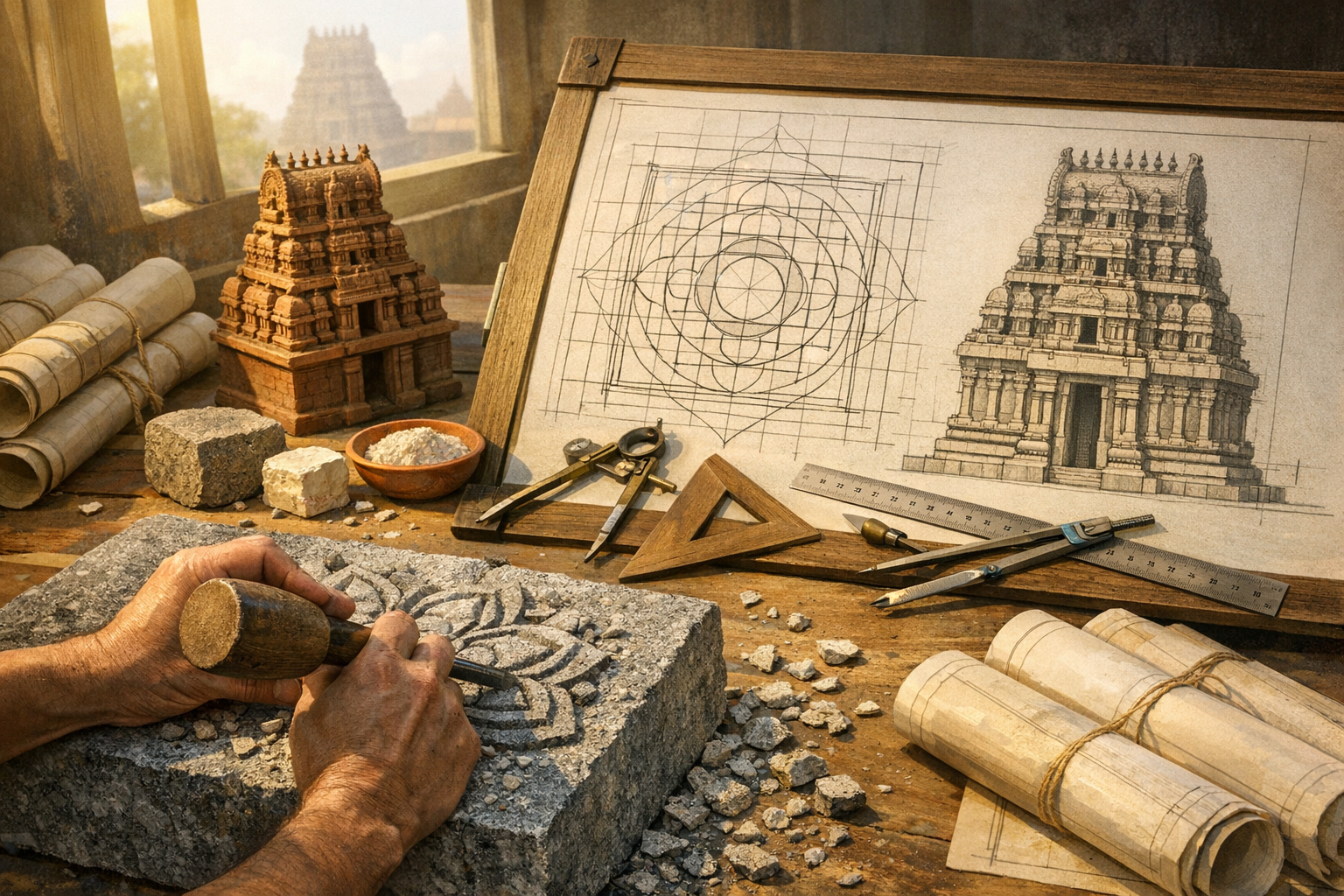
Temple Architecture in the Indic tradition draws on Sthapatya Veda and the broader corpus of Śilpa-śāstras and Vāstu literature. Foundational ideas include orientation to cardinal directions, proportional canons, and the Vāstu Puruṣa Maṇḍala as a framework for spatial ordering. Students engaged in this field customarily learn to interpret canonical treatises (such as Mānasāra and Mayamata) and to translate proportional logic into precise drawings and built work, maintaining coherence between text, geometry, and craft execution.
Architectural typologies across the subcontinent include Drāviḍa, Nāgara, and Vesara articulations, each distinguished by characteristic tower forms, base moldings (adhiṣṭhāna), and superstructure profiles. Core components—garbhagṛha (sanctum), antarāla (vestibule), maṇḍapa (pillared hall), and prākāra (enclosure)—are organized by canonical proportioning systems that unify structure, symbolism, and processional movement. Attention to drainage, threshold detailing, load paths in stone, and weathering behavior is critical to achieving longevity in tropical conditions.
Traditional sculpture training emphasizes iconometry (tālamāna), iconographic fidelity, and material intelligence. Whether working in granite, soapstone, or wood, practitioners sequence roughing, blocking, refinement of planes, and finishing with controlled toolwork. Surface character, polish level, and tactile clarity support both visual legibility and ritual function. The sculptor’s role interfaces with āgama-based ritual considerations—form and measure are not merely aesthetic, but sacramental, designed to receive and sustain worship with dignity.
Material science in traditional practice prioritizes durability, reparability, and compatibility. Lime-based mortars (with aggregates like surkhi) remain valued for breathability; timber joinery depends on seasoned species and precise mortise–tenon logic; stone selection responds to grain orientation, bedding planes, and salt exposure. Field conservation calls for diagnostic mapping of cracks, efflorescence, and settlement, pursuing minimum intervention and reversibility to respect historical fabric while arresting decay.
Fieldwork and documentation are essential in this discipline. Measured drawing, condition assessment, and photographic logs build technical literacy and historical sensitivity. Increasingly, practitioners complement hand measurement with photogrammetry and 3D scanning to create accurate records for restoration planning and archival use. However, digital tools serve rather than displace the craft hand; the center of gravity remains in disciplined drawing, geometry, and chisel confidence.
The social meaning of sacred design extends across the dhārmic family. Architectural and sculptural canons that shaped Hindu Temples also illuminate the planning and iconographic systems visible in historic Buddhist viharas and stupas, Jain temples and basadis, and aspects of Indic sacred geometry that inform Sikh heritage sites’ spatial dignity. Training that respects this wider Indic continuum encourages professionals to serve communities with a spirit of unity, dialogue, and shared stewardship of Cultural Heritage.
Graduates typically align with pathways such as temple trust works, artisan ateliers, conservation projects, heritage documentation, and independent sculpture studios. The work is exacting and deeply gratifying: it preserves continuity, cultivates local livelihoods, and sustains places of worship central to community life. Those who progress to master-craft status often mentor apprentices, reinforcing the gurukul ethic by which knowledge survives across generations.
Prospective applicants can strengthen readiness by practicing freehand drawing, geometric construction, and measured sketching of columns, bases, and moldings. Familiarity with Sanskrit technical terms (where applicable) and careful observation of local temples develop the habit of “seeing” proportion and detail. Physical stamina, workshop discipline, and a reflective mindset—attuned to the sanctity of materials and spaces—are equally important for success in studio and on site.
For 2026–2027, the essentials are clear: apply between May 04 and June 20; ensure 10th-pass eligibility; and note that selected students will receive free accommodation. The College in Tirupati, Andhra Pradesh, continues to stand at the intersection of practice, scripture, and community, preparing the next generation to design, build, conserve, and serve. Candidates should consult the official TTD notification for application forms, documentation, and any further instructions. In cultivating mastery of Temple Architecture & Sculpture, students help safeguard a shared dhārmic heritage—an enduring, unifying legacy for Hindu, Buddhist, Jain, and Sikh communities alike.
Inspired by this post on Hindu Pad.