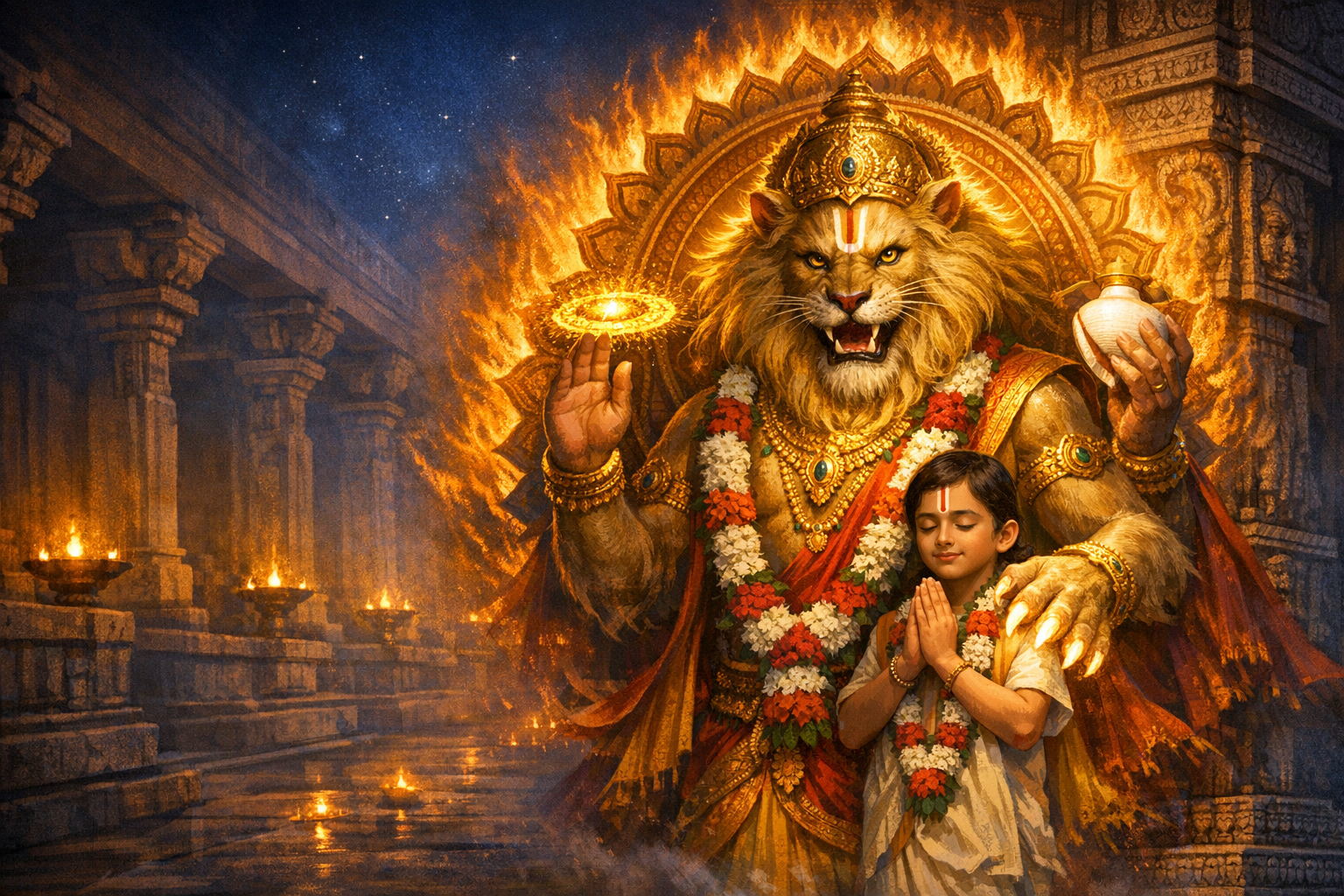
Narasimha Jayanti commemorates the appearance of Lord Nrsimhadeva, the man-lion avatara of Vishnu, whose manifestation is celebrated across the Vaishnava tradition and appreciated more broadly within the shared ethical horizon of the dharmic family. The narrative in the Bhagavata Purana situates this theophany as a decisive, restorative intervention that protects the vulnerable and reestablishes Dharma. While the imagery is formidable, the theological core is compassion in action—fierce only to the extent necessary to end systemic harm.
The textual locus classicus (Śrīmad-Bhāgavatam, Canto 7) describes the emergence of Lord Nrsimhadeva to protect Prahlada from his father, the absolutist ruler Hiranyakasipu. The Purana captures the moment with vivid kavya (poetic) intensity: “Lord Nrsimhadeva’s mouth and mane were sprinkled with drops of blood, and His fierce eyes, full of anger, were impossible to look at. Licking the edge of His mouth with His tongue, the Supreme Personality of Godhead, Nrsimhadeva, decorated with a garland of intestines taken from Hiranyakasipu’s abdomen, resembled a lion that has just killed an elephant.” (SB 7.8.30 ) The subsequent verse amplifies the scene of protection: ” The Supreme Personality of Godhead, who had many, many arms, first uprooted Hiranyakasipu’s heart and then threw him aside and turned toward the demon’s soldiers. These soldiers had come in thousands to fight with Him with raised weapons and were very faithful followers of Hiranyakasipu, but Lord Nrsimhadeva killed all of them merely with the ends of His nails.” (SB 7.8.31 )
In classical Sanskrit aesthetics, such imagery—lion and elephant, blood and garland, supernatural strength and effortless victory—functions as a symbolic grammar of moral restoration. The lion-elephant simile is a conventional topos marking irresistible justice over titanic but misdirected power. Devotional commentaries emphasize that the iconography is descriptive and signifying: it records an event and, simultaneously, encodes the message that adharma ultimately collapses under its own weight when confronted by uncompromising truth and compassion.
The avatara’s unique form resolves a set of conditions that insulated tyranny. Granted boons, Hiranyakasipu sought invulnerability “not by man, not by beast,” neither “inside nor outside,” neither “by day nor by night,” neither “on the ground nor in the sky,” and not by any weapon. Lord Nrsimhadeva manifests liminality itself—half-man, half-lion; appears at twilight; emerges from a pillar (neither inside nor outside); places the tyrant on His lap (neither earth nor sky); and uses nails rather than forged weapons. The narrative, read technically, is a sophisticated meditation on how absolute truth bypasses the logic of absolutism.
Prahlada’s steadfastness—bhakti grounded in fearlessness (abhaya)—is the ethical pivot of the story. His devotion denies the premise that power defines truth; instead, truth disciplines power. The ferocity seen in Lord Nrsimhadeva is thus not retribution for its own sake but the final safeguard of moral order when all other remedies have failed. In this sense, the Purana frames a doctrine of restorative protection: adharma is stopped so that compassion can breathe again.
Across the broader dharmic landscape, the protective motif resonates deeply. Buddhist traditions venerate guardian figures such as Vajrapani and Simhanada Avalokiteshvara, who subdue harm to clear the path for wisdom and compassion. Jain thought exalts inner conquest (jina) and radiates fearlessness (abhaya) as the antidote to aggression; the lion emblem of Mahavira symbolizes moral courage without cruelty. Sikh ethics articulate the sant-sipahi (saint-soldier) ideal—discipline and service oriented to defend the weak—embodied symbolically by the kirpan. While differing in doctrine and practice, these traditions converge on a shared principle: fierce compassion protects life and conscience, and its ultimate aim is harmony.
From a ritual and calendar perspective, Narasimha Jayanti is observed on Vaishakha Shukla Chaturdashi. Communities typically mark the day with fasting, recitation from the Bhagavata Purana (especially 7.8), kirtana, and reflective study on Dharma and Adharma. The emphasis falls on purification, ethical resolve, and gratitude for a cosmos in which truth is not powerless before might. Even where practices vary, the inner discipline—restraining harmful impulses and cultivating benevolence—remains the common thread.
Iconography codifies theology in form. Major forms include Ugra Narasimha (the fierce protector), Lakshmi Narasimha (compassion moderated by the presence of Sri), Yoga Narasimha (the contemplative protector), and Jvala Narasimha (surrounded by flames, signifying purificatory power). Attributes such as the yawning mane, flared nostrils, and emphasized nails (nakha) are not gratuitous detail but didactic cues: the ultimate instrument of justice is innate and incorruptible, not an external weapon that can be turned to oppression.
South Asian art history preserves these insights materially. The Vijayanagara-era Ugra Narasimha at Hampi dramatizes protective energy on a monumental scale; Ahobilam in Andhra Pradesh reveres multiple manifestations linked to episodes in the narrative; Simhachalam enshrines the deity in a distinctive aniconic-sheathed form for much of the year, ritually revealing the icon on Akshaya Tritiya. Sculptural programs and temple ritual together function as a living archive of Vaishnava theology, shaping memory and moral imagination across centuries.
Philologically, the very name “Nrsimha” (nri + simha) signals the confluence of humanity and the untamed potency of nature—a reminder that Dharma integrates strength with responsibility. The epithet “Ugra” denotes fierce resolve, while devotional literature also dwells on “Dayalu” (merciful) and “Bhakta-vatsala” (affectionate to devotees), balancing justice with tenderness. The narrative play between these rasas—raudra (fury) transforming into shanta (peace)—maps the arc from crisis to restoration.
Interpreters often add a psychological layer. Etymologically, “Hiranyakasipu” evokes attachment to gold and sensual ease (hiranya + kashipu), standing for materialist absolutism. On this reading, Lord Nrsimhadeva’s nails sever the inner tyrannies—anger, greed, delusion—that attempt to enthrone themselves as ultimate. In comparative perspective, this parallels the Buddhist overcoming of kleshas, the Jain conquest of kashayas, and the Sikh discipline against the “five thieves.” Such convergences underscore the dharmic insight that the subtlest battles are inward, and the most enduring victories are ethical.
Read ethically, the Bhagavata Purana’s dramatic verses do not valorize violence; they delimit it, subordinating force to compassion’s final cause. The scriptural logic is precise: when dialogue, restraint, and forbearance are exhausted, protective action may be required to prevent greater harm, and even that action is teleologically ordered to peace. In contemporary civic life, this translates into principled courage—speaking truth, safeguarding the vulnerable, and rebuilding trust without hatred.
For observants and learners alike, Narasimha Jayanti offers a structured opportunity to align conduct with conscience: study foundational texts (Bhagavata Purana 7.8), reflect on the unity of fierce compassion and gentle service, and recommit to practices that converge across dharmic communities—self-restraint, generosity, and truthfulness. By foregrounding shared ethical goods, the day becomes not only a Vaishnava festival but also a bridge of understanding within the wider family of Indian spiritual traditions.
Ultimately, Lord Nrsimhadeva’s appearance is remembered as Dharma’s triumph through compassionate resolve. The narrative assures that moral order is neither fragile nor abstract; it is animate, protective, and near. Marking the day with study, song, and service cultivates the same protective tenderness in society—fierce against injustice, tender toward all beings—thereby advancing the unity and mutual respect at the heart of dharmic civilization.
Inspired by this post on Dandavats.