Social media has compressed the distance between assertion and accountability. Like sunlight, it acts as a disinfectant, exposing the fragility of once-dominant gatekeepers. Where the early blogosphere allowed retreats and hibernations after reputational blows, today’s networks leave little room to hide. This transformation matters profoundly for the adjacent world of English-language publishing in India, where cultural authority, literary prestige, and market power have long converged.
The erosion of gatekeeping has been especially visible among legacy media luminaries who once shaped consensus with minimal contestation. Their reduced influence signals a broader realignment: the decline of an entrenched Delhi-centric, Anglophone establishment often shorthanded as “Lutyens,” and the rise of audiences that verify, rebut, and annotate in real time. Publishing sits at the fulcrum of this shift, because the narratives that circulate as news, opinion, and culture ultimately derive durability from what is acquired, edited, translated, and taught as literature.
A simple counterfactual captures this structural tension. Consider S. L. Bhyrappa’s Kannada novel Aavarana, a contemporary classic in Bharatiya Bhasha literature. If an unknown debutant had written an equivalent manuscript originally in English, would a major Indian house have taken the same bet? The difficulty of answering that question with confidence reveals systemic preferences—about language, taste, and perceived marketability—that long predate social media disruption and still define much of Indian English-language publishing.
Across four decades, many observers have noted a nagging absence of “India” in “Indian” English publishing. A recurring editorial tendency privileges deracinated backdrops over civilizational texture, and treats indigenous institutions, rituals, and knowledge systems primarily as foils for social critique. The White Tiger frequently surfaces in this discussion, not to diminish its craft but because numerous critics read it as emblematic of a template that rewards thin or instrumental understandings of Indian life with global accolades such as the Booker Prize.
Explaining why these sensibilities endure leads to familiar but still relevant contexts: Thomas Macaulay’s 1835 Minute that institutionalized English education; postcolonial policy choices associated with Jawaharlal Nehru; and the prestige economy attached to English proficiency. Their combined afterlife is often described as mental colonization, a deracinated elite sensibility that codes “English” as both the measure and the mediator of culture, intellect, and esteem.
Hartosh Singh Bal, in a widely cited essay, named this structure “The Literary Raj.” He noted, “Our publishers need the stamp of British approval… look what happens to sales of a book after it wins the Booker; somehow, the Pulitzer counts for nothing.” He further observed that a director of an Indian literary festival “does not consider it important to mention an Indian prize he may have received or an Indian publication he may have written for… his eyes are trained on the recognition that Britain’s literary world offers.” The point is not Anglophobia; it is the analytical recognition that the pipeline of recognition often runs outward for validation before it runs inward for distribution.
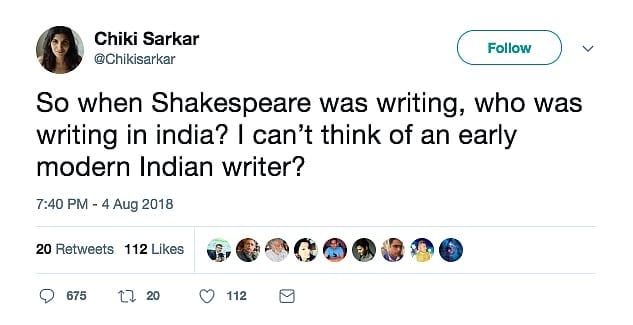
This craving for external stamps of approval shapes acquisition decisions, festival curation, and even the kinds of public questions that circulate as acceptable ignorance. An instructive instance was a widely shared query from a senior Indian publisher: “So, when Shakespeare was writing, who was writing in india?” In an era of ubiquitous digital reference, the question itself—posed by a cultural gatekeeper—highlighted the contours of the Anglophone knowledge gap and the hierarchies of prestige that still center Europe as default literary history.
Branding choices echo the same arc. The term “juggernaut,” widely used in English to denote an overwhelming force, derives from Jagannath. The commercial preference for the anglicized version is understandable, yet it also exemplifies a longer pattern: indigenous signifiers reframed to sound more “global” or “posh,” with the source culture’s resonance attenuated in translation.
Colonial administration did not conjure caste ex nihilo; rather, it reified fluid social formations—varna, kula, jati—through census-led categorization and legal codification. Parallel to that hardening was the rise of a subtler but equally durable hierarchy: English over non-English. In contemporary India, English proficiency remains a de facto credential for entry and advancement in media, publishing, academia, and policy-making, reinforcing cultural gatekeeping by language rather than by learning.
When senior cultural intermediaries pose basic civilizational questions on social platforms, three concerns arise. First, the trivial search cost of answers. Second, the due diligence expected of those who shape reading lists and prize nominations. Third, the literary histories they implicitly inhabit. The immediate answers are easy; the structural questions about why those answers are peripheral in Anglophone circuits are harder and more consequential.
For context, Indian contemporaries of Shakespeare span Sanskrit and Bharatiya Bhasha traditions: Tulasidas (Ramacharitmanas), Eknath, Keshavdas, Surdas, Rahim, Ezhuthachan in Malayalam, Appayya Dikshita in Sanskrit, and, slightly later, Tukaram among many others across Odia, Telugu, Kannada, Bengali, and Tamil. Their coexistence with European early modernity is well documented; what requires scrutiny is the incentive structure that renders such knowledge episodic in elite discourse.
The scale of India’s classical and vernacular corpus itself is staggering. Conservative, back-of-the-envelope estimates place the extant Sanskrit literature at roughly 70 lakh printed pages, encompassing Vedas, Vedangas, Puranas, Itihasa, Kavya, digests, commentaries, biographies, and drama—down to specialized treatises such as Tamboola Manjari on the art and practice of Paan. This tally excludes significant losses from the destruction of centers like Nalanda and Vikramashila, and does not yet incorporate the millennia-spanning literature of the Bharatiya Bhasha traditions.
When one adds the Pali Buddhist canons, Prakrit and Apabhramsha works, the Jain Agamas and commentarial traditions, and the Sikh Gurus’ Gurbani, the result is an unbroken, plural, and dialogic archive that binds Hinduism, Buddhism, Jainism, and Sikhism through shared philosophical vocabularies and ethical inquiry. This civilizational continuum is the baseline against which publishing choices—what gets translated, promoted, and taught—ought to be assessed.
The institutional trajectory of Gita Press, examined in Akshaya Mukul’s Gita Press and the Making of Hindu India, illustrates how alternative publishing ecosystems have flourished far from elite Anglophone circuits. Interpretations of the Press’s cultural role may differ, but the historical documentation and operational resilience are robust.
By early 2014, Gita Press reported cumulative sales of approximately 410 million copies of the Bhagavad Gita across languages and editions, 70 million copies of Tulasidas’ Ramacharitmanas, and nearly 20 million copies of the Puranas and Upanishads. Its monthly Hindi journal, Kalyan, circulated around 200,000 copies, while its English counterpart, Kalyan Kalpataru, circulated around 100,000. Its archives house more than 3,500 manuscripts and over a hundred interpretations and commentaries on the Bhagavad Gita, with a pricing philosophy geared to maximum accessibility.
Comparable longevity is visible at Chaukhamba Sanskrit Pratishthan (established 1892), which has sustained a living pipeline for classical texts and commentaries even as many peer institutions shuttered. Measured purely by reach, archives, and cultural assets, these publishing houses represent a national treasure in Cultural Heritage, though they are often peripheral to the metropolitan retail narrative.
That retail narrative continues to be dictated by English-language publishing and urban chains that seldom stock Indic classics at scale. The consequence is a distorted demand signal: readers who engage daily with Bharatiya Bhasha literature and dharmic scriptures are undercounted in the very places that set “bestseller” benchmarks and shape curricular adoptions.
Sales trajectories of writers like Narendra Kohli and Dr. S L Bhyrappa make the imbalance plain. Their novels and essays have sold in the lakhs across decades; on occasion, entire print runs were pre-sold before reaching bookstores. Their work endures not due to glittering launches but because, as Bhyrappa puts it, “a work should stand on its own merit, and not shine in the borrowed light of reviewers and critics.”
Paradoxically, many English-educated readers in Bengaluru and other metros remain unfamiliar with such authors, even when translations are abundant and admired. This gap reflects not a failure of readers but the combined effects of distribution norms, curricular choices, and a taste-making machinery that privileges the Anglophone public sphere over the wider Indic library.
The structural incentives that Hartosh Singh Bal described—foreign validation, prize ecologies, and editorial deference—still matter. As one senior publisher observed, lists submitted locally are “casually ignored,” rendering Indian publishers and writers “peripheral to the enterprise.” The outcome is a soft yet consequential hierarchy: English over non-English; metropolitan over regional; imported recognition over domestic esteem.
Addressing this imbalance does not require rejecting English; it requires recentring the Indic library. Concrete steps include: building translation pipelines across Sanskrit, Pali, Prakrit, and Bharatiya Bhasha literatures; hiring editors and marketers with demonstrated competence in dharmic and regional traditions; reforming metadata and retail discovery so chain bookstores algorithmically surface classical and modern Indic titles; redesigning curricula that pair Shakespeare with Tulasidas, Keshavdas, Ezhuthachan, and Appayya Dikshita; and supporting grants that place Hindu, Buddhist, Jain, and Sikh texts in sustained dialogue.
Social media has already flattened hierarchies of voice; the next imperative is to flatten hierarchies of validation. A publishing ecosystem anchored in civilizational self-respect, academic rigor, and dharmic pluralism can expand readership, correct historical imbalances, and allow India’s literary soul—across traditions—to be encountered on its own terms rather than through a borrowed gaze.
Inspired by this post on Dharma Dispatch.