Garuda, revered across Hindu scriptures as the swift and luminous vahana of Vishnu, is described with notable precision in the Vishnudharmottara Purana, a text famed for its encyclopedic treatment of iconography, aesthetics, and temple arts. Within the broader Puranic and Agamic tradition, this Purana anchors how sacred form conveys sacred meaning, offering a canonical profile of Garuda’s form (rupa), attributes (ayudhas), posture (sthiti), and visual grammar (lakshana) in service of both theology and ritual practice.
Vedic antecedents frame Garuda’s sanctity. Under names such as Suparṇa and Garutmān, the cosmic bird appears in early layers of Sanskrit literature as a being of radiant force and transcendent movement. Later Puranic narratives crystallize his genealogy—born of Kashyapa and Vinata, rival to the serpent-born Nagas of Kadru’s lineage—and his decisive role as liberator and bearer of amṛta in the aftermath of the Samudra Manthana. From these accounts emerge the two master symbols that guide later iconography: Garuda as destroyer of poison (subduer of serpents) and Garuda as the exalted carrier of Vishnu’s will.
As a keystone of art theory, the Vishnudharmottara Purana (notably in its extensive third part on image-making) sets out the pramāṇa (proportional canons), bhāva (expressive tenor), and āyudha (attributes) that define divine figures. In this framework, Garuda’s iconography is neither arbitrary nor merely decorative; it is a codified visual theology, regulating how artisans communicate metaphysical truths through measurable forms.
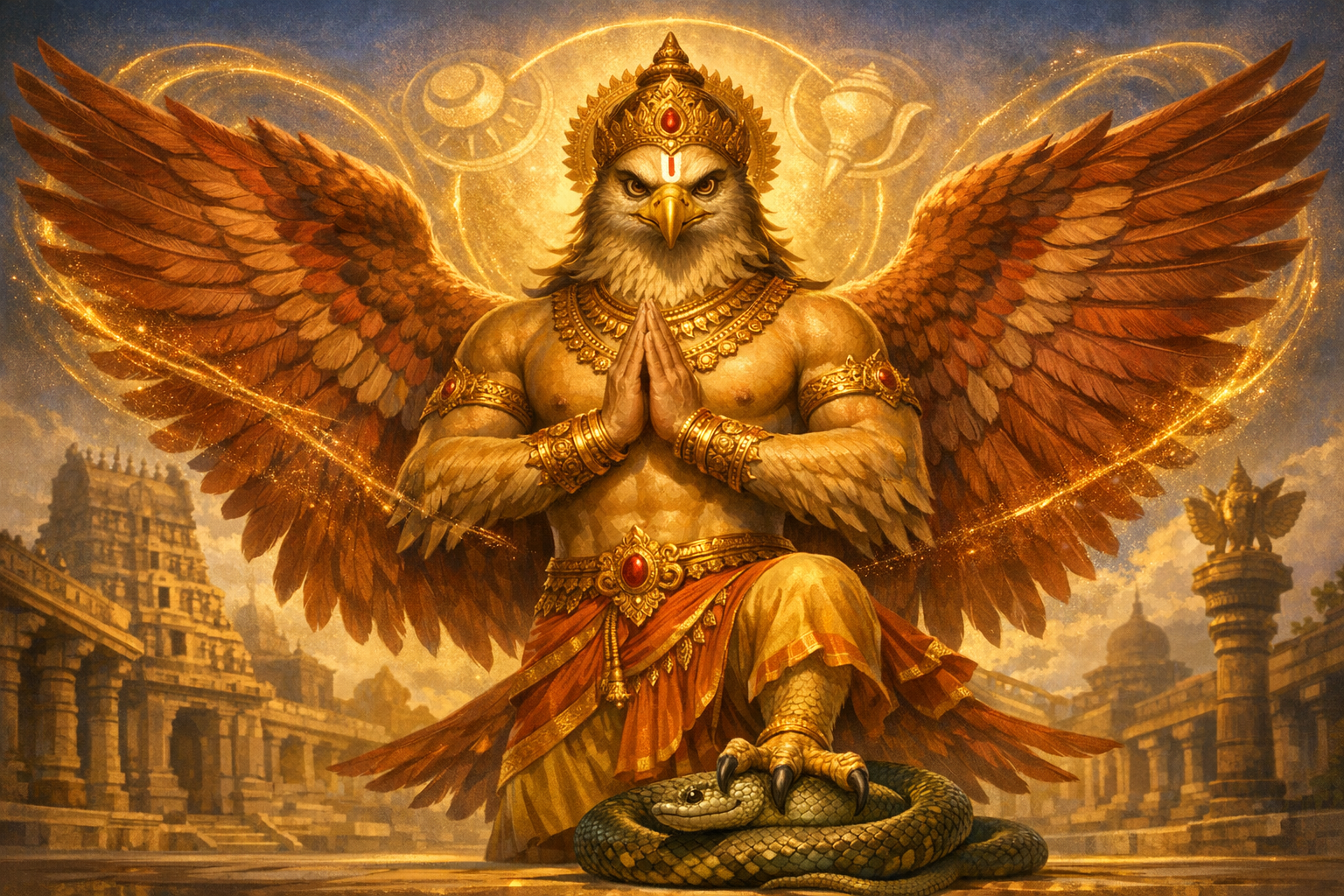
Garuda’s form is typically a harmonious avian–human composite. Prescriptions and later regional practices present him with a powerful, broad chest; a prominently beaked visage; large, outstretched wings; and sinewy limbs communicating tensile strength and velocity. The complexion is frequently described as golden or sun-hued, with red or tawny wings signifying vigor and radiance. Eyes are wide and intent, signaling vigilance; hair or crest may be stylized to amplify aerial dynamism; and the beak is rendered with enough definition to communicate both nourishment and ferocity, depending on context.
Arm configuration varies by textual school and period. Two-armed depictions accentuate flight and devotion, while four-armed forms accommodate emblematic attributes. In all cases, the icon is composed to evoke upward surge and protective presence—qualities central to Vaishnava ritual imagination.
Two principal liturgical placements dominate temple practice. First, as Vishnu’s carrier, Garuda is shown bearing Vishnu in alighting or ascendant motion, with the deity seated or standing upon him. Second, as the foremost devotee (parama-bhakta), he appears kneeling before the sanctum with hands in añjali-mudrā, wings folded in reverence. The latter is especially prominent in South Indian Vaishnava temples, where the Garuda image serves as the devotee’s proxy gaze into the sanctum, shaping the devotee–deity line of sight and intensifying the affective atmosphere of darśana.
Attributes and weapons (āyudhas) align with Garuda’s defining mythology. The primary and most consistent motif is the subjugated serpent, held or trampled, signaling the dissolution of poison, fear, and bondage. Text and tradition further associate Garuda with the power embodied in the Garuḍa-astra of epic lore—a conceptual “weapon” invoked to neutralize serpent energies—thereby extending his protective function into narrative and ritual domains. While some regional schools admit martial implements (such as a mace) in certain periods, the normative focus remains on naturalized attributes—talons, beak, wings—and the emblematic serpent as the sign of victorious protection rather than on an inventory of handheld weapons.
The Vishnudharmottara Purana and cognate Śilpa-Śāstra traditions emphasize color and material as vehicles of meaning. Golden-yellow or burnished tones emphasize solar vitality and the sattvic clarity of protective intelligence; red accents underscore dynamism and life-force. Metal icons may combine coppery alloys to achieve a warm, radiant sheen consonant with textual color prescriptions, while stone images rely on polish and proportion to project speed and strength.
Postural grammar reinforces function. Alighting poses (descending with purpose), soaring poses (wings fully unfurled), and subjugation poses (serpent held or pinned) translate narrative motifs into liturgical presence. Facial expression balances ferocity with compassion: when confronting toxins and obstacles, the visage hardens; when mediating devotion and service to Vishnu, it softens into calm attention.
The symbolic architecture of Garuda is multilayered. As the sacred bird that conquers poison, he functions as a visual antidote to fear and moral toxicity, promising purification and resilience. As the carrier of Vishnu, he manifests divine agency—speed, certainty, and right order (dharma) in motion. Yogic readings align Garuda with prāṇa, the vital wind that lifts consciousness upward; the winged ascent becomes an emblem of inner elevation, where discernment rises above the coils of inertia and ignorance. In social and ethical terms, Garuda’s vigilant gaze and swift response model protective leadership and principled strength.
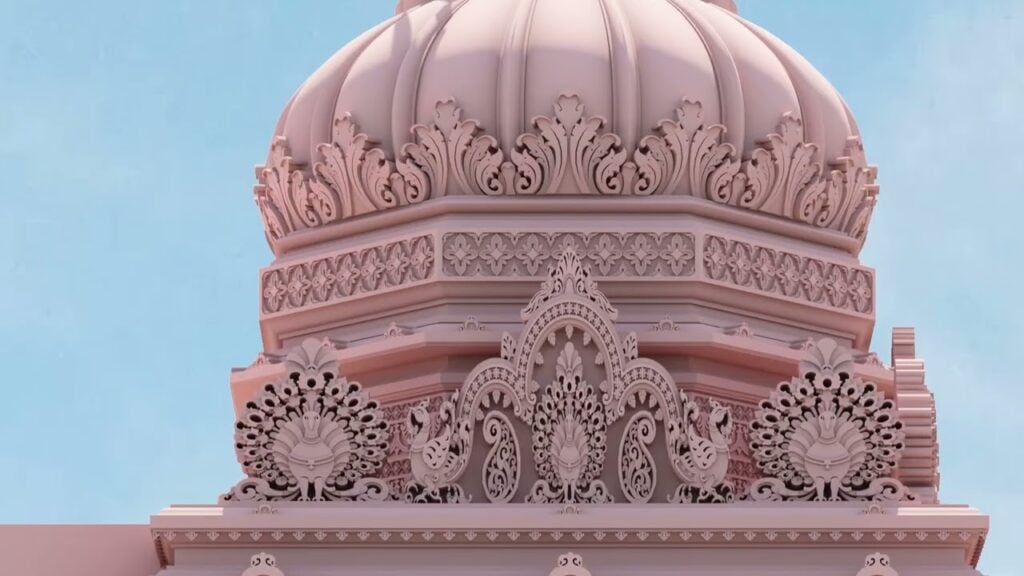
Temple space often amplifies Garuda’s mediating role. A Garuda-stambha or a dedicated Garuda mandapa commonly anchors the approach to the sanctum in major Vaishnava temples, binding the devotee’s pathway to the icon’s protective field. Ritual cycles such as the famed Garuda Seva during Brahmotsavam at Tirumala embody these principles in motion: Vishnu’s processional image borne upon Garuda becomes a moving theatre of protection, grace, and communal joy.
Beyond the sanctuary, the Garuḍa-dhvaja (Garuda standard) has carried political and cultural weight. The Gupta dynasty famously employed the Garuda emblem on coins and standards, signaling Vaishnava affiliation and the ideals of sovereignty, justice, and guardianship. Inscriptions and numismatic evidence attest that Garuda, as a dynastic and theological sign, articulated statecraft in the language of dharma.
The motif travels widely across Asia. Khmer, Thai, and Javanese art internalized Vaishnava iconography into local aesthetic idioms, where Garuda (Thai Krut) appears in powerful temple and palace reliefs as a sign of protective royalty. Indonesia’s national emblem, Garuda Pancasila, speaks to a long memory in which the cosmic bird stands for unity, moral law, and shared civic purpose. Monumental works such as Bali’s Garuda Wisnu Kencana visualize the Vaishnava ideal on a grand civic scale, merging devotion, heritage, and contemporary identity.
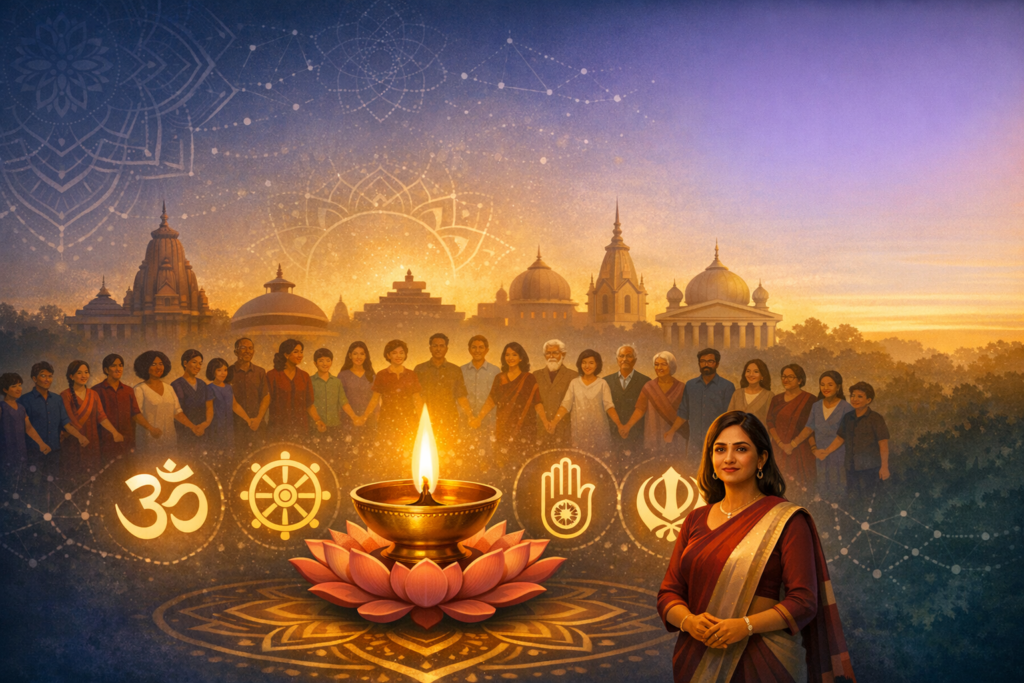
Dharmic interconnections deepen the figure’s resonance. In Buddhist traditions, Garuḍas appear as a class of powerful beings; in Tibetan Buddhism, the Khyung occupies a cognate symbolic niche as a sky-soaring guardian. Within Sikh heritage, the baaj (hawk) associated with Guru Gobind Singh conveys courage, clarity, and sovereign composure—values that parallel Garuda’s protective ethos. Even where theological frameworks differ, a shared Dharmic vocabulary recognizes the sky-bird as a sign of fearless virtue, disciplined power, and service to higher truth. Such convergences advance a spirit of unity across Hinduism, Buddhism, Jainism, and Sikhism, affirming a common ethical horizon of courage, compassion, and responsibility.
Ritually, Garuda’s association with antidotal power has informed protective prayers and local healing practices against snakebite in several regions, alongside observances such as Garuda Pañcami. While details vary by community, the underlying intention remains consistent with Puranic symbolism: to invite clarity over confusion, vitality over toxicity, and steadfast protection over vulnerability.
From an art-historical perspective, the Vishnudharmottara Purana ensures that Garuda’s depiction remains a measured revelation of doctrine. Proportion, color, and posture are not mere aesthetics; they are a pedagogy. The outstretched wing teaches readiness; the clenched talon teaches resolve; the reverent añjali teaches service. The icon, faithful to text, becomes a living textbook of Vaishnava theology and a bridge across Dharmic traditions that prize courage, wisdom, and compassionate protection.
In contemporary ethical and ecological reflection, Garuda’s sky-sovereignty can be read as a call to stewardship of the aerial and terrestrial commons. As the bird that clears the atmosphere of poison, Garuda emblemizes responsibility toward clean air, balanced ecosystems, and the collective resilience needed in times of environmental stress. Thus, the classical image acquires renewed urgency: to protect is to purify; to move swiftly is to serve; to take flight is to lift others.
In sum, the Vishnudharmottara Purana positions Garuda as an icon of precision and power: anatomically codified, ritually indispensable, politically meaningful, and spiritually transformative. His features embody aerodynamic grace and moral vigilance; his “weapons” are the naturalized signs of fearless protection and the narrative conquest of toxicity; and his symbolism unites aesthetic craft, theological clarity, and Dharmic solidarity—across temples, texts, and living communities.
Inspired by this post on Hindu Blog.