Beejabhidhana in Tantrism names a precise and sophisticated map of sacred sound, where bījākṣaras (seed syllables) function as concentrated loci of divine power and meaning. By cataloguing, defining, and situating these syllables within ritual and contemplative practice, Bījābhidhāna literature provides a grammar for how sound discloses reality and transforms consciousness. This is not merely a glossary; it is a technical framework that binds cosmology, ritual method, and inner experience into a unified discipline of mantra-śāstra.
Etymologically, bīja means seed—an indivisible potency from which form and function unfold—while abhidhāna denotes naming, lexicon, or technical designation. Bījābhidhāna therefore signifies the systematic nomenclature and hermeneutics of seed syllables. Across Śaiva, Śākta, and Vaiṣṇava Tantras—and later ritual compendia—sections often titled bījābhidhāna enumerate phonemes, specify their deities and elements, and prescribe their ritual deployment. The tradition is cumulative, with medieval manuals consolidating and commenting on earlier revelations in a highly technical idiom.
Within the tantric view, sound (śabda) is not an arbitrary label but the very vibration of consciousness (cit-śakti). Letters are personified as matrikās, the mothers of the cosmos, whose permutations generate phenomena. Bījākṣaras compress these forces: a single syllable such as hrīṁ or klīṁ encapsulates deity, element, function, and realization. Bījābhidhāna materials make this compression legible, offering a decoding schema that ties phoneme to tattva (ontological principle), nyāsa (enplacement), and sādhanā (method).
Technically, a bīja is analyzed letter by letter and diacritic by diacritic. Consonant, vowel, and bindu (nasalization) each denote specific powers. Commentarial traditions often gloss hrīṁ, for instance, as a composite in which the consonant can signify Śiva, the vowel the dynamic śakti, and the bindu the undifferentiated seed-state—together implying the emergence, play, and reabsorption of the cosmos. Variations of such glosses exist across lineages; the Bījābhidhāna genre records these mappings and their ritual implications while noting permissible variants.
The classical five-element bījas illustrate the taxonomic clarity of Bījābhidhāna: laṁ (earth), vaṁ (water), raṁ (fire), yaṁ (air), and haṁ (ether/space). In many haṭha- and tantra-informed yogic manuals, these are correlated with mūlādhāra through viśuddha centers respectively, shaping breath, visualization, and nyāsa. Through such mappings, seed syllables become precise tools for modulating prāṇa, stabilizing attention, and orienting contemplative inquiry within the framework of subtle anatomy.
The praṇava oṁ bridges Vedic and tantric discourses, serving as archetypal bīja. Upaniṣadic analysis reads oṁ as the entirety of temporal experience and the doorway to the timeless; tantric sources integrate that metaphysics with method—linking oṁ to cakra activation, nyāsa, and deity contemplation. Bījābhidhāna manuals typically introduce oṁ as a universal key before specifying lineage-protected syllables whose use depends on dīkṣā (initiation) and ethical discipline (yama-niyama).
Prominent śakti bījas include aiṁ (Vāgbhava, Sarasvatī’s expressive intelligence), hrīṁ (often called the māyā-bīja, indicating concealed radiance and compassionate veiling-revelation), śrīṁ (prosperity, auspiciousness, and sustaining abundance), and klīṁ (kāma-bīja, attractive cohesion and devotional magnetism). Protective bījas such as hūṁ and the severing syllable phaṭ are applied in boundary-setting, obstacle-clearing, and consecration. Bījābhidhāna compendia carefully specify contexts, meters, and nyāsas for these syllables to ensure that their energetic signatures are coherently deployed.
Śrīvidyā sources refine this mapping further through the triadic architecture of the Pañcadaśī mantra—vāgbhava-kūṭa, kāmarāja-kūṭa, and śakti-kūṭa—each segment populated by particular bījas and their phonosemantic logics. Bījābhidhāna explanations here operate like a blueprint: they demonstrate how letter-sequences encode theology (Śiva–Śakti nonduality), cosmology (emanation and reabsorption), and practice (dhyāna imagery, nyāsa points, japa cadence) in a single mantra-body.
A core procedure linked to Bījābhidhāna is nyāsa, the ritual of enplacing mantras and bījas on the body. Kara-nyāsa (on the hands), aṅga-nyāsa (on limbs), and mātrikā-nyāsa (installing the Sanskrit alphabet across somatic points) translate abstract mappings into embodied realization. Consistent with the subtle-body model found in haṭhayoga and tantrayoga, nyāsa integrates phoneme, prāṇa, and attention, turning the practitioner into a consecrated field where the mantra can take root.
Japa itself is stratified. Bījābhidhāna sources differentiate vācika (audible), upāṁśu (whispered), and mānasa (mental) practice, and link each to distinct aims and levels of subtlety. They also prescribe mālā counts, sandhyā timings, breath ratios, and visualizations to stabilize attention and entrain the nervous system toward steadiness and clarity. These prescriptions are not arbitrary; they arise from a long empirical tradition of contemplative testing within the parameters of dharma and lineage safeguards.
Technically inclined compendia further analyze accent, prosody, and phonation. Vowel length, aspiration, and nasality change functional outcomes; a misplaced bindu or visarga can redirect energetic emphasis. The discipline therefore recommends foundational study of śikṣā (phonetics) and vyākaraṇa (grammar), alongside chandas (meter), to ensure that bījās are pronounced as designed. Faithfulness to these details is presented as both reverence for lineage and a practical necessity for reliable results.
While specific chapter titles vary across texts, many influential tantras and later ritual digests preserve bījābhidhāna-style sections that catalogue correspondences and ritual recipes. Such materials appear, for example, in widely cited Śākta and Śaiva sources and in compendia that synthesize diverse streams of practice for temple and household rites. The tradition is conservative about initiation boundaries, yet transparent about general principles, allowing serious students to understand the architecture even when restricted mantras remain under guidance.
The semiotics of bījākṣaras extends beyond metaphysics into subtle psychology. Practitioners describe how stable japa reshapes attention, softens reactive patterns, and refines emotional tone. Bījābhidhāna analysis attributes these shifts to re-patterning the flow of prāṇa through nāḍīs and cakras, coordinated by breath, posture, and visualization. Contemporary research on breath and nervous-system regulation provides complementary insights without reducing the tradition to physiology; the tantric account remains rooted in consciousness-as-fundamental.
Cross-tradition resonances illuminate the wider dharmic context. In Vajrayāna Buddhism, bījas such as oṁ, āḥ, hūṁ, hrīḥ, and dhīḥ signify body–speech–mind and the wisdom qualities of buddhas and bodhisattvas. The celebrated oṁ maṇi padme hūṁ integrates seed syllables in a manner consonant with Bījābhidhāna logic: syllabic meaning, deity identity, and method are fused into a single recitational stream that cultivates compassion and insight.
Jain traditions, while emphasizing ahiṁsā and austerity, also preserve mantra practices that employ seed syllables in certain ritual strata, including devī and yakṣa–yakṣiṇī upāsanās historically recognized within Jain communities. Here too, bījās such as hrīṁ or śrīṁ can function as condensed carriers of protective and auspicious qualities, integrated with ethical commitments and contemplative aims central to Jain Dharma. These convergences highlight a broader Indic science of sacred sound that respects doctrinal differences while acknowledging a shared sonic grammar.
Sikh Dharma centers practice on the remembrance of the Divine Name (Nāma) and the assertion of unity expressed in Ik Oṅkār. Although distinct from tantric ritualism, this focus on primordial sound as a direct means of communion with the Absolute resonates with the idea—central to Bījābhidhāna—that sound discloses reality. Read together with due respect for each tradition’s integrity, these perspectives affirm a dharmic kinship grounded in the transformative power of sacred utterance.
Bījābhidhāna also clarifies how mantras interface with yantra (geometric diagrams) and mudrā (ritual gestures). Seed syllables anchor the diagram’s center points and petals, while mudrās seal intention and direct subtle currents. The triangulation of mantra–yantra–mudrā becomes, in this schema, a complete method for embodiment, cognition, and devotion converging on the same realization: the inseparability of consciousness and energy.
Because of the potency attributed to certain bījas, the literature consistently emphasizes adhikāra (fitness) and dīkṣā. Ethical preparation (yama–niyama), steadiness of lifestyle, and the guidance of a qualified guru are listed as non-negotiable safeguards for advanced work. At the same time, the tradition is inclusive in spirit: universally accessible practices—such as contemplation of oṁ, breath-synchronized mantra of elemental bījas, and gratitude-centered devotion—are presented as constructive pathways for all sincere seekers.
From a philological vantage, Bījābhidhāna invites careful attention to variants and lineage-specific readings. A single bīja can be glossed differently across Śākta, Śaiva, or Vaiṣṇava settings without contradiction, because each mapping is embedded in a larger theological and ritual ecology. Rather than seeking an exclusive “one-correct” definition, the technical method emphasizes coherence: each reading must harmonize with its host cosmology, nyāsa scheme, deity visualization, and soteriological aim.
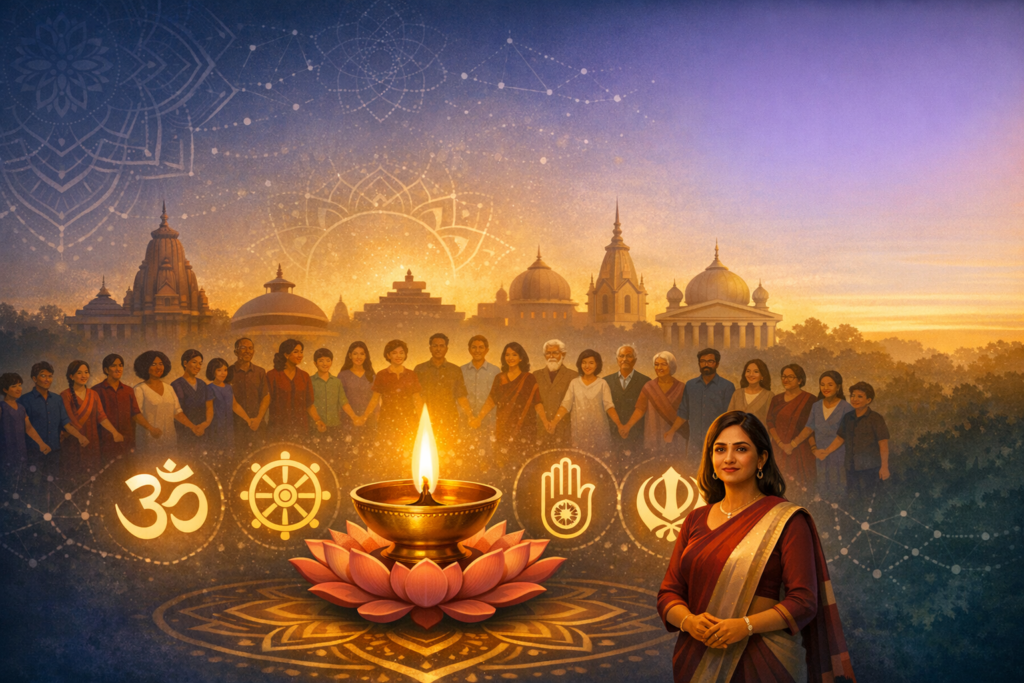
This disciplined pluralism is one reason the wider dharmic family—Hinduism, Buddhism, Jainism, and Sikhism—can be read as sharing a sonic substratum while maintaining distinct doctrinal norms. By honoring the internal consistency of each path and recognizing the common intuition that sacred sound transforms, Bījābhidhāna discourse supports inter-traditional understanding and unity without erasing difference. The result is a culture of respectful exchange grounded in technical clarity and spiritual purpose.
For modern readers, three study streams are especially fruitful. First, learn the phonetic discipline: accurate vowel length, aspiration, and nasalization are essential. Second, grasp the mantra architecture: how r̥ṣi, chandas, devatā, bīja, śakti, and kīlaka collectively define a mantra’s identity and use-case. Third, integrate practice with ethics and contemplative stability, allowing the syllables to illumine rather than agitate the mind. Bījābhidhāna provides the schematics; lived inquiry confirms their value.
Ultimately, Beejabhidhana in Tantrism portrays a universe voiced into being, sustained by rhythmic intelligence, and resolved in the silent fullness signified by bindu. Seed syllables are the compact signatures of that intelligence. When approached with humility, precision, and compassion, the Bījābhidhāna tradition becomes not only a technical science of mantra but also a shared bridge across dharmic lineages—supporting unity in diversity and a collective aspiration toward wisdom and liberation.
Inspired by this post on Hindu Blog.