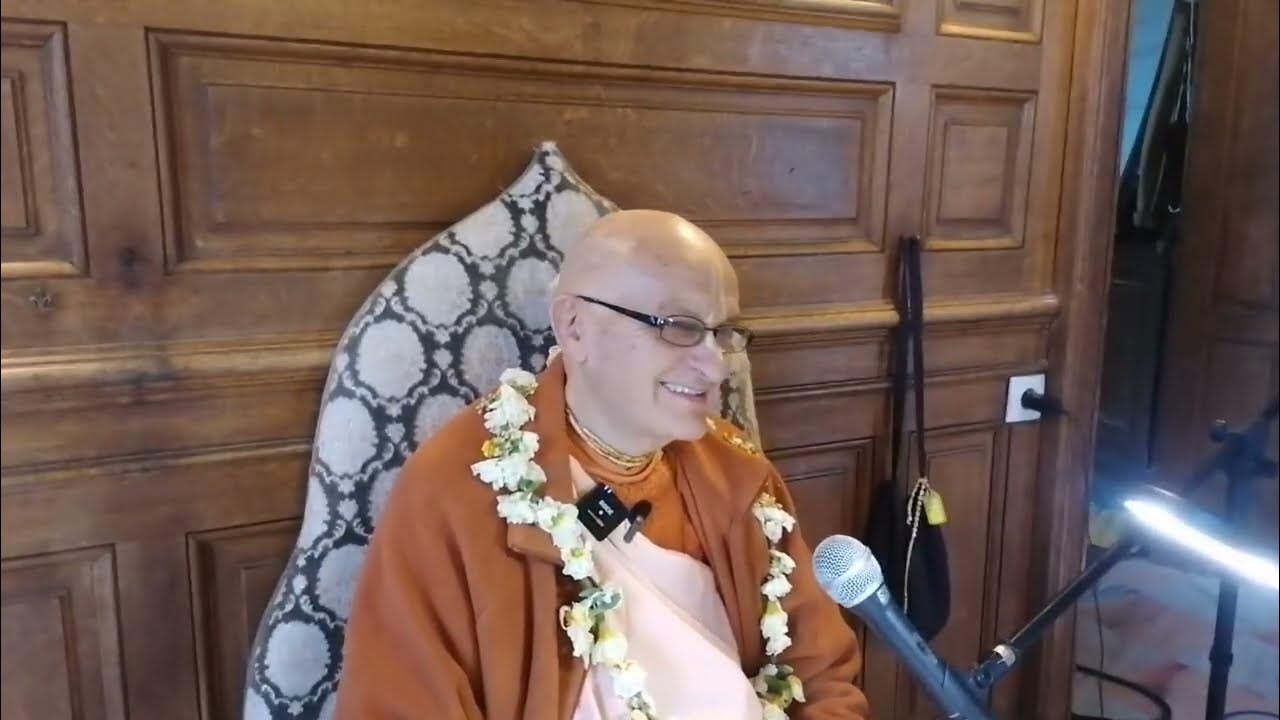
In a discourse delivered in ISKCON France on Śrīmad-Bhāgavatam (SB 1.5.19), HH Janananda Goswami highlighted a compelling axiom of the Bhakti Tradition: once the spiritual joy—rasa—of devotion to Krishna is genuinely tasted, a complete return to purely material preoccupations becomes untenable. This principle, encapsulated in the term “rasa-graha,” explains why a devotee who appears to falter does not become “ordinary” again; the indelible memory of the experience continues to draw the heart back to devotional practice. The insight resonates deeply across Hindu spirituality and offers a technical, scriptural, and experiential explanation of devotional resilience.
“Rasa-graha” can be read in two complementary ways: as the devotee’s grasp of rasa and as the devotee being grasped by rasa. In the Gaudiya Vaishnava aesthetic-theological framework, rasa denotes the fully developed relish of devotion, not a fleeting emotion. This relish arises when a stable devotional disposition (sthāyī-bhāva) becomes the organizing center for one’s experience, harmonized by stimuli (vibhāvas), expressive responses (anubhāvas), and transitory emotions (vyabhicāri-bhāvas). When this synthesis matures, it eclipses the motivational force of merely material pleasures.
The scriptural foundation is found in the celebrated sequence of verses (SB 1.5.17–19) often discussed together in commentarial literature. The seminal verse states: “tyaktvā sva-dharmaṁ caraṇāmbujaṁ harer bhajann apakvo ’tha patet tato yadi yatra kva vābhadram abhūd amuṣya kiṁ ko vārtha āpto ’bhajatāṁ sva-dharmataḥ.” Its essential point is that even if one temporarily falls from immature devotion after giving up conventional duties, there is ultimately no loss; conversely, dutiful conduct devoid of bhakti yields little spiritual gain. The doctrine reframes “falling” not as disqualification but as a stage in a longer arc of transformation initiated by contact with Krishna-bhakti.
From a theological standpoint, this irreversibility can be understood through the language of saṁskāra and vāsanā. Devotional engagement—hearing (śravaṇa), chanting (kīrtana), remembrance (smaraṇa), and service (seva)—lays down potent bhakti-saṁskāras that reconfigure one’s inner tendencies. In the progression articulated in Gaudiya texts—śraddhā, sādhu-saṅga, bhajana-kriyā, anartha-nivṛtti, niṣṭhā, ruci, āsakti, bhāva, prema—each stage deepens this reorientation. As ruci (taste) stabilizes into āsakti (attachment) and ripens into bhāva, the aesthetic relish of bhakti (rasa) becomes a lived center of gravity that repeatedly reasserts itself, even after interruptions.
Psychologically, the phenomenon aligns with how peak, meaning-laden experiences remodel memory networks. Salient encounters are not easily overwritten; they undergo reconsolidation that strengthens retrieval cues. Devotional practices amplify this effect by supplying rich multimodal anchors—mantra, melody, community, ritual, pilgrimage—that reactivate the core memory trace. Thus, when everyday life grows noisy, a single kīrtana, a line from Śrīmad-Bhāgavatam (Srimad Bhagavatham), or darśana in a temple can reignite the devotional state and re-route one’s priorities.
Importantly, “falling” in this context requires nuance. Gaudiya exegesis distinguishes between anarthas (lingering impurities) and aparādhas (offenses). Anarthas often surface precisely because practice has begun to churn the heart, making them visible and therefore removable. Aparādhas, by contrast, can impede progress and call for humility, rectification, and renewed sādhanā. In either case, the latent taste—rasa-graha—functions as a compass, ensuring that setbacks are temporary waypoints rather than terminal failures.
Community observations corroborate this doctrinal portrait. Practitioners frequently recount how, after vibrant kīrtana or extended study of Śrīmad-Bhāgavatam, ordinary pleasures feel comparatively thin. Months or years later, a single mantra remembered during a difficult moment reawakens the earlier joy and resets life’s direction. Retreat participants, pilgrims, and congregational members in ISKCON settings often describe the same pattern: the initial taste inaugurates a new “default,” to which the heart returns with surprising certainty.
Rasa-graha does not provide license for complacency; rather, it underwrites responsibility. If authentic spiritual taste is so compelling, one must protect and nourish it—through steady sādhana, ethical integrity, and compassionate service. The tradition therefore recommends robust daily anchors: attentive japa, heartfelt kīrtana, reflective study of scripture, association with the saintly (sādhu-saṅga), and practical seva. These disciplines stabilize the taste, hasten anartha-nivṛtti, and mature the devotee’s inner orientation toward Krishna.
The principle also aligns with a wider dharmic insight shared across traditions. In Buddhism, the srota-āpanna (stream-enterer) is said to have crossed a threshold after which full regression is no longer possible. In Jainism, samyag-darśana (right vision) plants a decisive insight that progressively transforms conduct through the guṇa-sthānas. In Sikhism, the ras of Nāam-simran reorders desire and identity, making worldly intoxications feel hollow by comparison. These convergences illustrate unity in spiritual diversity: once an authentic taste of the transcendent takes hold, it alters the trajectory of life across dharmic paths.
Seen through this integrative lens, HH Janananda Goswami’s emphasis on rasa-graha is both pastorally reassuring and philosophically precise. It validates the lived experience of devotees who feel repeatedly “called back,” explains why ethical and contemplative practices retain their brightness over time, and situates personal struggle within a scripturally sanctioned arc of growth. In the language of Hindu spirituality, bhakti-yoga does not merely add meaning to life; it reconstitutes meaning itself around Krishna, ensuring that even detours become part of the journey home.
Ultimately, the message of SB 1.5.17–19 is hopeful and exacting at once: the taste of devotion is precious, resilient, and worth safeguarding. By cultivating disciplined remembrance, wholesome association, and service-oriented living, practitioners allow rasa-graha to deepen from a momentary sweetness into a stable way of being. In that maturation, personal flourishing and the broader harmony of dharmic traditions naturally reinforce one another.
Inspired by this post on Dandavats.