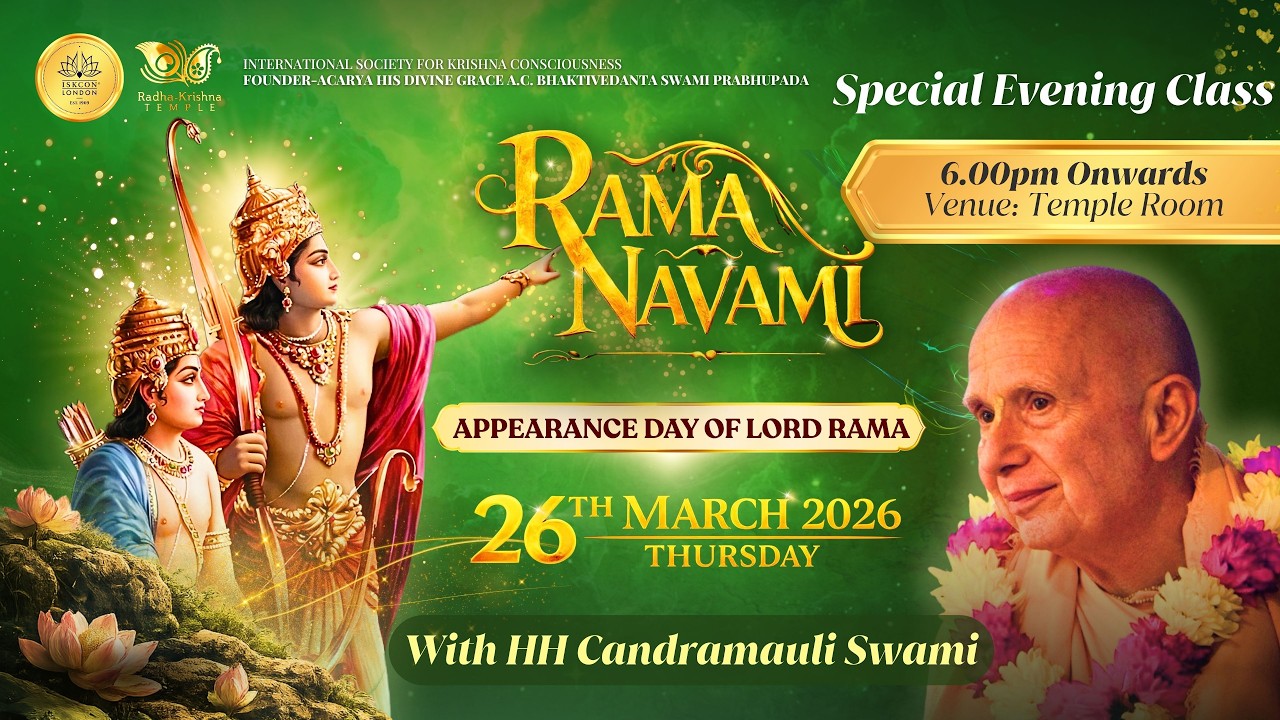
Rama Navami 2026 is marked by a special evening class on 26 March 2026 with His Holiness Chandramauli Swami Maharaja. Centred in the Gaudiya Vaishnava lineage within ISKCON (International Society for Krishna Consciousness), this session examines Śrī Rāmacandra as the ideal sovereign (Maryada Purushottama), while translating festival devotion into sustainable daily practice aligned with dharma and compassionate leadership.
Within the classical Vaishnava theological framework, the avatāra doctrine (avatāra-tattva) recognises innumerable divine descents suited to time, place, and circumstance. The Brahma-samhita encapsulates this flexibility and plenitude: rāmādi-mūrtiṣu kalā-niyamena tiṣṭhan nānāvatāram akarod bhuvaneṣu kintu kṛṣṇaḥ svayam samabhavat paramaḥ pumān yo (Brahma-saṁhitā 5.39). This verse affirms a spectrum of manifestations that includes Rāma among countless forms, all oriented toward dharma’s restoration.
Scripturally, Śrī Rāma’s life and governance are preserved chiefly in the Vālmīki Rāmāyaṇa and summarised in Śrīmad-Bhāgavatam (Canto 9), with additional interpretive richness in works such as the Adhyātma Rāmāyaṇa, Kamba Rāmāyaṇam, and Rāmcharitmānas. Traditional Purāṇic chronology situates the avatāra in Tretā-yuga, often expressed as more than two million years ago in the classical time-cycle model, whereas modern academic discourse commonly treats the epic as itihāsahistory suffused with moral, spiritual, and cultural meaning.
Chandramauli Swami Maharaja’s teaching style typically integrates textual exegesis with lived application. The evening class framework is expected to draw from primary texts, highlight decisive episodes of the Rāmāyaṇa, and extract principles of rajadharmajustice, restraint, service, truthfulness, and protection of the vulnerablethat remain relevant to contemporary public life and personal ethics.
As Maryada Purushottama, Śrī Rāma models disciplined virtue bound by vows. The decision to honour Daśaratha’s promise, voluntary acceptance of exile, and equanimity in adversity exemplify leadership that privileges ethical constraint over expedience. This paradigm offers a counterpoint to purely utilitarian governance: moral legitimacy is presented as a non-negotiable bedrock of sustainable authority.
Rajadharma in the Rāmāyaṇa is not merely legalism; it is a civilisational ethic. Episodes such as the Vāli encounter, the forging of alliances with Vānara communities, and the war-time conduct in Laṅkā invite reflection on proportionality, procedural fairness, and accountability. Commentarial traditions have long debated these moments, yielding a sophisticated discourse on means and ends that resonates with current debates in ethics, law, and international relations.
Śrī Rāma’s reign (Rāma-rājya) functions as an archetype of just governance: social trust, distributive fairness, accessible justice, and the ruler’s self-restraint. In contemporary terms, it translates into institutional integrity, citizen-centred service delivery, and community welfare, all grounded in a ruler’s internalised discipline (sva-dharma). Chandramauli Swami Maharaja often emphasises that character formation precedes systemic reform.
From a Gaudiya Vaishnava standpoint, avatāra-tattva is mapped with analytical precision: puruṣa-avatāras, līlā-avatāras (such as Rāma), guṇa-avatāras, manvantara-avatāras, and śaktyāveśa-avatāras. Śrīmad-Bhāgavatam 1.3 catalogs these manifestations and frames their educative purposepreserving cosmic order while offering practicable pathways for devotion (bhakti) and ethical life.
Rama Navami celebrations typically align with Chaitra Shukla Navami. Devotees observe vrata (fasting), recitations from the Rāmāyaṇa, and pūjā with pañcopacāra or daśopacāra offerings. In several regional traditions, the kalyāṇotsava (divine wedding) of Śrī Rāma and Sītā is commemorated, notably at Bhadrachalam and other historic temples, underlining the ideal of harmonious household dharma and shared public joy.
Gaudiya Vaishnavism affirms the Name’s potency as spiritual praxis. The remembrance and chanting of “Rāma” permeate diverse bhakti lineages; the rāma-nāma is praised for its capacity to centre the mind, refine intention, and align conduct with compassion and truth. Chandramauli Swami Maharaja typically underscores that nāma-saṅkīrtana, when coupled with study and service, consolidates inner steadiness.
While articulated in a Vaishnava framework, the class content naturally dovetails with shared dharmic values across Hinduism, Buddhism, Jainism, and Sikhism. The Buddhist emphasis on right conduct and compassionate governance, Jain commitments to ahiṁsā and aparigraha, and Sikh principles of sevā and sat (truth) converge with Rāma’s exemplification of ethical rule. This common ground fosters inter-tradition respect and unity without erasing doctrinal particularities.
An interdisciplinary reading reveals the Rāmāyaṇa as an ethical casebook. Themes include vow-keeping versus situational necessity, the tension between private sentiment and public duty, and the judicious application of force. These motifs inform contemporary leadership training: cultivating clarity of purpose, procedural justice, and the courage to accept short-term discomfort for long-term moral coherence.
The question of historicity is handled with methodological care. Traditional accounts accept Purāṇic chronology and cyclical time, whereas academic historiography prioritises textual criticism, archaeology, and comparative philology. A balanced approach recognises the epic’s living authority for practitioners while welcoming scholarly tools that illuminate linguistic strata, regional adaptations, and reception history.
Pedagogically, Chandramauli Swami Maharaja’s evening class is well-suited to a blended methodology: close reading of selected ślokas, thematic synthesis, and applied reflection. This sequencing helps participants carry festival inspiration beyond ceremonytoward sādhanā routines, study schedules, and concrete service commitments that integrate contemplation with action.
Core takeaways anticipated from such a session include a refined grasp of avatāra-tattva; a clearer sense of how rajadharma informs personal and institutional ethics; and a practical template for daily spiritual discipline. Many participants report that Rama Navami becomes a renewal point for recommitting to truthfulness (satya), compassion (dayā), self-mastery (dama), and service (sevā).
From a ritual standpoint, the festival invites mindful observances: simple, sattvic food; uninterrupted study intervals for the Rāmāyaṇa; and quiet time reserved for japa or kīrtana. These practices stabilise attention and nurture the virtues celebrated in Śrī Rāma’s character, allowing devotion to mature into habit and habit into second nature.
Ethically, the Rāmāyaṇa foregrounds the inseparability of means and ends. Episodes surrounding diplomacy with Sugrīva, compassion toward Vibhīṣaṇa, and balanced firmness in the Laṅkā campaign model a dharma-yuddha ethic predicated on restraint, clarity, and restoration over vengeance. Such framing remains germane to everything from community leadership to conflict resolution.
Comparative dharma studies further contextualise the epic’s insights. The Buddhist list of pāramitās (perfections), the Jain mahāvratas, and Sikh gurmat ethics furnish parallel commitments to non-harm, truth, contentment, and generosity. Read together, these strands strengthen a shared civilisational vocabulary of ethical action and interfaith respect.
In Gaudiya practice, scriptural synthesis links the Rāmāyaṇa to Śrīmad-Bhāgavatam’s devotion-centric telos. The recognition of numerous divine manifestations neither fragments divinity nor diminishes any form; rather, it accentuates the adaptability of the Absolute to uplift communities according to their psychologies, cultures, and historical needsprecisely the sense conveyed by rāmādi-mūrtiṣu kalā-niyamena tiṣṭhan.
Leadership studies often note that Śrī Rāma’s authority flows from integrity. The class is poised to highlight how inner governancemastery of impulse, clarity in speech, and constancy in dutyprecedes competent outer governance. This alignment offers a replicable model for family life, institutions, and public service.
For readers seeking structured engagement beyond the festival day, a practical progression might include: daily rāma-nāma japa at a fixed time; a paced reading of the Vālmīki Rāmāyaṇa or a respected regional retelling; weekly satsanga or discussion; and a concrete sevā initiative that addresses a local need, anchoring devotion in public good.
Rama Navami also carries a pedagogical opportunity for families and community groups. Storytelling, music, and the artsKatha, kīrtana, and classical danceoffer multisensory pathways into the epic’s ethical universe, making the values of truthfulness, courage, and compassion tangible for younger generations.
In summary, the 26 March 2026 evening class with HH Chandramauli Swami Maharaja situates Śrī Rāma within a robust theological and ethical frame while inviting participants to enact those ideals in personal routines and collective life. By illuminating intersections with broader dharmic traditions, it advances unity-in-diversityhonouring distinct pathways while foregrounding shared commitments to dharma, ahiṁsā, truth, and service.
Approached in this way, Rama Navami becomes more than commemoration; it becomes orientationa re-alignment of intention and habit with the luminous ideal of Maryada Purushottama. The fruit of such alignment is described not only in scriptural verses but in transformed communities defined by integrity, empathy, and steadfast care for all beings.
Inspired by this post on Dandavats.