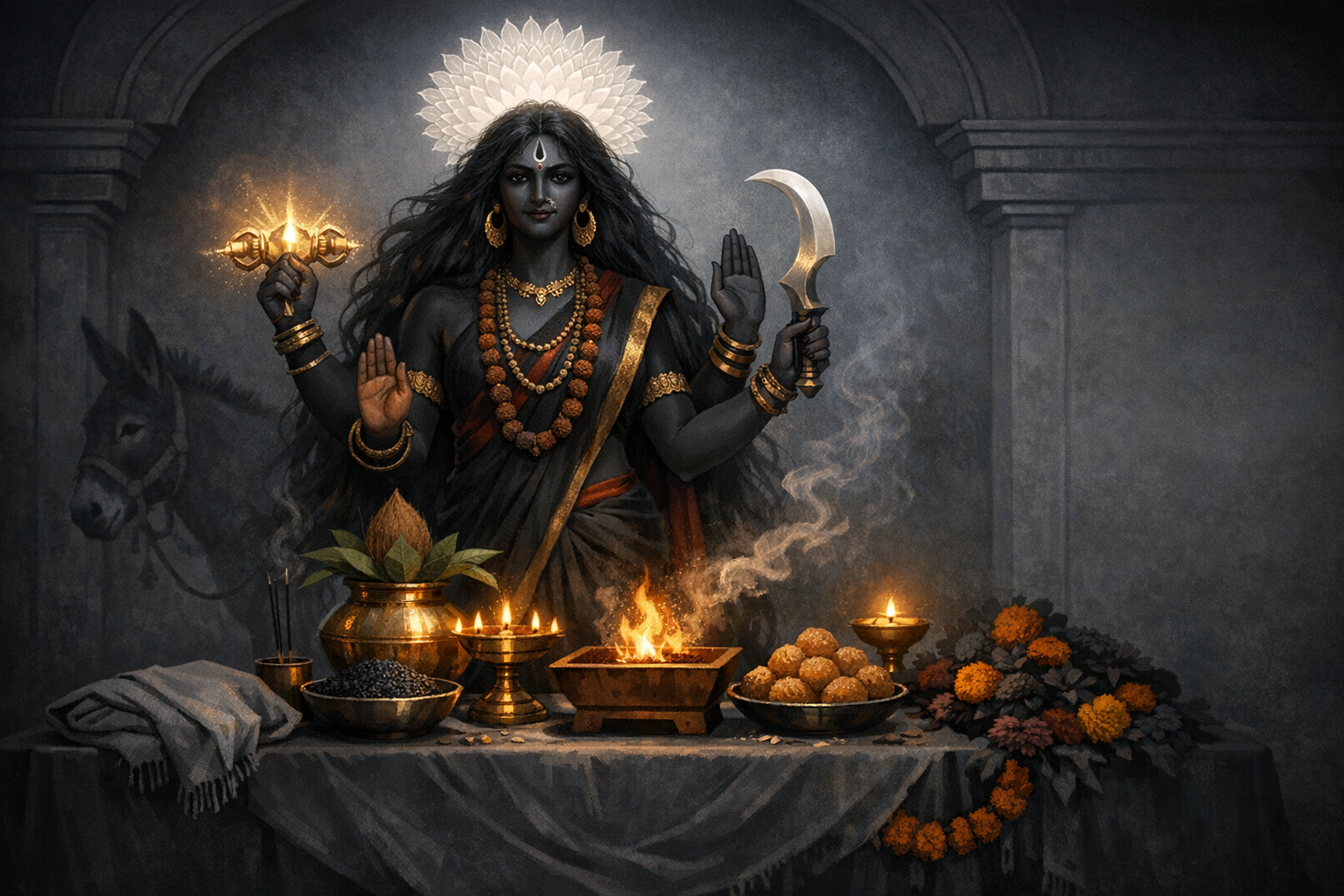
The seventh day of Navratri (Saptami) venerates Goddess Kalaratri, the most fear-dispelling and transformative form of Durga. In the Shakta tradition, Kalaratri signifies the destruction of darkness (tamas) and the dissolution of inner obstacles, yet she is also known as Shubankari“the auspicious one”because her fierce grace ultimately bestows protection, clarity, and wellbeing. Her iconographydark radiance, a vajra and cleaver in the left hands, abhaya and varada mudras in the right, and the vahana of a donkeyteaches spiritual fearlessness and disciplined compassion.
For 2026, the seventh day occurs twice: during Chaitra Navratri on 25 March 2026 and during Shardiya Navratri on 17 October 2026 in most regional panchangs. This guide focuses on Chaitra Navratri Saptami (25 March 2026), while noting that the same puja-vidhi and contemplative steps apply to the Sharad season as well. As tithi timings can span two civil dates across geographies, it is advisable to confirm local sunrise, tithi start–end, and sandhya windows with a trusted regional panchang.
Beyond ritual, Kalaratri’s teaching is a rigorous inner discipline: to meet fear with wisdom, inertia with effort, and confusion with insight. In many lineages, this day is mapped to the Sahasrara chakra (the thousand-petalled lotus), emblematic of transcendence and luminous awareness. The widely observed color for Saptami is grey, symbolizing the alchemy of shadow into strength; many also use black to honor the goddess’s tamas-dissolving power. Within the broader dharmic familyHinduism, Buddhism, Jainism, and Sikhismthe shared ethical arc is unmistakable: conquer inner afflictions, cultivate non-violence and service, and embody fearless compassion.
1. Set an informed sankalpa aligned to Saptami and protection. After verifying Chaitra Shukla Saptami locally for 25 March 2026, articulate a clear sankalpa stating place, date, name, and intention (śubha-kārya-siddhi, bhaya-śoka-vināśa, and sarva-kalyāṇa). This intentional framing is not symbolic alone; it is the cognitive anchor that directs attention, stabilizes practice, and makes the day’s ritual steps coherent.
2. Prepare a simple, sattvic altar oriented for fierce grace. A clean surface dressed with grey or black cloth, a kalasha with water, mango or ashoka leaves, and coconut, a ghee or sesame-oil lamp (deepa), dhoopa (incense), flowers, and naivedya establish the ritual field. Facing west is traditional for fierce forms of the goddess, though north-facing is also observed. Keep all implements safe and stable; fire safety and adequate ventilation are essential.
3. Perform a Shodashopachara Kalaratri Puja with the moola mantra. After āvāhana and āsana, offer pādya, arghya, āchamana, snāna (abhisheka if customary), vastra, yajnopavita, gandha, pushpa, dhoopa, deepa, naivedya, tāmbūla, dakshina, and conclude with pradakshina–namaskara and visarjana. Offerings associated with Kalaratri include sesame (til), jaggery (gur), and dark-hued blossoms. The moola mantra ॐ देवी कालरात्र्यै नमः may be recited in 108 or 1008 japa counts. A widely loved stutiया देवी सर्वभूतेषु शक्तिरूपेण संस्थिता नमस्तस्यै नमस्तस्यै नमस्तस्यै नमो नमःintegrates beautifully before or after naivedya.
4. Recite texts that consolidate inner courage and clarity. The Devi Mahatmya (Durga Saptashati/Chandi Path) is authoritative; many practitioners favor reading Adhyayas 8–10 on Saptami, preceded by Kavacha–Argala–Keelaka. A Kalaratri-stotra or names from the Durga Ashtottara/Sahasranama also deepen bhakti. For those seeking brevity with depth, sustained japa of ॐ देवी कालरात्र्यै नमः with attentive breath regulation is precise and potent.
5. Observe a disciplined Saptami fast (vrata) with sattvic guidelines. Customarily, devotees follow phalahara (fruit), milk, or light sattvic meals without onion–garlic, choosing whole grains such as samak or kuttu flour if permitted in their family tradition. Hydration is maintained with water or lemon-water; break the fast after the evening or night puja with prasadsweet offerings of jaggery, sesame laddus, or kheer are common for Kalaratri. Dietary discipline is not merely prohibitive; it optimizes steadiness for mantra, meditation, and havan.
6. Offer a succinct Saptami havan for protection and purification. A small-scale homa with black sesame, guggul, and cow ghee as ahuti, using the mantra ॐ देवी कालरात्र्यै नमः स्वाहा for 11, 27, or 108 offerings, aligns well with the day’s sankalpa. Keep a fireproof base, a nearby lid or damp cloth for safety, and adequate ventilation. Havan shifts the ritual from symbolic offering to embodied breath–fire coordination, reinforcing focus and resolve.
7. Undertake night sadhana: sahasrara-focused meditation and pranayama. Ratri-jagran on Saptami is a time-honored practice, but it is best approached with structure: 5–10 minutes of nadi shodhana (alternate nostril breathing), 15–30 minutes of mantra-japa synchronized to the breath, and 10–20 minutes of silent meditation. Visualizing a cool, white radiance at the crown aligns with the Sahasrara mapping for Kalaratri. Many practitioners report that such steady nocturnal practice reduces anxiety reactivity and enhances equanimity the next day.
8. Practice seva and dana with a dharmic-unity ethos. Donations of black or grey clothing, sesame, oil, blankets, or educational support to women and children resonate strongly with Kalaratri’s Shubankari aspect. Annadanam at temples or community kitchens, volunteering at a langar, supporting animal shelters, or contributing to healthcare initiatives extends the day’s protection to the vulnerable. This shared ethic of compassionate service is cherished across Hindu, Buddhist, Jain, and Sikh communities, strengthening inter-dharmic harmony.
9. Light protective deepas and perform simple graha-shanti upaya. Lighting a sesame-oil lamp at the home threshold during the evening sandhya is a traditional nazar–nivaran and protection rite. Where family tradition permits, one may place a small amount of black sesame near the main door and later offer it respectfully to a flowing water source. When Saptami aligns with challenging personal transits, a brief Saturn–Mars pacification (for example, a sesame or jaggery donation, or Hanuman Chalisa recitation in the evening) is sometimes observed in lineages that integrate graha-shanti with Navratri.
10. Study, reflect, and integrate the teaching into daily conduct. Reading a passage from the Devi Upanishad or a relevant section of the Bhagavad Gita (e.g., 4.7–8 on dharma-restoration) followed by journaling about fear, habit, and skillful action converts ritual insight into lived practice. Many families also use Saptami to plan Kanya Puja logistics for Ashtami/Navami, ensuring care, dignity, and thoughtful gifting for the young girls who will be welcomed as embodiments of the Devi.
For those observing color and bhog conventions, grey attire is widely chosen on Day 7 to signify transformation; black accents may be included reverentially for Kalaratri. Naivedya often features gur-based sweets, sesame preparations, or kheer, reflecting the day’s protective and nourishing mood. Where regional traditions suggest specific flowers, leaves, or local sweets, honoring that continuity enriches the observance.
A practical pacing for 25 March 2026 integrates morning sankalpa and puja, midday stotra or a short Chandi recitation during the Abhijit window if available, evening sandhya with deepa and naivedya, and a measured night sadhana. Families often find that sharing a brief reflective circlenaming a fear, an aspiration, and a concrete next stepstrengthens bonds and aligns personal growth with the festival’s spiritual current.
In essence, Kalaratri Saptami is not a “day of wrath,” but a methodical rite of inner renewal. By combining puja-vidhi, japa, havan, meditation, and seva, practitioners harness the fierce gentleness of Shubankariremoving darkness without animosity and guarding wellbeing without exclusion. Observed on 25 March 2026 in the Chaitra cycle, and echoed again in October, Day 7 stands as a meticulously designed moment in the Navadurga arc to cultivate protection, insight, and fearless compassion for oneself and the wider community.
Inspired by this post on Hindu Pad.