The ancient city of Kolhapur in Maharashtra owes its very name and sanctity to a profound Purāṇic narrative in which devotion, divine intervention, and redemption converge. Preserved in the Karavira Mahatmya of the Skanda Purana, the legend recounts how Mahalakshmirevered locally as Ambabaiestablished an abiding presence in this sacred land, transforming Karavira-kshetra into a living center of Shakti worship and a renowned pilgrimage node for seekers across generations.
As a tirtha-mahatmya, the Karavira Mahatmya functions both as sacred geography and theological map. Embedded within the Sahyadri Khanda of the Skanda Purana, it sets forth the religious topography of Karavira, enumerating its rivers, ghats, shrines, and merits of pilgrimage, while canonizing the temple’s foundation story. The narrative structure follows a classical Purāṇic pattern: the rise of adharma, the invocation of the Goddess, the restoration of order, and the moral coda of compassion and grace.
In the core legend, the asura Kolhaalso remembered as Kolhasurobtains power and subjugates Karavira. Responding to the appeals of sages and devas, Mahalakshmi descends as Karavīra Nivāsinī. Through a series of confrontations, she liberates the land and brings an end to Kolha’s tyranny. On the cusp of defeat, Kolha seeks a final boon: that the city bear his name and that the Goddess dwell here for the welfare of all. Granting both petitions, Mahalakshmi affirms a theology not of mere conquest but of restorative justice and ultimate redemption, where even the vanquished contributes to communal memory and place-nameKolhapur.
This puranic arc is emblematic of dharma’s return through Shakti tempered by karuna. The redemptive ending positions the legend as more than a triumphal tale; it becomes a meditation on transformation. Its ethical horizon resonates across dharmic traditions: self-mastery and the stilling of inner afflictions emphasized in Jain practice, the cessation of duḥkha through insight in Buddhism, the Sikh ideals of sarbat da bhala and nadar (grace), and the Hindu understanding of Shakti as the compassionate force that reorders cosmos and conscience alike.
Historically, the Kolhapur Mahalakshmi Temple (Ambabai) displays layered architectural phases. Early medieval cores are legible in black basalt masonry, with later accretions during Yadava and Maratha periods. The fabric commonly associated with Hemadpanti techniquecharacterized by robust stone courses and practical, rhythmic detailingframes a clear ritual axis from the mandapa to the garbhagriha. The complex includes deepamalas (lamp towers), subsidiary shrines, and carved stone screens, situating the sanctum within an integrated sacral precinct.
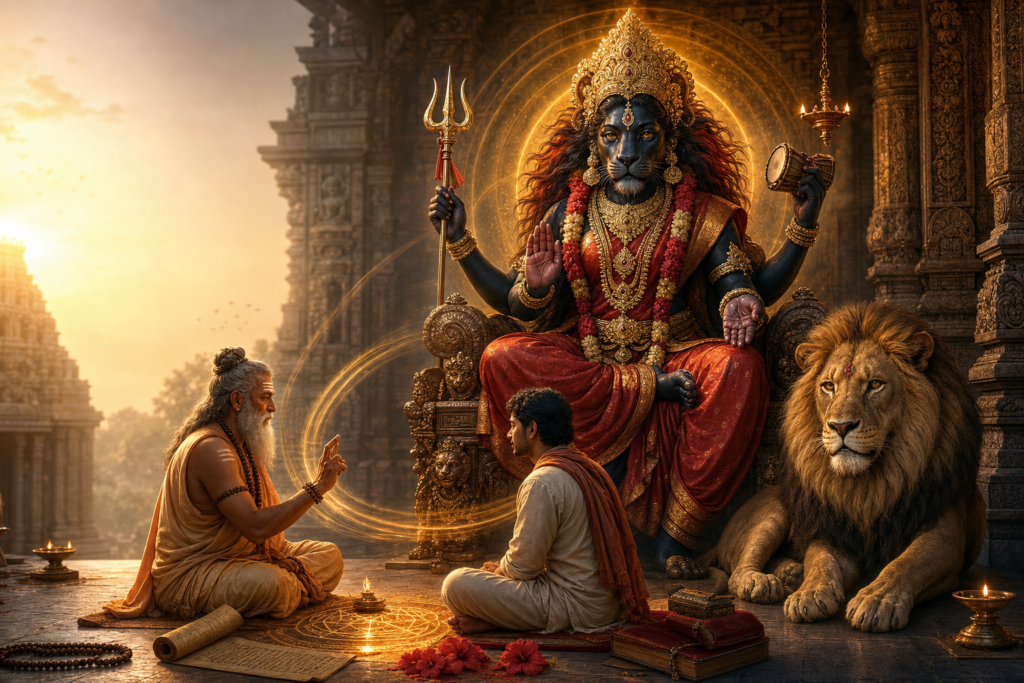
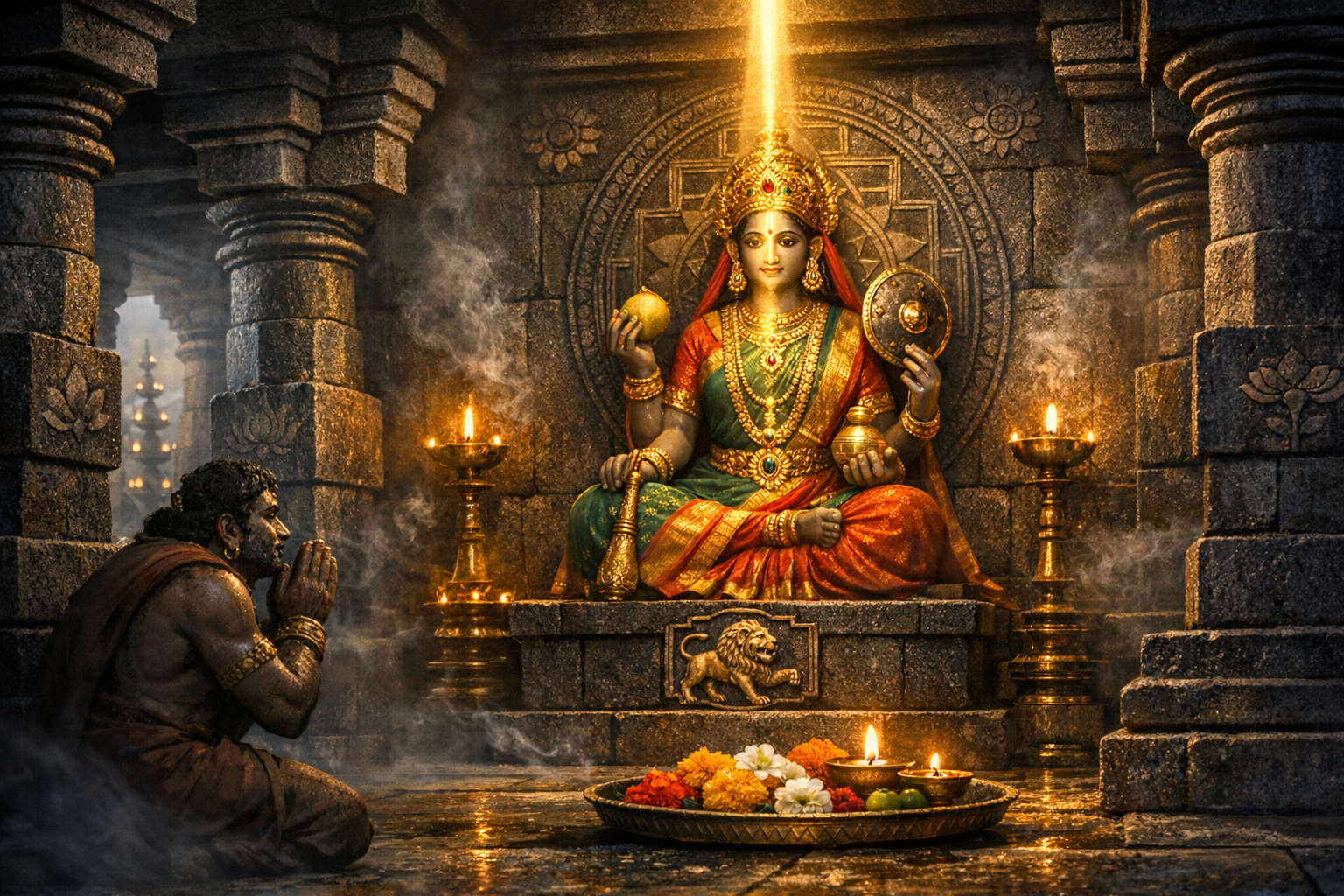
The iconography of Ambabai is both distinctive and theologically rich. The four-armed image, crowned and bejeweled, typically holds a matulinga (citron), khetaka (shield), gada (mace), and a small vessel (often described as a panapatra), while the simha (lion) signifies royal power and fearless protection. The presence of a Sriyantra and nearby shrines to other deities reflect a Shakta–Vaishnava synthesis long characteristic of Maharashtra’s devotional landscape, where sectarian streams interflow within a shared sacred space.
A notable feature of the temple is the biannual solar event popularly known as Kiranotsava (or Kirnotsav). On select days aligned with the Sun’s transit, a beam of sunlight threads the sanctum’s axis to illumine the deityfrom feet, to torso, to faceover successive evenings. The phenomenon speaks to deliberate orientation and an accomplished understanding of solar geometry by early temple builders, intertwining architecture with cosmology in a precise, experiential liturgy of light.
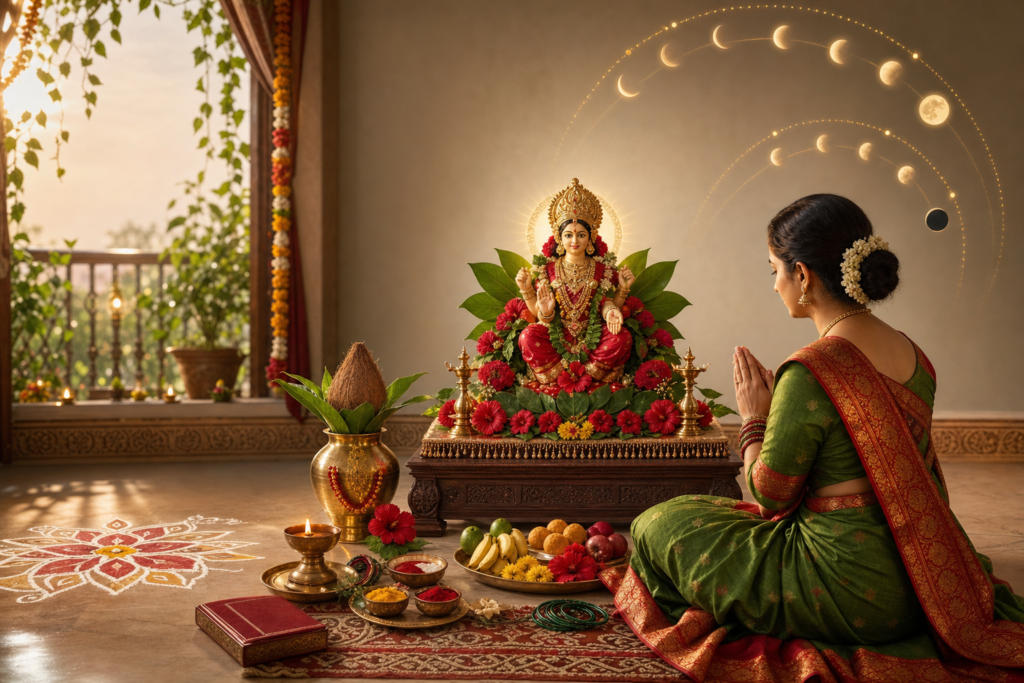
The ritual calendar is dense and participatory. Daily abhisheka, alankara, naivedya, and arati structure the liturgical core, while weekly observancesespecially the auspicious Margashirsha Fridays dedicated to Lakshmidraw large congregations. Seasonal celebrations, including the Navratri cycle and other regional utsavas, anchor communal rhythms of worship, charity (dana), and service (seva). Processions, music, and shared meals cultivate social cohesion around a sacred focal point.
In sacred geography, Karavira-kshetra encompasses the Panchaganga River and a constellation of tirthas referenced in the Karavira Mahatmya. The region’s pilgrimage circuits naturally intersect with other Shakti centers in Maharashtra, such as Tuljapur Bhavani and Saptashrungi, reflecting a culturally embedded pattern of multi-shrine yatras. This networked sacred landscape reinforces the idea that devotion unfolds as a journey through interlinked sites of memory, meaning, and merit.
Over centuries, the temple has remained a civic and cultural anchor. Rulers and communities patronized repairs, additions, and festivals, weaving Ambabai devotion into Kolhapur’s urban identity, artisanal economies, and seasonal livelihoods. Beyond ritual, the precinct has functioned as a commons of counsel, celebration, and collective resolvean exemplary case of how temples in India serve both spiritual and civic life.
The legend’s moral grammar extends a unifying message for all dharmic traditionsHinduism, Buddhism, Jainism, and Sikhism. It foregrounds the conquest of inner “Kolha”: pride, greed, and delusion. Mahalakshmi’s abiding grace mirrors the universal quest for balance, virtue, and compassion. Pilgrims from diverse lineages often participate in the cultural and ethical life of the shrine while remaining true to their paths, embodying India’s longstanding ethos of unity in spiritual diversity.
For many visitors, the experiential core is unforgettable. As a golden sunbeam glides across the sanctum during Kiranotsava, a shared hush often descendsan intergenerational moment of wonder binding families, neighbors, and strangers. The fragrance of lamps, the cadence of bells, and the sight of Ambabai’s adorned image together compose a living pedagogy of reverence, continuity, and hope.
Read as allegory, Kolhasur personifies the turbulent impulses that unsettle individuals and societies; Ambabai symbolizes the stabilizing inner Shakti that reorients life toward dharma. The demon’s final request and the Goddess’s promise form a charter for humility and grace: memory is not erased but transformed, and place-names themselves become vessels of ethical remembrance.
Responsible pilgrimage naturally follows from such insights. Observing local customs, queuing patiently, choosing eco-conscious offerings, and supporting heritage care sustain both sanctity and site. In this way, devotion aligns with stewardship, preserving the temple’s integrity for future generations.
The Kolhapur Mahalakshmi Temple thus unites text, stone, ritual, and sky. Through the Karavira Mahatmya, the architectural precision of its sanctum, the luminosity of Kiranotsava, and the rhythm of collective worship, Karavira remains what the Purana intended it to be: a place where divine presence and human aspiration meet, and where dharmic unity is not an abstraction but a daily, shared practice.
Inspired by this post on Hindu Blog.