The Maitrayaniya Upanishad, also known as the Maitri Upanishad, is a compelling testament to the depth and range of Vedic inquiry. Belonging to the Maitrayaniya shakha of the Krishna Yajurveda, it explores the nature of the Self (atman), ultimate reality (Brahman), the problem of suffering, and the yogic means to liberation. While not always listed among the so-called “major” or Mukhya Upanishads, it occupies a pivotal place in the late-Upanishadic corpus for its unusually systematic synthesis of Vedanta and early Yoga.
The text’s dual title reflects both school affiliation and thematic emphasis. “Maitrayaniya” identifies its Vedic lineage, whereas “Maitri” alludes to a traditional association within that school. Its voice is unmistakably Upanishadicprobing, dialogical, and soteriologicalyet its language and categories often anticipate classical Yoga and later Vedanta, making it a bridge across key currents of Indian philosophy.
On dating, traditional memory places the teaching in deep Vedic antiquity. Modern textual scholarship, however, typically situates its composition in the late Upanishadic period, roughly between the 4th and 2nd centuries BCE, with possible later accretions in the early centuries CE. This layered formation helps explain why the Maitri Upanishad reads both as a culmination of earlier Vedic intuitions and as a formative source for subsequent yogic and Vedantic discourse.
Structurally, manuscripts present six or seven prapathakas (lessons), combining prose with verse and doctrinal analysis with meditative instruction. This organization allows the text to move from existential questioning and metaphysical statements toward practical disciplines, culminating in a concise yoga framework famous for its sixfold articulation. The overall movement mirrors the Upanishadic path: from inquiry to insight to interiorization.
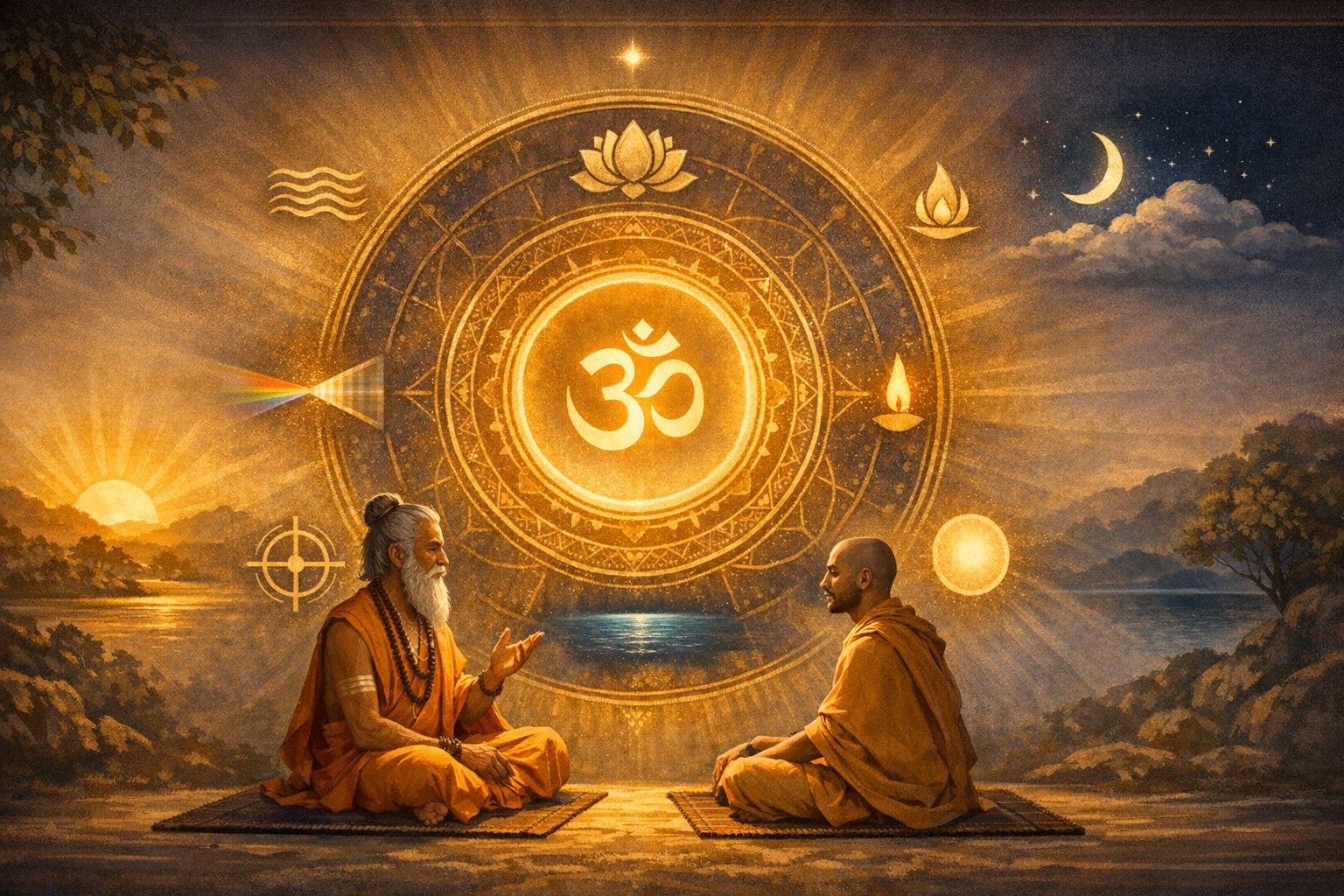
The narrative frame often takes the form of dialoguesmost notably teachings delivered by the sage Śakayanya to a royal renunciatethereby situating intense philosophical reflection within the lived drama of renunciation, duty, and the thirst for release (moksha). This dialogical setting renders the abstract concrete, as questions about suffering, time, and consciousness are pressed toward experiential resolution rather than left at the level of theory.
One of the Maitri Upanishad’s distinctive contributions is its analysis of time (kāla). The text explores two modalities: “time” as the ordered, cyclic process that shapes phenomenal life, and “non-time” as the timeless ground beyond process. While acknowledging that time pervades and measures the world, the Upanishad ultimately discloses a Self that stands beyond timeBrahman as the non-temporal support, known not through sensory extension but through direct insight.
Equally significant is its acute psychological insight: the mind can function as both obstacle and instrument. By projecting multiplicity, the mind binds; by becoming clear and one-pointed, it reveals the Self. The text also engages the classical “threefold suffering” (tāpa-traya)adhyātmika (pertaining to body-mind), adhibhautika (arising from other beings), and adhidaivika (stemming from forces beyond immediate control)and prescribes knowledge (vidyā) and disciplined practice as a combined remedy. In doing so, it aligns philosophical clarity with practical transformation.
In keeping with Vedic tradition, the Maitri Upanishad highlights meditation on Om (praṇava) as a direct means of interiorization. Om functions as a sonic emblem of Brahman and a concentrative aid, harmonizing breath, attention, and meaning. Meditating on Omunderstood as encompassing waking, dream, deep sleep, and the unconditionedguides the practitioner from the shifting thresholds of experience to the steady light of awareness.
The analysis of consciousness bears classic Upanishadic features: waking (jāgrat), dream (svapna), and deep sleep (suṣupti) form a triad through which the nature of awareness is examined. The text points beyond all three to a fourth, unconditioned mode often glossed in the tradition as turīyathe silent, witnessing Self that neither comes nor goes and in which the other states arise and subside. This contemplative phenomenology serves not only as metaphysical doctrine but as a map for meditative verification.
Perhaps the Maitri Upanishad’s most cited contribution is its enumeration of the sixfold Yoga. In several passages, it presents a compact yet influential sequence: prāṇāyāma (regulation of breath), pratyāhāra (withdrawal of the senses), dhyāna (meditative absorption), dhāraṇā (stabilized concentration), tarka (discriminative inquiry), and samādhi (unitive absorption). The order reveals a pedagogy: physiological calming and sensory restraint enable steady attention; stabilized attention supports inquiry; clear discernment matures into non-dual absorption.
Each limb carries technical nuance. Prāṇāyāma steadies the oscillations of breath and mind through measured inhalation, retention, and exhalation. Pratyāhāra refines this steadiness into independence from sensory compulsion. Dhyāna and dhāraṇā build a quiet, luminous attention that can stay with its chosen support without fatigue. Tarka, here not mere disputation but a contemplative discrimination, clarifies the real (satya) from the transient (anitya). Samādhi, finally, names the shift from conceptual knowing to direct, non-dual apprehension of atman as Brahman.
This yoga is not set against knowledge; it is knowledge’s ally. The Maitri Upanishad insists that insight without inner discipline can remain brittle, while practice without discernment can drift. Their integrationVedanta’s non-dual vision conjoined with yoga’s interior technologiesbecomes the hallmark of the text’s soteriology. In contemporary terms, it aligns contemplative science (method) with metaphysical clarity (meaning), yielding a path that is both rigorous and compassionate.
Readers across dharmic traditions often recognize resonances here. The shared concern with suffering and its cessation recalls Buddhist analysis, even as the Upanishad’s affirmation of atman differs from Buddhist anatta. Jain reflections on disciplined conduct and interior purity converge with the text’s emphasis on restraint and clarity. Sikh remembrance of the One (Ik Onkar) parallels the Upanishadic insistence on a single, all-pervading Brahman. Such convergences affirm a broad unity-in-diversitydistinct vocabularies and insights serving a common aspiration toward truth, compassion, and liberation.
As a late Upanishad, the Maitri also helped shape discussions within Advaita Vedanta and enriched the conceptual grammar of early Yoga. Its sixfold sequence anticipates and complements later systematizations, while its meditations on Om and states of consciousness inform subsequent exegesis. The text thus stands not merely as an archive of ideas but as an active interlocutor in India’s intellectual history.
Text-critically, recensional variation matters. Some manuscripts transmit six prapathakas, others seven; vocabulary and arrangement can vary, suggesting historical layering. These features do not diminish the work; they illuminate its growth, reception, and pedagogical flexibility. Responsible reading benefits from awareness of such layers, as well as from consulting multiple translations and, where possible, the Sanskrit.
Contemporary relevance is immediate. By contrasting time and the timeless, the Upanishad reframes modern anxieties around urgency, productivity, and loss. By positioning the mind as both problem and path, it invites practical training rather than self-reproach. By integrating Vedanta and Yoga, it offers a holistic disciplineclear seeing supported by stable attentionequally at home in solitude and service, scholarship and daily life.
Practitioners commonly adapt its counsel in three steps. First, cultivate rhythmic breath (gentle prāṇāyāma) to steady attention. Second, withdraw periodically from sensory overload (brief pratyāhāra) and rest awareness in Om or a chosen focus (dhyāna & dhāraṇā). Third, engage reflective inquiry (tarka) to test appearances against what endures, allowing insight to ripen into quiet, non-dual presence (samādhi). Even short, consistent sessions can reshape one’s relationship to stress, clarity, and compassion.
In sum, the Maitrayaniya (Maitri) Upanishad presents a rare confluence: a subtle metaphysic of Brahman and atman; a phenomenology of consciousness; a sobering diagnosis of suffering; and a concise, actionable yoga. Its signature visiontimeless awareness shining through time-bound experiencecontinues to support seekers and scholars alike, and to strengthen bonds across Hinduism, Buddhism, Jainism, and Sikhism through shared dedication to wisdom, inner freedom, and the welfare of all beings.
Inspired by this post on Hindu Blog.