“The real India lives in her villages” remains a useful heuristic only when freed from two extremes that long distort discussion of Rural India: inherited colonial disdain on one side and uncritical romanticization on the other. A careful reading of nineteenth-century village life in South Indiaanchored in primary accounts and corroborated by socioeconomic contextreveals a complex, resilient social ecology whose lessons matter for contemporary debates on local governance, education, health, and cultural continuity across the dharmic traditions of Hinduism, Buddhism, Jainism, and Sikhism.
At the close of the nineteenth century, the Madras Presidency recorded roughly 31 million inhabitants, about ninety percent residing in more than 55,000 villages. Observing this milieu in 1891, B. Knight, a British joint collector, wrote: “It is in the villages of southern India that we must go to see Hindu life at its best, unaffected as it is by Mahommedan conquest or by the influence of Western civilisation.” While this statement bears the linguistic imprint of its time, it usefully directs attention to the village as a primary locus of cultural and institutional continuity in South Indian history.
Within this setting, the village of Kelambakkamsituated in the Chingleput (now Chengalpattu) district between Kanchipuram and Mahabalipuram (Mamallapuram)became the subject of a detailed portrait in T. Ramakrishna’s Life in an Indian Village (1891), a work accompanied by a foreword from Mountstuart Elphinstone Grant Duff. Local tradition places Kelambakkam’s origins in the 11th century, an era that also anchors many enduring Chola-period institutions of revenue, irrigation, and temple-based community life in South Indian history.
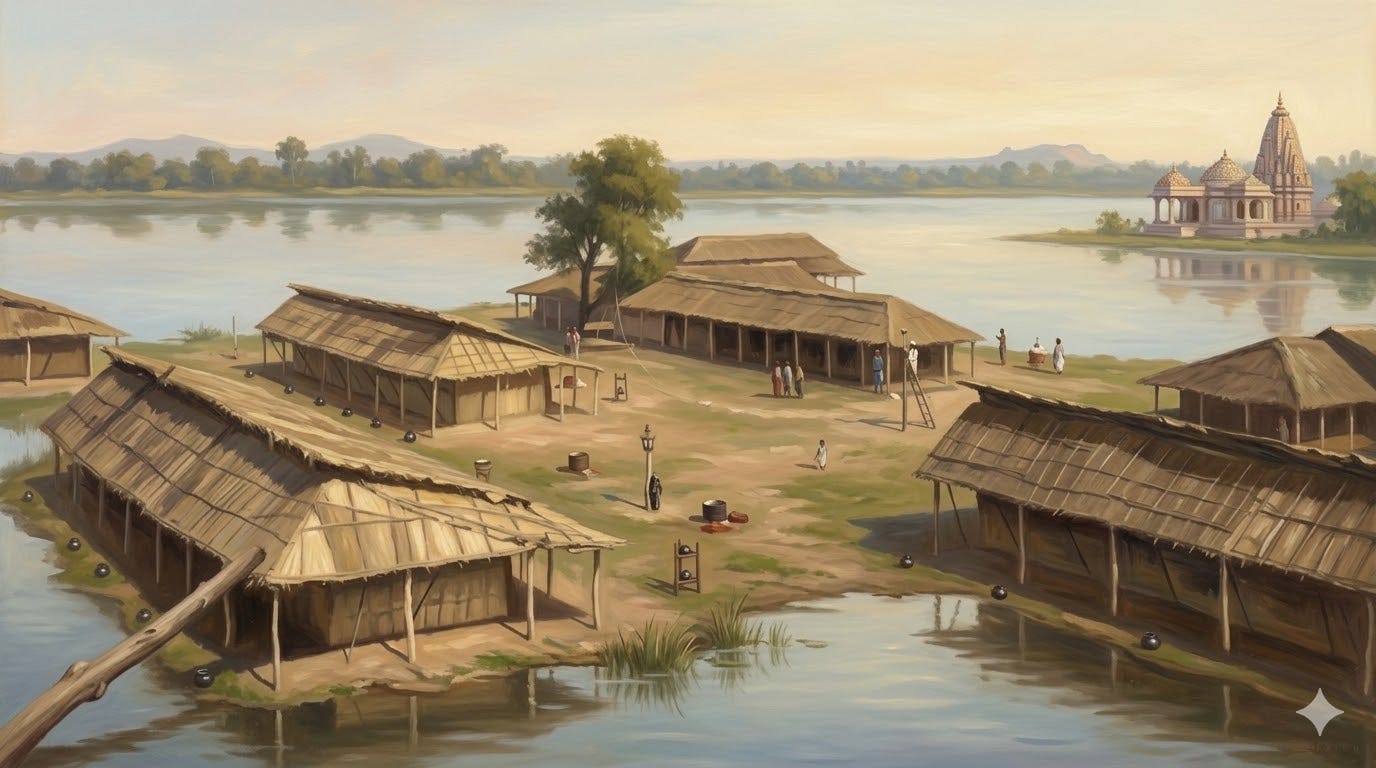
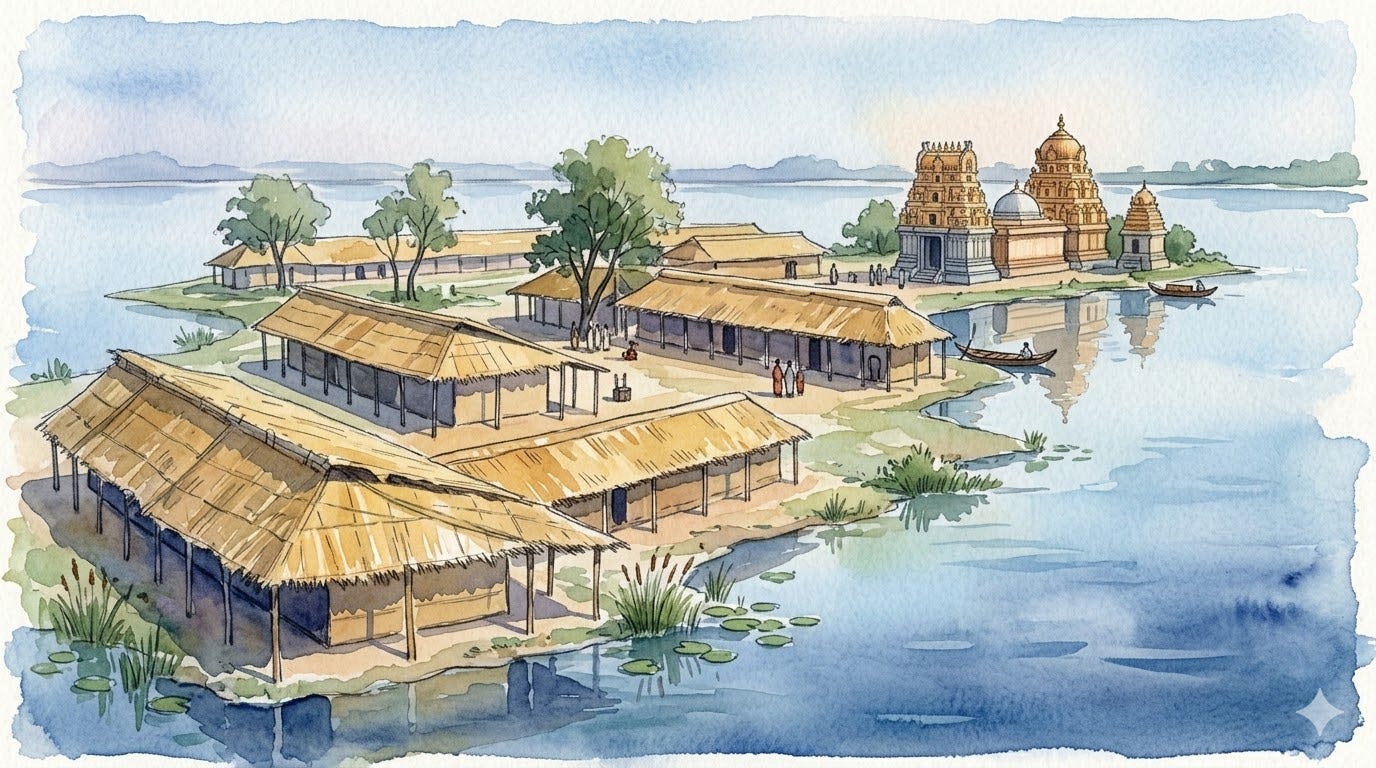
Ramakrishna’s account describes a village core shaded by tamarind, mango, cocoanut, and plantain; fifty to sixty dwellings, some thatched and others tiled; a small temple at the center; and surrounding it roughly five hundred acres of green fields sustained by a large irrigation tank capable of watering those fields for six months. With a population of about 300implying households averaging five to six membersKelambakkam exemplifies the classical South Indian agro-ecological unit: compact habitation, proximate temple precinct, and a tank-centered agricultural system.
Technically, the tank- or eri-based irrigation of Tamil Nadu balanced monsoon capture, percolation, and staged release through sluices into paddy fields, sustaining both wet cultivation and local groundwater recharge. Such hydraulic infrastructuresmaintained through communal labor regimes and seasonal repairunderwrote food security, crop scheduling, and risk management across years of variable rainfall. In this respect, Kelambakkam offers a precise microcosm for studying the Village Administration System and its tight coupling to water management in South Indian history.
Village governance, as described, vested primary executive responsibility in the Munsiff (headman), typically of respected ancestry, tasked with adjudicating petty civil and criminal matters, coordinating tax collection, and assisting higher authorities. Alongside stood the Karnam (village accountant), a role demanding exact knowledge of field boundaries, rents, and holdings, as well as mediation of monetary disputes. The Taliyari (watchman) provided night security, guarded ripening crops, and deterred theft. Together, these roles illustrate a layered, function-specific architecture of local order that resonates with wider patterns of panchayat-style self-governance.
Cultural and ritual life centered on the Purohita, a Brahmin versed in Sanskrit, astrology, and the “four thousand stanzas of the Divya Prabhandham.” Advisory functions extended beyond ritual performance to practical counsel in household and village matters, reflecting the dharmic ideal of integrating sacred and social obligations (dharma) with daily life. Temple worship proceeded in orderly turns by two other Brahmins, embedding collective participation into the liturgical calendar.
Education in Kelambakkam revolved around the Vadyar (schoolmaster), whose role combined pedagogy, pastoral care, and moral guidance. Instruction began before sunrise and continued in structured intervals through the day, blending literacy, arithmetic (including compound rules and simple interest), and recitation. Children learned letters by tracing on sanded floors, progressed to writing on cadjan (palm) leaves, and read aloud from cadjan books in a multi-age classroom. The school opened and closed with prayers to Saraswati and Vighneswara; holidays featured the memorization of poetical maxims and invocations such as “Victory be to Rama! Siva is everywhere!”an ethical curriculum oriented toward satya (truth), shraddha (devotion), and reverence for parents and elders.
The Vythian (physician) practiced according to the Vagadam, a Tamil text in verse, prescribing remedies and diets with authoritative citation. In consonance with the integrative ethos common across dharmic traditionswhere care spans body, mind, and spirittreatment also engaged religious observances to cultivate hope, social solidarity, and calm, aligning with the broader South Asian recognition of psycho-social dimensions in healing, analogous in spirit to classical Ayurveda’s balancing of tridosha with conduct, diet, and mental composure.
The local economy depended on interdependent crafts and services: carpenter, blacksmith, shepherd, washerman, potter, barber, and others, all regarded with courtesy and dignity. Compensation flowed through grain shares or rent-free service lands, a system designed to stabilize livelihoods and distribute risk. In many South Indian localities, such service tenures supported ongoing maintenance of common infrastructure including tanks, pathways, and temple assets, exemplifying a practical ethic of seva (service) that resonates across Hindu, Jain, Buddhist, and Sikh traditions.
Religious protection and public health intersected in the worship of the Grama Devata (village Goddess), whose pujaoften associated with warding off epidemic diseasewas conducted by a Pujari who also served occasionally as oracle. Contributions gathered during festivals and vow-fulfillments financed communal needs, reflecting the temple’s role as both spiritual anchor and civic institution.

The schoolhousearguably the village’s moral epicenteroperated as a multi-level learning laboratory. Five- to seven-year-olds voiced the alphabet while inscribing letters on sand; older pupils wrote on cadjan leaves, read from palm manuscripts, worked sums aloud, and recited metrical stanzas. Competency was assessed not by grade levels but by demonstrable mastery: clear reading and writing on cadjan, together with accuracy in arithmetic, typically achieved after four to five years. The Vadyar’s remit extended to home visits to ensure children took medicine, ate on time, and behaved responsiblyan early form of holistic student welfare integrated into community life.
The Ambattan (barber), Kailasam by name in the account, functioned simultaneously as hairdresser, village musician, and practical surgeon. No temple festival or household ceremony proceeded without the ensemble’s flutes and drums. Kailasam’s wife, Thoyamma, served as midwife, attending daily to new mothers and infantsbathing, administering simple remedies, and monitoring recoveryillustrating a gendered knowledge system of reproductive and neonatal care foundational to Rural India’s health ecology.
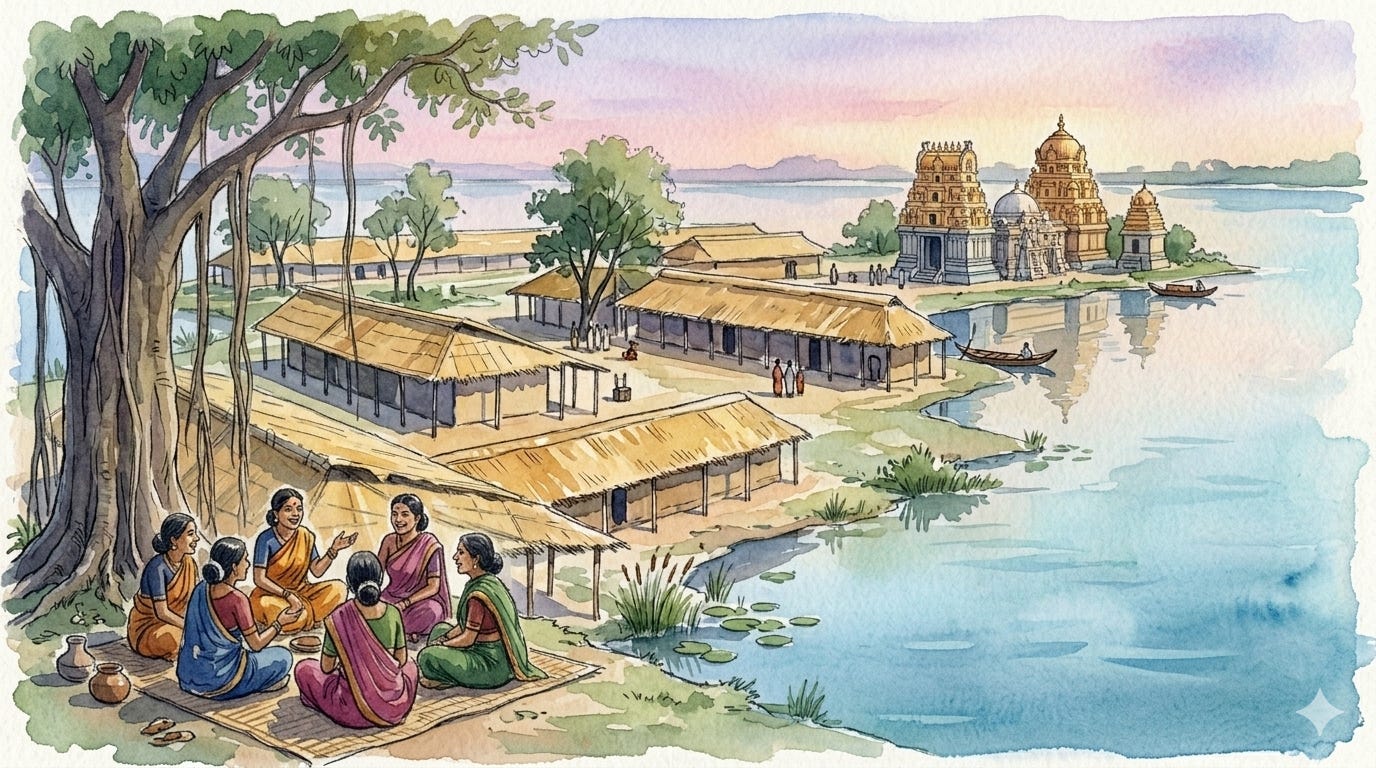
Ramakrishna’s narrative pushes back against the caricature of Indian women as merely “subordinate” or “child-bearing machines,” asserting instead that affection, intelligence, and wit infuse domestic and social exchanges in Kelambakkam. He cites the quiet dignity of conjugal love: “Unseen by man’s disturbing eye, love shines / Curtained from the sight / Of the gross world, illumining / One only mansion with her light.” While local realities undeniably varied across regions and strata, this portrait emphasizes social esteem, conversational acuity, and economic agency within households, reminding readers to ground assessments in situated evidence rather than sweeping generalization.
Taken as a whole, Kelambakkam appears as a self-regulating micro-polity“a little world in itself”preserving inherited practices even amid the broader influences of colonial administration and global trade. Work proceeded with machine-like regularity because roles, rights, obligations, and supports were mutually legible: cultivators thrived when rains were timely; artisans were sustained through grain and land; priests, teachers, and physicians integrated worship, ethics, learning, and care. Politics outside the village mattered less than the monsoon’s cadence and the tank’s waterlinea pragmatic prioritization that kept attention focused on subsistence, virtue, and social harmony.
Life in an Indian Village thus reads both as a delightful ethnographic sketch and as a ledger of loss. Over the subsequent century, rapid urbanization, centralized development paradigms, and changing land tenures reconfigured many such village systems. To understand what changed, it is useful to distinguish the descriptive from the prescriptive: nineteenth-century observers documented institutions that had evolved over centuries to fit ecological and cultural conditions; reform and modernization, valuable in many respects, sometimes displaced those fit-for-purpose designs before their underlying functions were fully translated into new forms.
Grant Duff’s foreword advances a historically situated thesis: that externally imposed “European methods of Government” would be ill-suited to “their characters and conditions,” and that the most constructive assistance would be to ensure peace and protect villages from predation. Read today, this viewpoint emphasizes institutional pluralism and subsidiaritythe principle that durable governance attends first to the smallest competent unitwhile recognizing that peace, order, and just protection are prerequisites for local flourishing across all communities, including Hindu, Buddhist, Jain, and Sikh.
The postscript to Kelambakkam’s story is the transformative sweep of the twentieth and twenty-first centuries. Today, Kelambakkam is a suburban neighborhood of Chennai along the Old Mahabalipuram Road (OMR), approximately 5 km from the Siruseri IT Park and 12 km from the Sholinganallur junction, often described as the southern gateway to the city on OMR. It comes under Thiruporur Taluk of Chengalpattu district. In less than 130 years, the settlement transitioned from tank-irrigated agrarian ecology to a node in a metropolitan technology corridoran arc that encapsulates South India’s rapid socioeconomic change.
For historians and policymakers alike, Kelambakkam’s 1891 portrait offers a structured template to analyze South Indian village institutions: water governance (eri systems), the Village Administration System (Munsiff, Karnam, Taliyari), temple-centered civic finance, school-based moral pedagogy, integrative health practices (Vythian, midwifery), and the interdependence of artisanal services with agrarian production. These elements demonstrate not nostalgia but design intelligence: locally adapted solutions that achieved resilience using ecological knowledge, distributed authority, and community norms rooted in dharmaconcepts congruent with Buddhist sila, Jain anuvratas, and Sikh seva.
This synthesis argues for two practical applications. First, curricula in Education and History should incorporate carefully edited excerpts from primary works such as Life in an Indian Village, enabling students to read evidence closely, compare institutions across regions, and derive context-aware insights. Second, contemporary rural development can profit from a translation approach: preserving functional intent (water security, vocational dignity, ethical education, and primary health) while modernizing form (technology, legal protection, and inclusive participation), thereby strengthening cultural heritage without freezing it in time.
Viewed through this lens, Kelambakkam’s past illuminates a shared dharmic civilizational grammarseva, satya, daya (compassion), and shiksha (education)that has long empowered village communities to weave moral purpose with material sustenance. The task today is neither to romanticize nor to repudiate that inheritance, but to read it accurately and adapt its enduring strengths to contemporary needs, so that Rural India, in all its diversity, continues to thrive.
Inspired by this post on Dharma Dispatch.