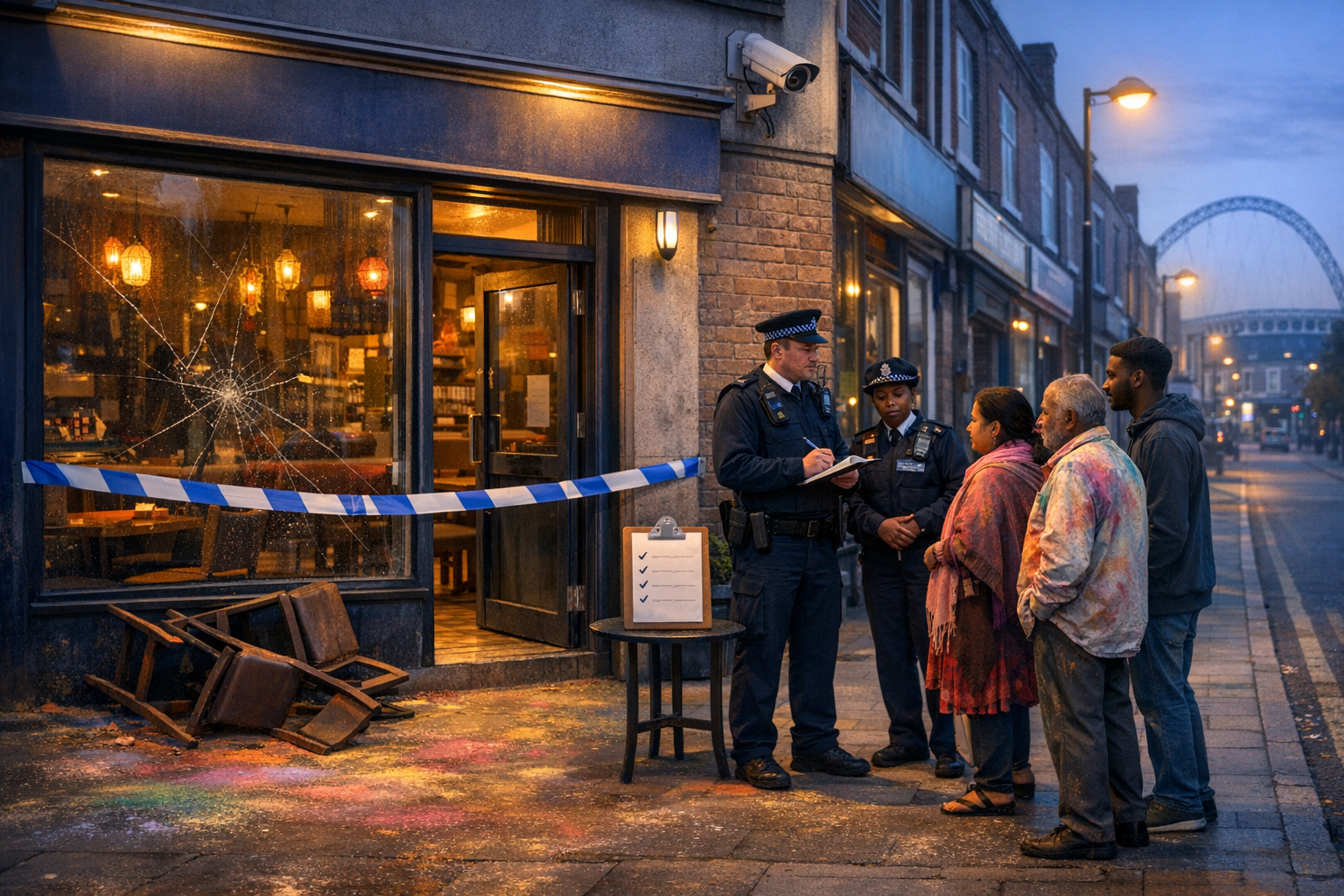
Reports from Wembley in North West London indicate a series of post-Holi attacks targeting Indian-owned restaurants and shops, heightening concerns about Hinduphobia and the safety of diaspora businesses in the city. The incidentscirculating widely via social media videoshave unsettled local residents and renewed calls for coordinated action by communities, councils, and police.
According to local accounts and footage shared online, masked groups entered premises, smashed furniture, and destroyed property before fleeing. Among the sites referenced by community members were Manek Chowkreportedly attacked twice within daysand Panesar Food and Wine, where crates of produce were thrown onto the street. While social media has amplified the visibility of these events, the precise timelines and perpetrator identities remain subject to police verification.
At the time of writing, no arrests have been publicly confirmed. The Metropolitan Police are understood to be reviewing CCTV and witness statements. Brent Council condemned the violence and urged anyone with information to come forward. Conservative MP Bob Blackman also drew attention to a related disturbance during Holi celebrations in nearby Harrow, underscoring a broader atmosphere of concern among London’s Indian community.
It is vital to separate verified facts from online speculation. Social media videos can help identify suspects and patterns, but they can also invite misattribution and escalation. Residents are encouraged to preserve original video files, share evidence directly with investigators, and avoid sharing unverified claims that may fuel communal tensions or inadvertently compromise inquiries.
From a legal perspective, the UK classifies offences as hate crimes when hostility toward a protected characteristicsuch as religion or racemotivates or aggravates the conduct. The Crime and Disorder Act 1998 defines racially or religiously aggravated offences, while the Public Order Act 1986 (as amended by the Racial and Religious Hatred Act 2006) addresses incitement. In practice, police assess intent, language, symbols, and context; prosecutors then apply evidentiary thresholds to determine charges. This framework helps ensure that incidents involving Hinduphobia are neither minimized nor politicizedbut handled with evidentiary rigor.
Context matters. Diaspora-owned microbusinesses often operate in high-footfall, late-hour settings, exposing them to opportunistic theft, anti-social behavior, or, in some cases, identity-based hostility. Post-festival periods can see temporary spikes in foot traffic, emotions, and misinformationfactors that occasionally converge into escalatory flashpoints. Evidence-led policing, rapid reporting, and community cohesion are the best defenses against these dynamics.
The human impact is profound. For many shopkeepers and restaurateurs, the business is a family lifeline and a cultural bridgea place where Hindu, Sikh, Jain, and Buddhist traditions meet the wider London community. When premises are vandalized, the loss extends beyond property damage to include emotional distress, staff anxiety, and a frayed sense of belonging. Acknowledging Hinduphobia where it occurs is essential, as is rejecting collective blame: perpetrators represent themselves, not any faith or ethnicity.
Policy debates around dietary standards and labelingsuch as discussions of halal certificationhave occasionally become flashpoints in the public square. Proprietors, including individuals like Harman Singh Kapoor, have publicized their policy choices; regardless of viewpoint, civic norms require that disagreements be expressed peacefully and lawfully. Dharmic values shared across Hinduism, Buddhism, Jainism, and Sikhismsuch as ahiṁsā (non-violence), karuṇā (compassion), and satya (truthfulness)offer a constructive framework for dialogue that protects conscience while upholding mutual respect.
Practical security steps can mitigate risk without creating a fortress-like atmosphere. Crime Prevention Through Environmental Design (CPTED) principlesclear sightlines, controlled access, and good lightingreduce opportunities for rapid-entry vandalism. Secured by Design (SBD) standards and professionally installed shutters, glazing, and locks can harden targets proportionately. High-definition CCTV positioned at entrances, tills, and perimeters, with at least 30 days of retention if feasible, significantly improves suspect identification.
When an incident occurs, immediate priorities are safety and evidence. Call 999 in emergencies; use 101 for non-urgent reporting. Obtain a crime reference number, and preserve original CCTV files. Where possible, document incident timelines, witness details, and property damage. Retain copies of still images and video with intact metadata; avoid excessive editing and, if feasible, hash original files (e.g., SHA-256) to support chain-of-custody integrity. Share relevant material securely with the Metropolitan Police and your insurer.
For suspected hate crime or hate incidents, the True Vision portal (report-it.org.uk) provides guidance and reporting options. Anonymous tips can be shared via Crimestoppers. Businesses may also benefit from local Business Crime Reduction Partnerships (BCRPs), Business Improvement Districts (BIDs), and council-led Community Safety Partnerships, which often coordinate with police on patrol patterns, intelligence sharing, and practical support.
Community-level resilience is equally important. Interfaith neighborhood forums that include Hindu, Sikh, Jain, Buddhist, and Muslim representatives can de-escalate rumor cycles, counter harmful stereotypes, and keep the focus on shared neighborhood safety. Joint safety walks, trader WhatsApp networks with clear verification protocols, and regular briefings with Safer Neighbourhoods Teams help align expectations about response times, evidence needs, and hotspot management.
Information hygiene reduces harm. Before amplifying alleged details (e.g., identities, motives, or affiliations), residents can cross-check time stamps, landmarks, and official statements; avoid posting identifiable details of bystanders; and refrain from naming suspects without confirmation. Responsible sharing prevents doxxing, reduces copycat effects, and ensures that due process remains intact.
The Wembley incidents should be understood as a test of civic resolve. London’s strength lies in its ability to protect minorities, support small businesses, and uphold the rule of law without succumbing to polarization. A clear-eyed, evidence-based responseone that names Hinduphobia when substantiated, rejects collective blame, and prioritizes collaborationbest serves the Indian diaspora and the broader city. Dharmic unity and inter-community solidarity are not just moral imperatives; they are practical tools for restoring safety, dignity, and trust.
Inspired by this post on Hindu Human Rights Blog.