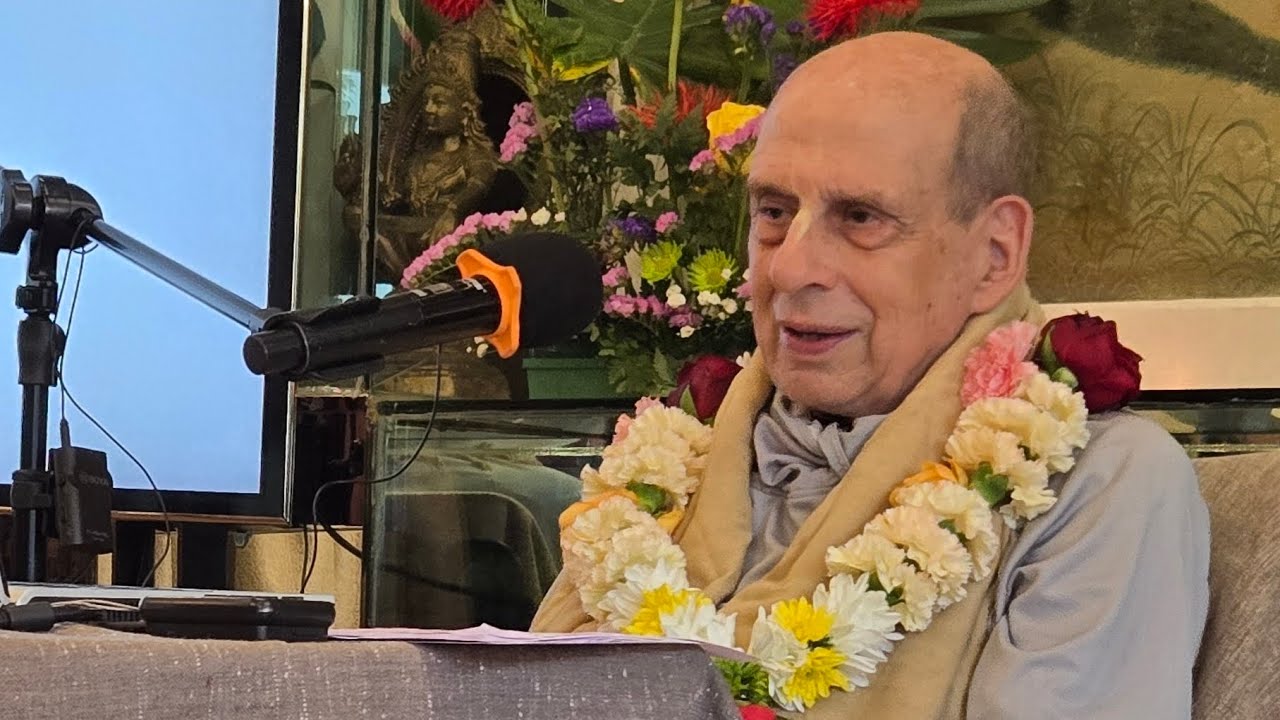
On 7 March 2026, ISKCON Hong Kong hosted a focused seminar on Sri Siksastakam under the guidance of HG Bhurijana Prabhu. The session examined the first verse in depthits Sanskrit poetics, theological import in the Gaudiya Vaishnava tradition, and its practical relevance for contemporary spiritual life. With academic clarity and lived devotional insight, the seminar traced how congregational chanting (sankirtana) functions simultaneously as a sadhana (discipline), a social practice, and a transformative philosophy aligned with the broader currents of Hindu Dharma.
(1) cheto-darpana-marjanam bhava-maha-davagni-nirvapanam shreyah-kairava-chandrika-vitaranam vidya-vadhu-jivanam anandambhdhi-vardhanam prati-padam purnamritasvadanam sarvatma-snapanam param vijayate shri-krishna-sankirtanam
The verse extols shri-krishna-sankirtanamthe congregational chanting of the holy namesas the most benevolent force for spiritual and social uplift. It purifies the heart of accumulated conditioning, cools the burning distress of cyclical suffering, unfolds auspiciousness like moonlight causing the lotus of good fortune to bloom, animates true knowledge, expands the ocean of bliss, grants a taste of full nectar at every step, and bathes the entire self. In the Gaudiya understanding, these claims are not rhetorical flourishes but a concise map of inner transformation that is replicable through disciplined practice.
The seminar emphasized the verse’s carefully sequenced vision of growth. First comes cheto-darpana-marjanam, the cleansing of awareness that restores clarity and moral discernment. Next is bhava-maha-davagni-nirvapanam, the extinguishing of the ‘forest fire’ of restlessness, fear, and alienation that characterize conditioned existence. Then follow gifts that are both aesthetic and epistemic: shreyah-kairava-chandrika-vitaranam, the moonlight of supreme good that helps the inner lotus open; vidya-vadhu-jivanam, the enlivening of genuine, liberating knowledge. The trajectory culminates in continual relishanandambhdhi-vardhanam and prati-padam purnamritasvadanamleading to sarvatma-snapanam, a comprehensive renewal of the person.
Philologically, each compound is exacting. Cheto-darpana-marjanam is a karmadhāraya/tatpurusha construction: the ‘cleansing of the mirror of consciousness’ that removes distortion rather than adding content. Bhava-maha-davagni-nirvapanam presents a vivid image of samsara as an uncontrolled conflagration; nirvapanam indicates full quenching, not temporary relief. Shreyah-kairava-chandrika-vitaranam distributes (vitaranam) moonlight (chandrika) to the kairava, the white night-blooming lotus of the heart; in classical poetics, moonlight is a catalytic presence for inward blossoming. Vidya-vadhu-jivanam describes chanting as the very life (jivanam) of the bride of knowledge (vidya-vadhu), meaning that realized knowledge is sustained by continuous remembrance. Anandambhdhi-vardhanam expresses an experiential paradox: a boundless ocean that nevertheless ‘increases,’ suggesting the ever-fresh nature of spiritual rasa. Prati-padam purnamritasvadanam points to reliable, step-by-step savoring of nectar, while sarvatma-snapanam signifies a full-bath purification that reaches the subtle levels of identity.
Doctrinally, the discussion situated Sri Siksastakam within the theology of Sri Caitanya Mahaprabhu, where nama-bhakti is central and the holy name of Sri Krishna is held to be non-different from the Supreme. This non-difference explains why sankirtana is depicted as causative across cognition, emotion, and will. The verse functions as a compressed soteriology: it outlines how remembrance through sacred sound replaces forgetfulness, how devotion stabilizes ethical life, and how love-centered consciousness emerges not as an imposed belief but as a culmination of purified perception.
From a practical standpoint, the seminar distinguished individual japa from congregational sankirtana. Japa builds steadiness and intimacy; kirtana adds the catalytic elements of shared rhythm, call-and-response, and collective intention. Both engage breath, posture, and attention in ways that refine prana flow and reduce cognitive noise, aligning with the broader yoga and mantra traditions of Hindu Dharma. When practiced with attentive pronunciation, humility, and service-mindedness, the holy names become a living pedagogytraining attention, healing affect, and orienting action.
The session also noted convergences with contemporary research on contemplative arts and group singing, which consistently associates melodic repetition and synchronized rhythm with stress reduction, improved vagal tone, and social cohesion. These findings illuminate, without replacing, the scriptural claim that sankirtana cools the ‘forest fire’ of inner turbulence. Attendees often report an arc familiar to practitioners across lineages: initial mental scattering, a phase of settling, moments of spontaneous gratitude or contrition, and, at times, tears that feel like release rather than sorrowmarkers of cheto-darpana-marjanam in lived experience.
Anchored in unity across Dharmic traditions, the seminar highlighted resonances beyond Gaudiya Vaishnavism. Sikh kirtan and Naam Simran, Buddhist mantra recitation in various Mahayana and Vajrayana practices, and the Jain Namokar Mantra all affirm the purificatory and unifying potency of sacred sound. This shared inheritance underscores a wider civilizational insight: diverse paths within Hinduism, Buddhism, Jainism, and Sikhism converge on disciplined remembrance, ethical tenderness, and communal harmony. In that spirit, sankirtana was presented not as a sectarian claim but as one luminous instance of a pan-Dharmic grammar of liberation through sound, attention, and love.
HG Bhurijana Prabhu’s exposition connected textual nuance to practicable guidance: chant with clear articulation; cultivate humility (amanitva) and service (seva) before and after kirtana; observe the mind without judgment as it wanders and gently return to the names; allow meaning to deepen over time rather than chasing novelty. These counsel points align with the verse’s progressionfrom clarity to cooling, from dawning benevolence to enlivened wisdom, and finally to stable joy that nourishes ethical action and compassion.
A key takeaway concerned vidya-vadhu-jivanam in daily life. Knowledge remains abstract unless animated by practice that softens the heart. Consistent sankirtana sustains insight by embodying it; study informs chanting, and chanting, in turn, makes study luminous. Thus, scripture (shastra), practice (sadhana), and community (sanga) become mutually reinforcingan integral model well attested across Dharmic pedagogy.
Ethically, sarvatma-snapanam was presented as more than private catharsis. As the self is bathed, reactivity diminishes and relational intelligence increases. The practical fruitssteadier speech, kinder action, and responsibility in communityare signs that inner victory (param vijayate) is taking shape outwardly. In this way, sankirtana contributes to social healing, echoing the inclusive ethos of Hindu Dharma and its sister traditions.
In summary, the first verse of Sri Siksastakam offers a compact, testable blueprint of transformation. It begins with lucid awareness and culminates in nectar-like continuity of joy, not by bypassing suffering but by transmuting it in the crucible of sacred sound. The ISKCON Hong Kong seminar framed this process with philological care, philosophical coherence, and compassionate practicality, making the verse’s promises legible to seekers, scholars, and community members alike. Param vijayate shri-krishna-sankirtanammay this victory be understood as the flourishing of clarity, compassion, and unity across all Dharmic paths.
Inspired by this post on Dandavats.