Srimad Bhagavatam 1.13.39 presents a charged moment of transition in the Kuru dynasty: a conscientious king’s concern colliding with the irreversible pull of renunciation. Set after the Kurukshetra War and the consolidation of rule under Mahārāja Yudhiṣṭhira, this verse captures the moral psychology of a ruler who embodies both familial tenderness and public responsibility, while elders in his care choose the vanaprastha path. The scene, compact in language yet expansive in implication, continues to inform dharmic reflection on grief, duty, and the ethics of letting go.
“Mahārāja Yudhiṣṭhira said: O godly personality, I do not know where my two uncles have gone. Nor can I find my ascetic aunt who is griefstricken by the loss of all her sons.”
Traditional commentators identify the “godly personality” as Nārada Muni, the “two uncles” as Dhṛtarāṣṭra and Vidura, and the “ascetic aunt” as Gāndhārī, who had lost all her one hundred sons in the war. The narrative context within the first canto is pivotal: after receiving Vidura’s incisive counsel (often associated with Vidura-nīti), Dhṛtarāṣṭra renounces palace life and departs for the forest with Gāndhārī; Vidura, too, withdraws. Their quiet departure, undertaken without dramatic proclamation, confronts Yudhiṣṭhira with the dual realities of royal guardianship and the autonomy of renunciants within the varṇāśrama framework.
The verse’s tone is not accusatory but elegiac. Yudhiṣṭhira’s question, posed to a realized sage, indexes both humility and urgency. The monarch does not presume possession over his elders; rather, he reveals concern arising from dharmahe had accepted post-war responsibility for their care, and his uncertainty about their whereabouts tests the limits of that responsibility. This sense of stewardship aligns with rājadharma, wherein a ruler must protect dependents while also respecting the sacred pathways that individuals, especially elders late in life, may choose.
Within the broader narrative arc (SB 1.13.28–55), Vidura’s admonitions and Nārada’s subsequent counsel redirect Yudhiṣṭhira from anxious attachment to contemplative acceptance. The text thereby dramatizes a central dharmic paradox: compassion is incomplete without wisdom, and wisdom is compromised without compassion. In SB 1.13.39, compassion speaks first; in the verses following, wisdom, carried by Nārada, provides its horizon. The king’s inquiry, then, is not a lapse of understanding but a humanly truthful starting pointunderlining how dharma is often worked out through feeling, not in denial of it.
Philosophically, the passage foregrounds vanaprastha as a socially intelligible and spiritually honored transition. Detachment (vairāgya) is not indifference but reorientationfrom household duties to contemplative austerity. For Dhṛtarāṣṭra and Gāndhārī, the forest is not escape but culmination: after imperial tragedy and profound loss, austerity restores moral clarity. Yudhiṣṭhira’s anxiety, therefore, is the disquiet that arises when love acknowledges it can no longer insist. In this sense, the verse rehearses a perennial ethical question: how can social duty and spiritual freedom co-exist without infringement?
Addressing Nārada as “O godly personality” signals methodological humility. In the world of Hindu scriptures, moral dilemmas are entrusted to sages whose counsel bridges revealed wisdom and lived reality. Yudhiṣṭhira’s recourse to guidance models a critical aspect of Vedic philosophy: when grief and duty converge, śāstra and sadhu-saṅga (scriptural counsel and saintly association) become the instruments of discernment.
The verse’s characterization of Gāndhārī as “ascetic” and “grief-stricken” performs both ethical and historical work. Ethically, her tapas marks a reconstitution of agency after devastating loss; historically, the text acknowledges an extraordinary mother whose grief becomes a discipline rather than a private implosion. Her trajectory resonates with a larger Purāṇic motif: suffering, when transmuted through austerity and remembrance of the divine, matures into insight rather than resentment. In this, Gāndhārī personifies a restorative ideal, one that complements Yudhiṣṭhira’s conscientious kingship.
Intertextually, the scene harmonizes with teachings familiar from the Bhagavad Gita: impermanence (anityatā), the inevitability of change within embodied life, and the call to equanimity amidst flux. Yet Srimad Bhagavatam 1.13.39 adds a vital social dimension: impermanence is not merely a philosophical abstraction; it is a public event that reorganizes family, court, and kingdom. The king’s question hence becomes a litmus test of how dharma navigates the thresholds between household protection and spiritual emancipation.
Cross-tradition resonance strengthens this reading and serves the shared aims of dharmic unity. In Buddhism, recognition of anicca (impermanence) and compassionate non-clinging illuminates why the elders’ departure is neither betrayal nor abandonment but a maturation of path. In Jainism, aparigraha (non-possessiveness) parallels the renunciant turn while also challenging householders to loosen claims rooted in fear. In Sikh tradition, humility (nimratā) and steady acceptance (sehaj) invite a courageous balance: serving family and community without obstructing a loved one’s spiritual aspiration. Srimad Bhagavatam 1.13.39 thus functions as a dharmic commons, where Hindu, Buddhist, Jain, and Sikh sensibilities recognize a convergent ethiccare that does not control, love that does not confine.
Narratively, the identification of the “two uncles” matters. Yudhiṣṭhira’s regard for Dhṛtarāṣṭra and Vidura is not symmetricalone is the blind elder whose past partialities helped seed catastrophe; the other is the incisive moral critic whose counsel helps avert future ills. Yet the verse compresses both under a single gesture of filial honor, modeling a dharma that distinguishes without disrespecting. That double recognitiontoward the erring elder and the guiding elderarticulates a sophisticated ethic of memory: justice without contempt, gratitude without naiveté.
Subsequent verses have Nārada ease Yudhiṣṭhira’s apprehensions by reframing the elders’ departure within cosmic law and individual destiny. The implication is not fatalism but trust: dharma is effective when performed with clear sight of life’s transience. This guidance does not dispense with responsibility; rather, it recalibrates iturging the king to continue exemplary governance grounded in renunciation’s inward spirit, even as he remains a householder. In this way, Srimad Bhagavatam affirms that the heart of rājadharma is interior freedom in public duty.
Contemporary readers often recognize a poignant parallel: when aging parents or mentors choose withdrawalinto pilgrimage, monastic life, or quieter seclusioncaregivers may experience anxiety that feels morally binding. Srimad Bhagavatam 1.13.39 validates that first response, then orients it: inquiry should mature into accompaniment that respects autonomy. Practically, this can include ensuring safety and consent, seeking wise counsel when uncertainties remain, and interpreting separation not as rejection but as a dignified transition in a shared spiritual journey.
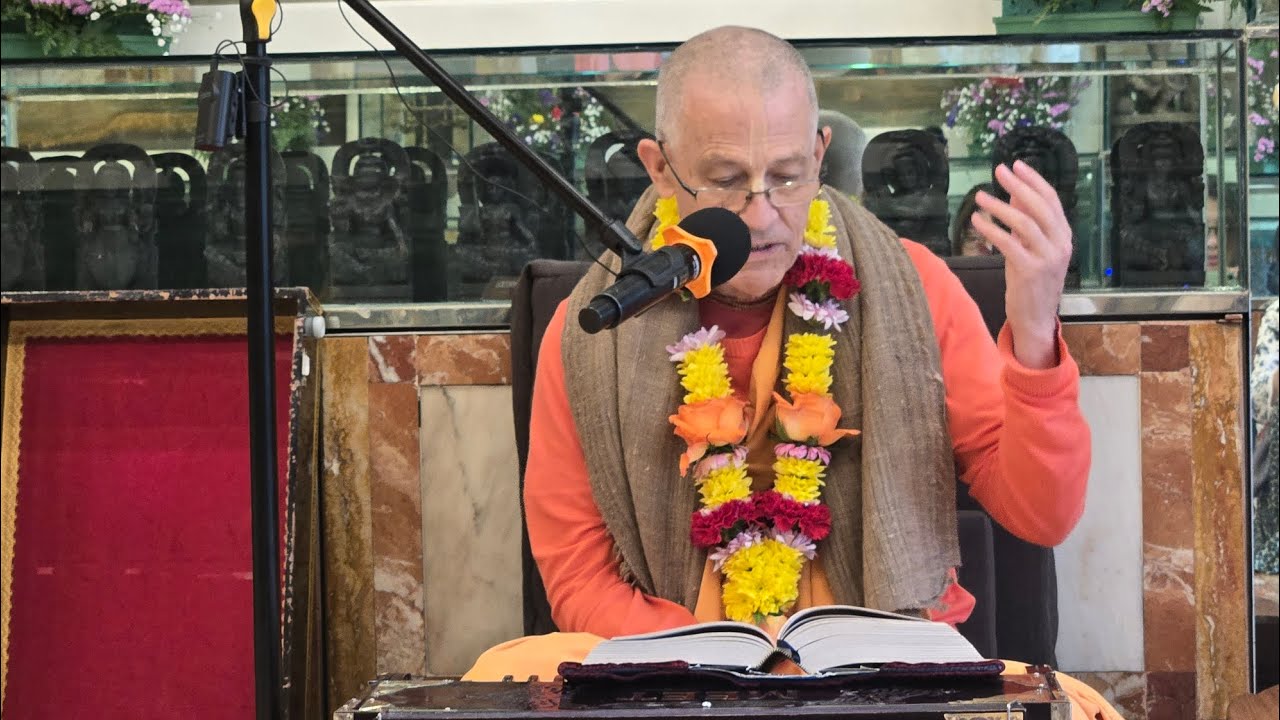
Vaiṣṇava expositions, including reflections shared by HH Krishna Kshetra Swami, underscore this synthesis of compassion and detachment. The verse does not glorify neglect; it sanctifies discernment. It articulates a standard by which devotion is tested: not merely in offering protection, but in knowing when protection must give way to blessing the path of renunciation. In this view, Yudhiṣṭhira’s question is already part of the answerhe turns to a sage, invites a higher framing, and accepts that love sometimes completes itself in release.
Read as a whole, Srimad Bhagavatam 1.13.39 advances a comprehensive ethic congruent with Sanatana Dharma and resonant across dharmic traditions. It honors the householder’s vow to protect, the renunciant’s vow to seek, and the ruler’s vow to harmonize both for the common good. In that triad, unity is not uniformity; it is the disciplined cooperation of life stages, life aims, and living communities, all converging toward wisdom. The verse therefore remains a living guideinviting conscientious care, principled non-attachment, and a shared commitment to spiritual flourishing.
Inspired by this post on Dandavats.