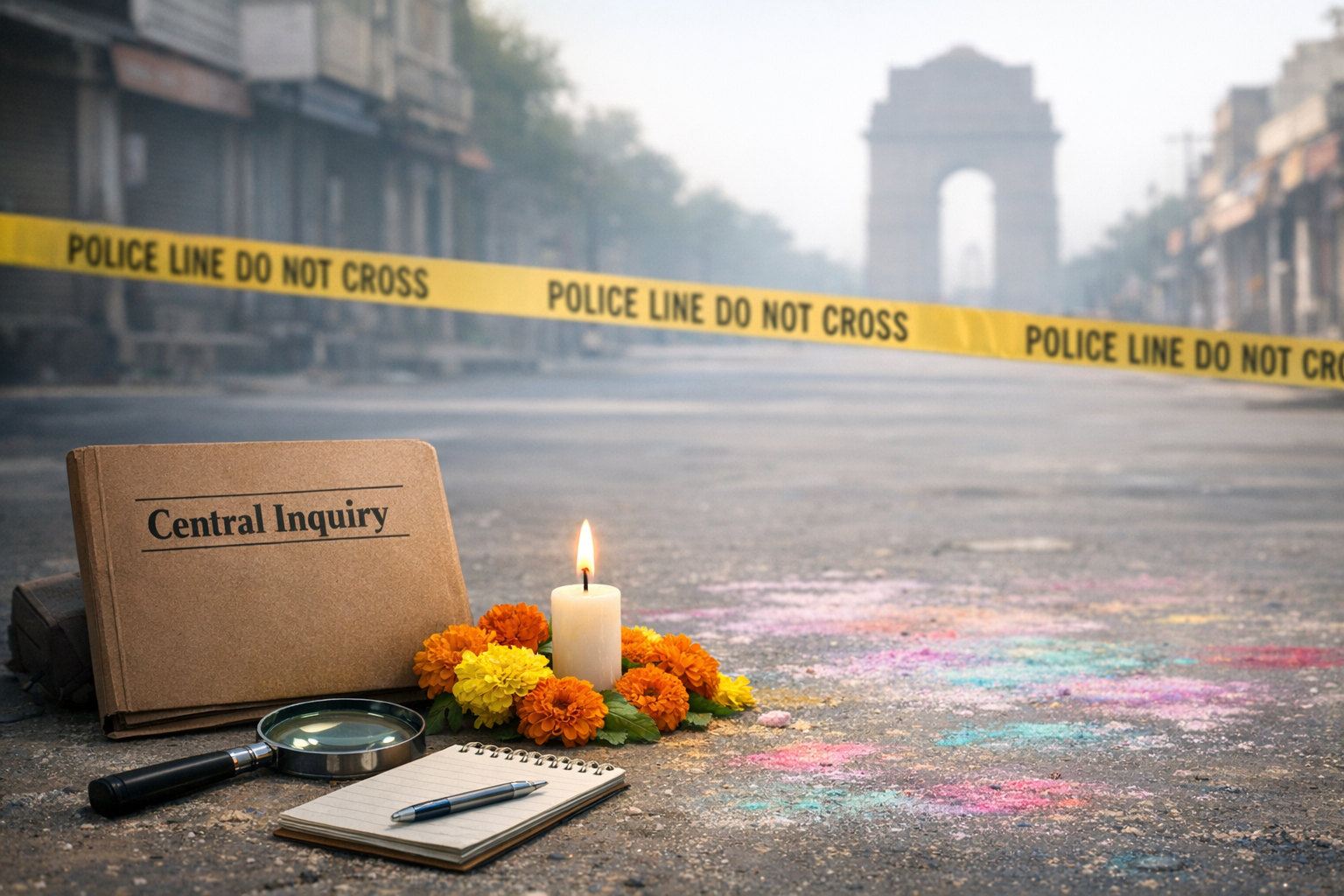
During Holi celebrations in Delhi, a street-side altercation reportedly escalated into lethal violence, culminating in the death of Tarun Kumar. According to the family’s account, the dispute began after a water balloon allegedly struck a woman wearing a burqa, triggering a confrontation in which Kumar sustained fatal injuries. In the aftermath, his father emphasizing that Kumar had been the family’s only source of support has demanded that the Central Bureau of Investigation (CBI) take over the case. The incident has fueled anxiety about communal tension in Delhi even as appeals for calm and due process gain prominence.
Available public accounts describe a sequence common to festival-time disputes: a moment of perceived insult or harm, a brief exchange, and a sudden surge of collective anger. At this stage, however, the specific roles and identities of individual assailants remain matters for investigation, not inference. The central questions are evidentiary: what transpired, who participated, what intent can be established, and how do forensic findings align with eyewitness statements and digital records. It is essential that public discourse avoid generalizations about entire communities and remain anchored to verifiable facts and the rule of law.
A lawful and credible investigation into the Delhi Holi clash requires a precise sequence under the Indian Penal Code (IPC), the Code of Criminal Procedure (CrPC), and established forensic protocols. The expected pathway includes prompt registration of an FIR; scene-of-crime documentation; medical-legal examination and autopsy; seizure and preservation of physical and digital evidence; and systematic witness examination. The integrity of this chain directly shapes prosecutorial success under sections potentially engaged by violent group conduct, including IPC 302 (murder), 307 (attempt to murder, if applicable), 147–149 (rioting and unlawful assembly), 34 (common intention), and, where warranted by content and context, 153A/295A/505 (offences involving communal provocation or public mischief).
The father’s appeal for a CBI probe invites clarity on jurisdiction and process. Under the Delhi Special Police Establishment Act, 1946, the CBI may assume investigation upon consent of the competent government or by direction of a constitutional court. In the National Capital Territory (NCT) of Delhi, policing falls under the Union Ministry of Home Affairs, enabling the Central Government to consider a transfer to the CBI where the interests of justice or inter-state ramifications so require. Separately, the High Court or Supreme Court can direct a CBI investigation when demonstrable deficiencies, conflict of interest, or extraordinary public importance are credibly shown. These standards protect both investigative autonomy and constitutional rights under Articles 14 and 21.
In practice, Delhi Police (including the Crime Branch) often constitutes a Special Investigation Team (SIT) for complex or sensitive cases. An SIT can marshal resources quickly, coordinate with the Forensic Science Laboratory (FSL) and the Central Forensic Science Laboratory (CFSL), and deliver time-bound updates under CrPC Section 173. A CBI transfer, by contrast, centralizes oversight at the national level, which can be beneficial where cross-jurisdictional evidence, alleged interference, or institutional confidence is at stake. Courts frequently weigh whether an SIT with judicial monitoring could address the family’s concerns as effectively as a CBI probe.
Forensically, investigators will seek to align injury patterns, weapon typology (if any), timeline reconstruction, and individual participation. Core tasks include high-resolution crime-scene photography, bloodstain pattern analysis, trace evidence capture, and biomechanical assessment of injuries. Postmortem findings (time since death, nature and sequence of wounds, toxicology) should be read alongside video analytics (CCTV, dashcams, body-worn cameras), call detail records, cell-site location data, and social media metadata. Admissibility hinges on chain-of-custody documentation and Indian Evidence Act Section 65B certificates for electronic records.
Witness testimony remains crucial but fragile. Under CrPC Sections 161 and 164, investigators must promptly record statements and, where appropriate, seek judicially recorded depositions to reduce later recantation. The Witness Protection Scheme, 2018, and fast-track case monitoring can mitigate intimidation risks. Where crowd dynamics complicate identification, modern methods including photogrammetric analysis and gait or clothing-matching algorithms can supplement traditional line-ups without substituting for evidentiary rigor.
Magisterial inquiry under CrPC Section 176 may be warranted to examine any custodial or procedural dimensions, while prohibitory orders under CrPC Section 144 can be deployed to prevent further escalation in volatile localities. If communal provocation is credibly alleged, parallel scrutiny under IPC Sections 153A, 295A, and 505 may be appropriate for those who incite hatred, regardless of community. These provisions punish deliberate and malicious acts that threaten social cohesion, aligning with constitutional commitments to equality, dignity, and public order.
Victim-centered justice requires more than correct charging. The Delhi Victim Compensation Scheme and court-directed interim relief provide financial and psychosocial support for bereaved families. Legal Services Authorities (Article 39A) can ensure free, competent legal aid. Families should receive regular updates on investigation milestones, an opportunity to present representations for or against transfer of investigation, and access to grievance redressal mechanisms when delays or lapses occur.
Festival-related violence is preventable. Pre-Holi advisories, local peace marches, and neighborhood mediation protocols reduce flashpoints associated with water balloons, intoxication, and group confrontation. Hotspot mapping, targeted patrolling, and rapid-response teams connected to the 112 emergency grid enhance deterrence. Public messaging that emphasizes consent, dignity, and non-violent celebration in multiple languages and across platforms helps correct risky norms before they manifest as harm.
Holi’s cultural meaning renewal, forgiveness, and the triumph of good over discord is a shared civilizational inheritance across dharmic communities. Traditions of ahimsa (non-violence), karuṇā (compassion), maitri (friendliness), and daya (empathy) in Hinduism, Buddhism, Jainism, and Sikhism converge on the simple norm that festive joy must never license humiliation or harm. Safeguarding Holi’s inclusive spirit thus requires responsible celebration, empathetic bystander intervention, and immediate de-escalation when misunderstandings arise.
The reported trigger in this case a water balloon striking a woman wearing a burqa highlights two intertwined duties: respecting bodily autonomy and respecting religious attire. City authorities and community groups can collaborate on designated play-zones, child-safe materials, and time-bound guidelines that balance tradition with safety. Where grievances occur, restorative approaches (apology, restitution, facilitated dialogue) can stop a misstep from metastasizing into a communal flashpoint.
Information vacuums are dangerous. Editors and influencers should follow the Press Council of India’s Norms of Journalistic Conduct for reporting on communal incidents, avoiding speculative attributions, dehumanizing language, or sensational framing. Verified timelines, clearly labeled opinion versus fact, and prompt corrections strengthen public trust. Community leaders, too, can model restraint by urging followers to await authenticated updates from investigators and courts rather than circulating unverified claims.
Sustained peace depends on everyday architecture: mohalla peace committees with equitable representation; interfaith dialogues at temples, viharas, gurdwaras, and local community centers; youth-led volunteer brigades for festival stewardship; and grievance hotlines staffed by trained mediators. Joint service initiatives such as cleanliness drives and blood-donation camps deepen interpersonal trust across lines of identity, affirming that civic friendship is stronger than rumor or rage.
This tragedy has two urgent imperatives. First, a thorough, impartial investigation whether by an SIT with court monitoring or by the CBI must secure accountability grounded in evidence, not conjecture. Second, communities must refuse the false choice between justice and harmony. A rights-based approach, faithful to Articles 14 and 21, demonstrates that both aims are inseparable: the same rule of law that punishes culpable individuals also protects innocents from collective blame.
As Delhi deliberates the appropriate investigative forum, empathy for the bereaved family and vigilance against communal polarization should guide public action. The father’s call for a CBI probe is, at its core, a plea for confidence in the process. Meeting that plea requires transparency, timely updates, and visible independence together with a renewed civic commitment to celebrate Holi, and every festival, in a way that honors the shared values of India’s dharmic traditions and the constitutional promise of dignity for all.
Inspired by this post on Struggle for Hindu Existence.