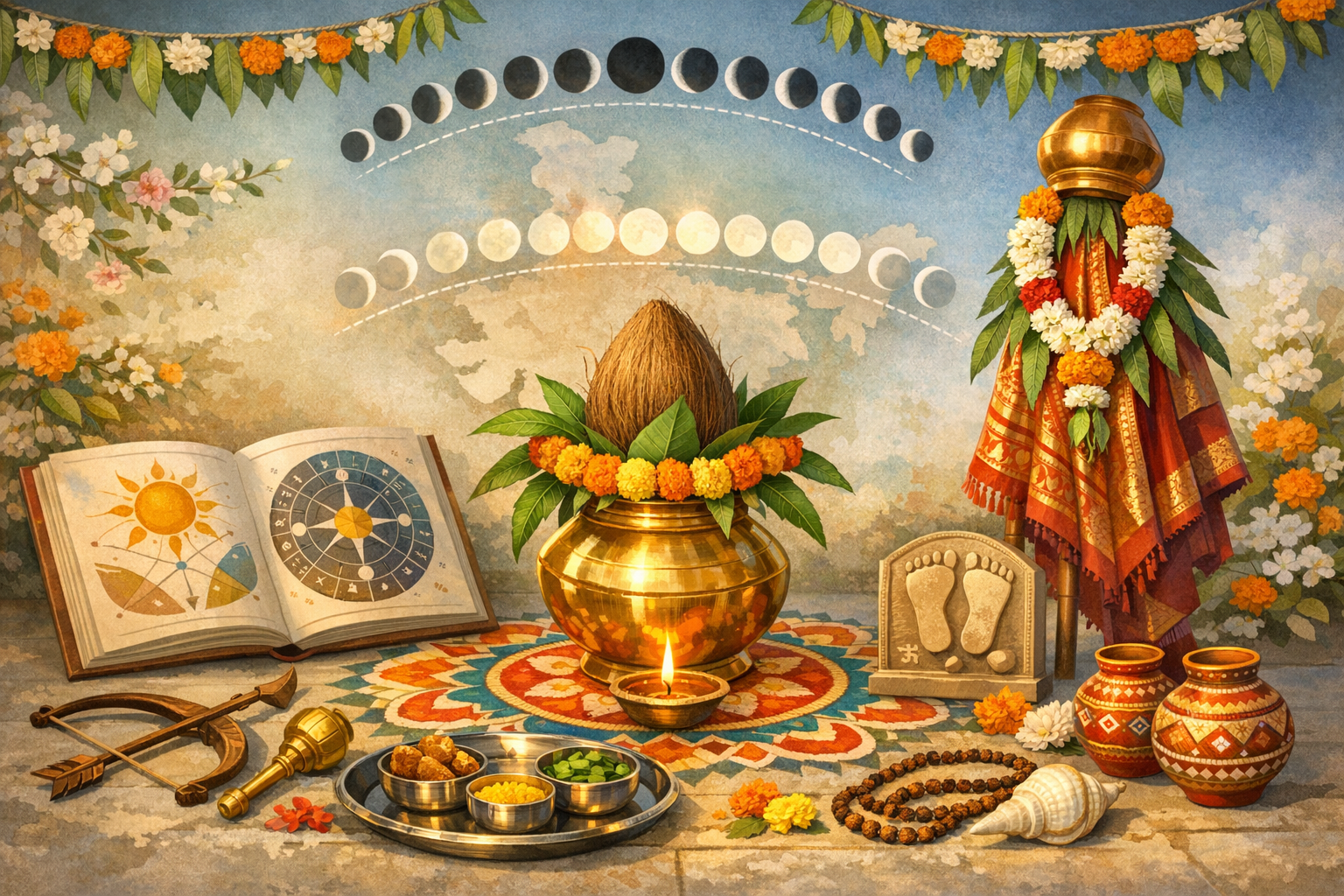
Chaitra Month 2026 (Chaitra Masam, also called Chait Mahina or Chait Maas) spans from 4 March 2026 to 2 April 2026 in the North Indian Hindu calendar that follows the Purnimanta system. These dates apply across Uttar Pradesh, Madhya Pradesh, Bihar, Jharkhand, Himachal Pradesh, Uttarakhand, and Chhattisgarh and are stated in Indian Standard Time (IST). Within this framework, a lunar month begins the day after the full moon and concludes on the following full moon, so Chaitra 2026 begins just after the Phalguna Purnima and ends at Chaitra Purnima.
As the first month of the Hindu lunisolar year in many traditions, Chaitra carries the symbolic weight of renewal. It aligns sacred timekeeping (Panchang) with the onset of spring, when households refresh sankalpas, temples commence their annual sequences of pujas, and communities prepare for a dense cluster of observances that introduce the spiritual and cultural cadence of the new year.
Two well-established conventions determine the start and end of lunar months in the Hindu calendar: Purnimanta (month runs from the day after the full moon to the next full moon) and Amanta (month runs from the day after the new moon to the next new moon). North India predominantly follows the Purnimanta count, while the Amanta convention is common in Maharashtra, Goa, Andhra Pradesh, Telangana, and Karnataka. Both systems are internally consistent and scripturally grounded; the choice of system primarily reflects regional tradition rather than doctrinal difference.
In 2026, the Amanta reckoning designates Chaitra from the day after the astronomical new moon of March 2026 until the next new moon in April 2026. That span includes Chaitra Shukla Pratipada, on which Ugadi and Gudi Padwa are observed in the Deccan region and among Marathi, Kannada, and Telugu communities. This day inaugurates Shaka Samvat 1948 and, in many regional almanacs, the Samvatsara named Parabhava. Because Amanta months are new-moon based, their civil date range differs by roughly two weeks from the Purnimanta dates cited above; practitioners should consult a reliable local Panchang for exact Gregorian dates at their location.
The term Chaitra also appears in the Indian National Calendar (the reformed Saka calendar). In that solar framework, Saka year 1948 begins on 22 March 2026 (in non-leap years) with the month named Chaitra. This is distinct from the lunisolar months used for religious observances, yet both systems anchor the cultural sense of a springtime beginning.
Ritually, Chaitra 2026 introduces a year of vrata, yajna, and utsava. The period includes Chaitra Navratri, a nine-night observance from Shukla Pratipada through Navami, honoring Devi in her benevolent and protective forms. Temples and homes install kalashas, perform daily upacharas, and recite Durga Saptashati or other Shakta texts, culminating in the celebration of Rama’s birth.
Chaitra Shukla Pratipada is also the traditional New Year day for multiple regions and communities under various names—Ugadi (Andhra Pradesh, Telangana, Karnataka), Gudi Padwa (Maharashtra), and Navreh (Kashmiri Pandits). Sindhi communities mark Cheti Chand (typically on or near Chaitra Shukla Dwitiya), venerating Jhulelal and celebrating a community New Year. The shared symbolism is striking: a collective recommitment to dharma, household well-being, and communal harmony, expressed through regionally distinct yet spiritually resonant customs.
Rama Navami, observed on Chaitra Shukla Navami, becomes the theological and emotional summit of Chaitra. Smarta and Vaishnava traditions emphasize the Navami tithi present during madhyahna (midday period) for puja; recitations such as the Ramayana, Vishnu Sahasranama, or Ram Raksha Stotra, along with akhanda kirtans, are common. In the broader civilizational memory, this festival affirms maryada (righteous conduct) and compassionate statecraft, values that inform contemporary spiritual and social life.
In the same fortnight, Jains commemorate Mahavir Jayanti—Mahavir Janma Kalyanak—generally on Chaitra Shukla Trayodashi. Processions, prabhat pheris, discourses (pravachans), and seva activities foreground ahimsa and aparigraha as living principles. This observance complements the Chaitra ethos across dharmic traditions, where personal restraint and public compassion define the year’s aspiration.
North Indian communities often celebrate Hanuman Jayanti on Chaitra Purnima, venerating Hanuman as the exemplar of bhakti, strength, and service. Reading of the Hanuman Chalisa and Sundara Kanda parayana are widespread. Many households also observe Satyanarayan Puja on the full moon, integrating vrata with community annadana and family sankalpas for health, prosperity, and harmony.
Chaitra is also renowned for Gangaur and Gauri Puja in Rajasthan and parts of Gujarat, honoring Shiva and Gauri as a divine couple. The festivities emphasize conjugal well-being, social solidarity, and agrarian prosperity, bridging household spirituality with community identity. In practice, the observance unfolds over the early Chaitra fortnight with regional variations in procession, iconography, and folk arts.
Two Ekadashis typically frame the month’s sadhana. Papamochani Ekadashi occurs in the Krishna Paksha near the beginning of Purnimanta Chaitra, emphasizing prayer and fasting for inner purification. Kamada Ekadashi returns in the Shukla Paksha, associated in Puranic lore with release (kshama) from subtle transgressions. Both are observed with upavas, japa, and charity, reflecting the Panchang’s role in structuring periodic self-reflection.
Behind these observances lies a technical calendar logic. A tithi is a lunar day defined by 12 degrees of elongation between the Sun and the Moon; it does not align perfectly with the 24-hour civil day. Religious dates are assigned primarily by the tithi prevailing at local sunrise (with specific festival rules—such as midday or moonrise criteria—applied where scripture prescribes). Minor differences may arise among Panchangs due to ephemeris choices (Drik vs. traditional Surya Siddhanta), ayanamsha values, and local horizon effects, which is why a trusted regional almanac remains the practical authority for final observance.
Time zone differences can shift a festival’s civil date outside India. Communities in North America, Europe, Africa, and Southeast Asia often find key tithis straddling two civil dates relative to IST; the correct observance locally is always determined by the tithi at sunrise (or the specified festival criterion) at one’s own location. This principle preserves both scriptural fidelity and community cohesion worldwide.
Chaitra’s spirit of renewal resonates across the broader dharmic family. While Sikh Vaisakhi, Tamil Varusha Pirappu (Puthandu), Malayalam Vishu, and Bengali Pohela Boishakh are anchored in mid-April solar transitions (and hence fall just after the North Indian Chaitra end date in 2026), the shared seasonal arc underscores unity in diversity: distinct calendars, common values of gratitude, courage, generosity, and right conduct. This interwoven fabric—Hindu, Buddhist, Jain, and Sikh—reinforces a civilizational commitment to plural paths toward inner and social harmony.
In practice, families approach Chaitra as a structured invitation to begin well: aligning sankalpas with daily sandhya, adopting simple vrata for clarity and discipline, supporting community annadanam, and revisiting foundational texts in a spirit of curiosity and humility. Whether one follows the Purnimanta or Amanta system, the Panchang’s purpose remains consistent—attuning life to cosmic rhythms so that personal growth and community well-being evolve together.
Summary for planning: in the Purnimanta system used across much of North India, Chaitra 2026 runs from 4 March to 2 April (IST). In Amanta regions, the month begins the day after the March 2026 new moon and concludes on the April 2026 new moon, embedding Ugadi/Gudi Padwa at Chaitra Shukla Pratipada, the start of Shaka Samvat 1948 (Parabhava). Within this month fall Chaitra Navratri, Rama Navami, Mahavir Jayanti, Hanuman Jayanti (North India), Gangaur, Papamochani Ekadashi, and Kamada Ekadashi. Local Panchang guidance ensures precise civil dates for each locale while preserving the shared meaning of a sacred new beginning.
Inspired by this post on Hindu Pad.