On 28 February 2026 in Ghaziabad, Uttar Pradesh, YouTuber Saleem Wastikwidely described in media coverage as an ex-Muslim voice and Sanatan defenderwas reportedly stabbed by unidentified assailants, sustaining serious injuries. Early accounts suggest his condition was critical; formal medical updates from treating doctors and authorities are awaited. This overview consolidates what is known from initial reports and outlines the legal, investigative, and community-safety dimensions relevant to such a targeted attack.
At the time of writing, law enforcement had not issued comprehensive findings on the identities of the assailants, the specific motive, weapon recovery, or the full sequence of events. Given the fluidity of early reporting, caution is warranted: the focus here is on due process, verifiable procedures, and the public-interest frameworks that guide an impartial investigation in Uttar Pradesh.
Saleem Wastik has built a substantial digital audience through commentary at the intersection of faith, social ethics, and Sanatan perspectives. As with many public communicators who address religion and public policy, his channel’s visibility can attract both support and intense disagreement. The right to lawful expression remains central; the remedy for disagreement is reasoned debate, not violence.
Beyond the headline, targeted violence carries a human cost. Families wait outside intensive care units; viewers refresh credible sources for updates; neighborhoods reassess routinesroutes to work, late-night returns, and the visibility of online identities in offline spaces. Such incidents reverberate through the social fabric of Ghaziabad and the wider Uttar Pradesh community.
Typical investigative steps in a stabbing case include: registration of a First Information Report (FIR) under Section 154 of the Criminal Procedure Code (CrPC); protection and documentation of the scene of crime; seizure and chain-of-custody records; retrieval of CCTV and private camera feeds; telecom analytics such as call detail records and geofencing; forensic serology and DNA analysis; and witness statements recorded under Sections 161 CrPC and, where appropriate, Section 164 before a magistrate.
Offences commonly examined in comparable cases include Section 307 of the Indian Penal Code (attempt to murder), read with Section 34 (common intention) or Section 120B (criminal conspiracy), alongside relevant provisions of the Arms Act if applicable. These references are indicative rather than determinative; final charges depend on evidence gathered and prosecutorial review.
Independent watchdogs have documented that online harassment can escalate into offline harm for journalists and creators. Threat trajectories may involve doxxing, stalking, coordinated mass-reporting, and ultimately physical intimidation. India is not unique in facing such risks; however, high population density, rapid urban mobility, and ubiquitous low-cost connectivity can compress the time between online provocation and offline action, especially in urban nodes such as Ghaziabad within the National Capital Region.
Risk modeling for public-facing creators typically assesses four vectors: identity exposure (home, commute, and family data), routine predictability (venues, timing, and repeated pathways), grievance intensity (ideological, interpersonal, or opportunistic), and local enablers (availability of weapons, getaway logistics, and perceived impunity). When multiple vectors converge, residual risk rises significantly.
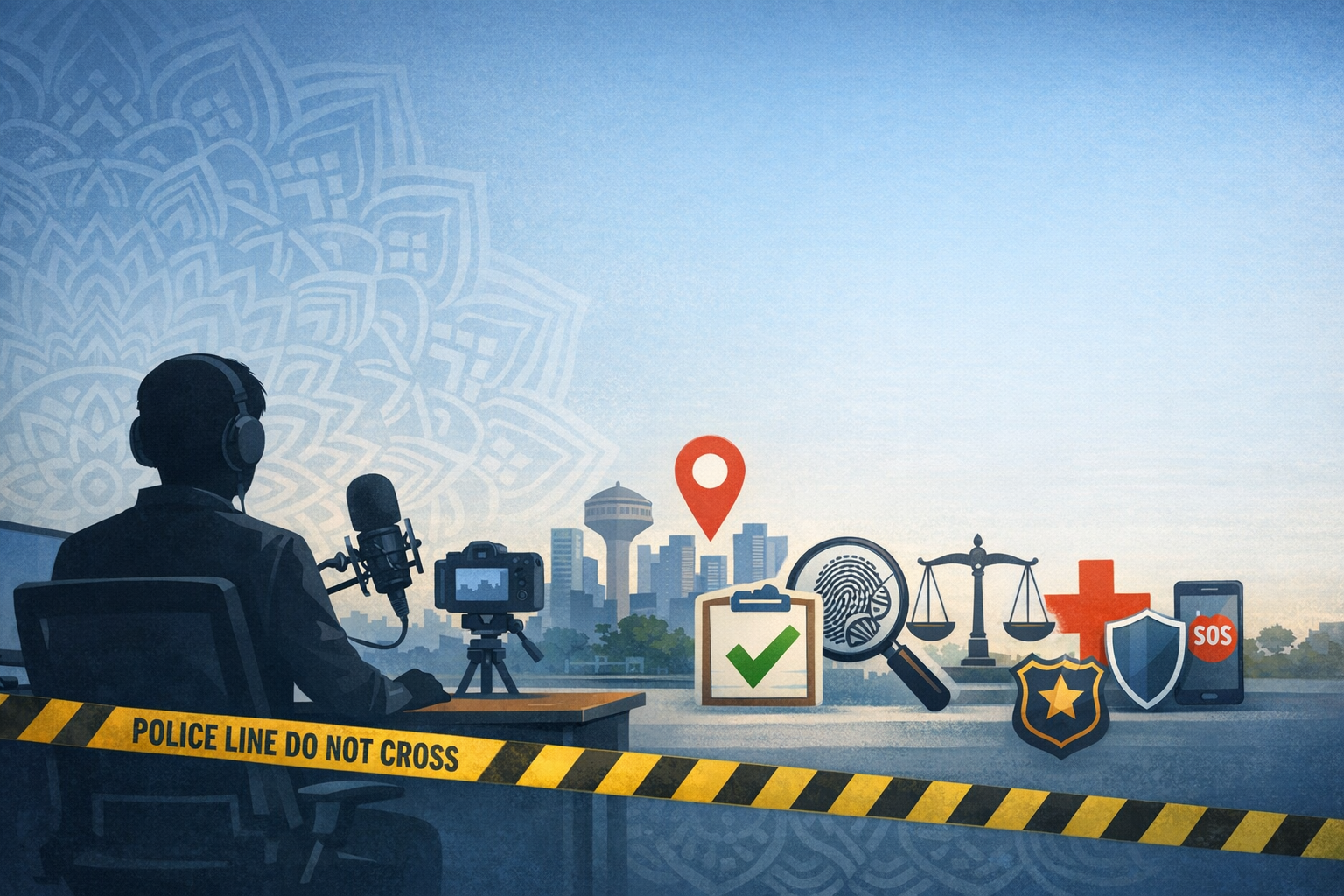
Practical mitigationwithout compromising lawful speechincludes route variability; suppression or delay of geotagged posts; vetted event security; silent location sharing with trusted contacts; and 24/7 emergency readiness via the 112 India app. Proactive documentation of threats, preservation of screenshots and headers, and prompt engagement with police can support swift FIR filing and protection. Within households, a simple emergency contact tree and a pre-decided hospital preference card can save minutes that matter during trauma care.
On presentation of stabbing injuries, hospitals register a Medico-Legal Case (MLC) and inform police. Clinical priorities follow Advanced Trauma Life Support principlesairway, breathing, circulation, disability, exposure. Where surgery is indicated, operative notes and injury mapping inform later forensic opinions about weapon characteristics and intent, which can be probative under IPC Section 307.
Victim protection and redress draw on established frameworks: the Witness Protection Scheme (2018) as approved by the Supreme Court; Section 357A CrPC victim compensation administered by State Legal Services Authorities; and judicial oversight in serious offences. Effective use of these mechanisms reduces secondary victimization during protracted proceedings.
Digital intermediaries operate under the Information Technology (Intermediary Guidelines and Digital Media Ethics Code) Rules, 2021. Platforms are expected to preserve data upon lawful request, appoint grievance officers, and act expeditiously on valid orders. Responsible cooperationbalanced by privacy and due processcan accelerate attribution without undermining fundamental rights.
Given media references to ideological hostility, motive attribution requires caution. Investigative conclusions must arise from evidence, not conjecture. Public safety is best served by resisting collective blame, rejecting inflammatory labels, and centering constitutional guarantees of equality before law and freedom of expression.
Unity across dharmic traditionsHinduism, Buddhism, Jainism, and Sikhismoffers a resilient foundation in moments of strain. Shared commitments to ahimsa, satya, and compassion can translate into concrete actions: peaceful vigils, verified information-sharing, and support for lawful investigation. Such responses reduce space for rumor, retaliation, and polarization while affirming Sanatan values in practice.
Local administrations can enhance resilience through creator-safety advisories, rapid-response protocols for threats against public communicators, and joint training that links cyber units with field investigators. When civic groups, religious institutions, and police co-design de-escalation pathways, communities become harder targets for those who seek to manufacture chaos.
For readers tracking developments, authoritative signals to watch include official police bulletins, court filings on remand and charges, hospital MLC updates, and forensic timelines. Social media claims should be cross-checked against primary documents or accredited reportage before amplification to safeguard both accuracy and community trust.
This incident underscores a baseline principle: disagreementhowever sharpmust be argued with reason, not settled with knives. A society confident in its ideas safeguards even the voices it disputes, investigates violence without prejudice, and refuses to let fear redraw the boundaries of legitimate debate.
As details emerge, the priority remains clear: ensure the best possible medical outcome for Saleem Wastik, protect witnesses, secure and analyze evidence with rigor, and uphold the rule of law. In doing so, communities affirm that Sanatan values and the broader dharmic ethos of non-violence and dialogue are not abstractions but living commitments in Ghaziabad, across Uttar Pradesh, and beyond.
Inspired by this post on Struggle for Hindu Existence.