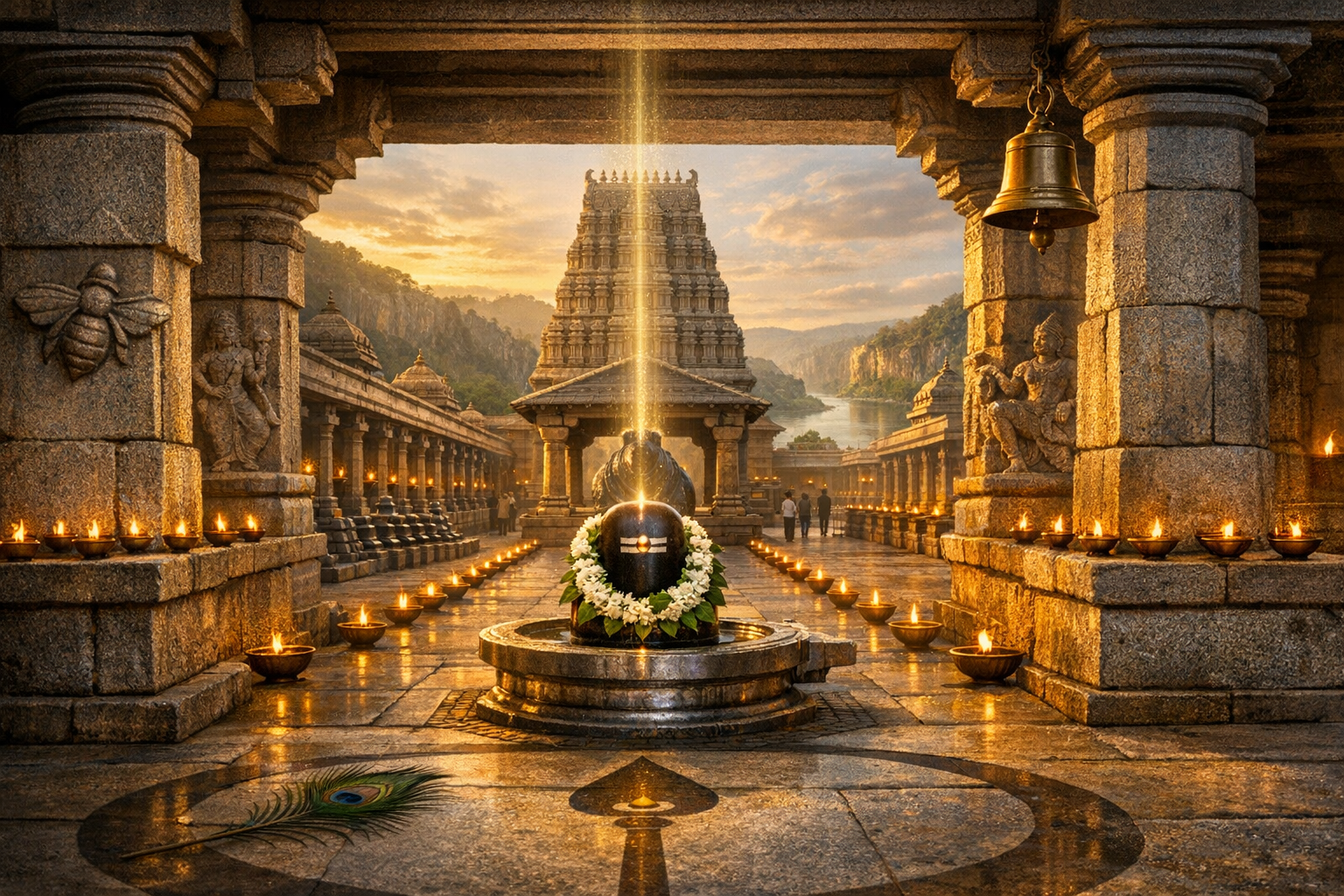
Rising from the Nallamala Hills above the Krishna River in Andhra Pradesh, the Srisailam temple complex enshrines the Mallikarjuna Jyotirlinga and Bhramaramba Devi in a rare Saiva–Shakta confluence revered for centuries as Dakshina Kailasa. The site’s sacred landscape, layered ritual life, and robust Dravidian temple architecture together sustain a living tradition that unites mythic memory, disciplined worship, and regional cultural history.
In the Shiva Purana and allied Saiva sources, a jyotirlinga signifies Shiva as an infinite, self-revealed pillar of light (jyoti), without beginning or end. Among the twelve such tirthas enumerated in pan-Indic pilgrimage circuits, Mallikarjuna holds a central Deccan position, binding northern routes from Kashi and Ujjain to southern termini such as Rameshwaram. The theology of the jyotirlinga encodes the metaphysical insight that ultimate reality transcends form while remaining immanent in consecrated space and time.
Local sthala-purana traditions explain the compound name “Mallikarjuna” as a synthesis of mallika (jasmine) and Arjuna (a celebrated epithet of Shiva). One widely transmitted narrative recalls the daily offering of jasmine garlands to the lingamsometimes attributed to Parvati, at other times to the pious Chandravatithrough which Shiva’s presence became manifest in the Srisailam stone. This etymological and ritual memory continues in contemporary practice, where bilva leaves and mallika flowers remain principal upacharas.
The Kartikeya (Skanda, Kumara, Murugan) dimension of Srisailam’s sacred story is equally formative. Pan-Indian tellings recount the fraternal contest between Kartikeya and Ganesha and the former’s subsequent tapas on southern heights. In regional retellings associated with Srisailam and the Skanda Purana’s Srisaila Khanda, Shiva and Parvati descend to console their son, and the compassionate descent becomes the theological ground for Shiva’s abiding presence here as Mallikarjuna, with Parvati as Bhramaramba. This narrative of filial devotion and parental grace frames Srisailam as a kshetra where ardor (tapas), insight (jnana), and compassion (daya) converge.
The moral architecture of the Kartikeya episode is frequently interpreted as a study in spiritual maturation: steadfast effort, the refinement of motive, and the harmonization of zeal with wisdom. Ganesha’s inward circumambulation of parents as the cosmos and Kartikeya’s outward circumambulation of the world together model the perennial dialogue between inner realization and outer strivingan interpretive lens that continues to inform discourse in dharmic philosophy and practice.
Bhramaramba Devi’s shrine within the same complex amplifies Srisailam’s stature as both Jyotirlinga and Shakti Peetha in the popular sacred geography of India. The epithet “Bhramaramba” (Mother as the swarm of bees, bhramara) alludes to traditions in which the Goddess subdues arrogance and restores cosmic balance, a motif that complements Shiva’s formless luminosity. The proximity of Shripati (Mallikarjuna) and Sri (Bhramaramba) structures a dynamic Saiva–Shakta liturgical ecology that shapes daily and seasonal worship.
Sacred geography is palpable in the approach to the hill. The descent to Pathala Ganga on the Krishna River, the forested escarpments of the Nallamala, and the limestone caverns associated with Akkamahadevi (a 12th-century Kannada saint-poet) create a pilgrimage topography in which water, stone, and syllable are ritually integrated. Giripradakshinathe circumambulation of the Srisailam hillis observed as a vow by many, binding bodily discipline to contemplative focus.
Architecturally, Srisailam is a fortified Dravidian complex characterized by multiple prakaras, axial alignments, and towering gopurams that mediate the transition from mundane to sacred space. The Mallikarjuna garbhagriha, with its swayambhu lingam, is approached through antarala and mandapas articulated by granite pillars bearing reliefs of Saiva iconographyDakshinamurti, Nataraja, Chandikeshvara, Veerabhadra, and processional ganaswhile the Nandi pavilion anchors the sacred gaze. A Sahasra-linga and numerous subsidiary shrines create a dense ritual field in which circumambulation, mantra-recitation, and darshan coalesce.
Epigraphic evidence and temple chronicles attest to continuous patronage across many centuries. Kakatiya, Reddi, and Vijayanagara rulers, among others, sponsored extensions, prakaras, and gopurams, with notable benefactions in the late-medieval and early-modern periods, including the Vijayanagara era’s strong fortifications and ritual endowments. These layers of construction and inscription record a vibrant exchange among royal houses, merchant guilds, and monastic communities that sustained the temple economy and ritual calendar.
Srisailam’s social history also reflects a reciprocal bond with the indigenous Chenchu community. A living regional narrative of “Chenchu Mallayya” recalls Shiva’s intimate association with the hill’s first inhabitants, a motif that encodes mutual recognition and stewardship of land, water, and worship. This inclusive ethic strengthens the tirtha’s civic fabric and exemplifies a wider Indic pattern in which regional communities co-create and sustain sacred institutions.
The daily Shivalinga Puja is structured through abhishekam cyclesRudrabhishekam and Panchamrita abhishekamfollowed by alankara with bilva, mallika, and sandal paste, and archana with Vedic and Agamic mantras. Devotees undertake sankalpa, pradakshina, and deepa-dana, while listening to stotra recitations such as the Shiva Sahasranama and hymns from the Tevaram tradition carried in oral and liturgical memory.
Karthika masam (October–November) endows the complex with an ocean of lamps, reflecting a pan-dharmic symbolism of inner illumination. Deepotsava, annadana, extended parayana, and austerities such as upavasa and japa are rigorously observed. The emphasis on light (deepa, jyoti) during Karthika aligns naturally with the jyotirlinga theology and the embodied discipline of devotees who undertake vratas with mindful conduct.
Maha Shivaratri remains the climactic festival, marked by jagarana (night-long vigil), Lingodbhava kalam narratives, special abhishekams, and elaborate processions. The vigil integrates scriptural exposition, music, and mantra, with many undertaking fasts and recitation of the Sri Rudram. On this night, the temple enacts the cosmic memory of Shiva as the endless pillar of fire, while pilgrims experience a carefully choreographed progression from sonic intensity to meditative stillness.
Pilgrimage praxis at Srisailam often begins with a purificatory snana at Pathala Ganga, a protective sankalpa, and then an ascent to the temple for darshan. Many undertake giripradakshina as a vrata, practice manasa japa while crossing mandapas, and complete offerings through deepa-dana and naivedya. The regulated flow within prakaras exemplifies how traditional temple architecture guides sensory attention toward contemplative awareness.
Iconographically, the complex balances Shiva’s transcendence with narrativized presence: the Mallikarjuna lingam, the maternal nearness of Bhramaramba, and sub-shrines for Ganapati, Subrahmanya, and Bhairava form a pedagogical ensemble. Murti forms and narrative panels present key Saiva motifscreation, concealment, revelation, sustenance, and dissolutionwhile processional utsava-murtis extend that pedagogy into civic space through seasonal yatra.
Within the larger network of twelve JyotirlingasSomnath, Mallikarjuna, Mahakaleshwar, Omkareshwar, Kedarnath, Bhimashankar, Kashi Vishwanath, Trimbakeshwar, Vaidyanath, Nageshwar, Rameshwaram, and GrishneshwarSrisailam mediates Deccan routes between northern and southern tirthas. Its location has historically linked maritime trade on the east coast with inland markets, facilitating the movement of merchants, scholars, and pilgrims who sustained dakshina-north pilgrim loops over centuries.
Though distinct in theology and practice, dharmic traditions converge at Srisailam around shared values of inner light, disciplined compassion, and service. The symbolic language of jyoti resonates with Buddhist and Jain contemplative metaphors of luminosity and clarity, and the ethics of tapas and ahimsa inform the conduct of pilgrims. The Sikh emphasis on remembrance (simran) and truthful living (satya) offers complementary lenses through which to read the Kartikeya narrative as a call to steadfastness guided by wisdom and humility.
Visitors frequently describe an affective arc that begins with the cool granitic hush of the mandapa, sharpens with the cadence of Sri Rudram, and settles into the fragrance of mallika and sandala sensory grammar that enables inward attention. The ringing of the ghanta at abhishekam, the gleam of lamps in Karthika masam, and the silence of jagarana on Maha Shivaratri shape an experience at once aesthetic, ethical, and contemplative.
Situated within the Srisailam–Nagarjunsagar Tiger Reserve, the kshetra today also models a growing ethic of environmental stewardship. Pilgrimage authorities and local communities increasingly coordinate to manage riverfront access, regulate cave visitation, and reduce waste generation through mindful sevaaligning temple practice with ecological responsibility.
As a whole, Srisailam’s Mallikarjuna Jyotirlinga articulates a luminous vow: that devotion (bhakti) and insight (jnana), ardor and tenderness, ritual precision and ethical care, can be held together. The Kartikeya story situates zeal within wisdom; the jasmine etymology sustains the intimacy of daily puja; and the dual presence of Mallikarjuna and Bhramaramba seals a vision of sacred complementarity. In this synthesis, Srisailam continues to guide diverse seekers along converging paths of dharma, unity, and inner light.
Inspired by this post on Hindu Blog.