Why Tagore Called the Mahabharata Indispensable: A Profound Guide to India’s Living Epic
Rabindranath Tagore famously observed, “Without reading the Mahabharata, no one’s education in our country is complete.” Far from a rhetorical flourish, this verdict identifies the Mahabharata as India’s greatest educational heritagea capacious epic that unites poetry, philosophy, statecraft, ethics, and spiritual inquiry into a single civilizational curriculum.
Positioned at the confluence of Eastern wisdom and modern humanistic learning, Tagore understood that the Mahabharata is not merely an ancient story but a living framework for education in ethics, governance, interpersonal duty (dharma), and inner freedom (moksha). Its reach into everyday lifefamily, polity, diplomacy, and the search for ultimate truthmakes it indispensable to understanding Indian Civilization.
Tradition remembers Bhagavan Veda Vyasa (Maharishi Veda Vyasa) as the compiler of this itihasahistory in the sense of “thus indeed it was”a genre that preserves moral memory alongside eventful narrative. The text grew over centuries through oral transmission and careful redaction, and its vitality today rests in this dialogic, many-voiced character that reflects India’s plural intellectual traditions.
Spanning approximately one hundred thousand shlokas across eighteen parvas (books), the Mahabharata integrates epic narrative with embedded treatises. It encompasses the Bhagavad Gita, Shanti Parva, and Anushasana Parva, among many other philosophical and didactic sections. The Critical Edition prepared in the modern era has provided a stable base for scholarship while preserving the text’s polyphony.
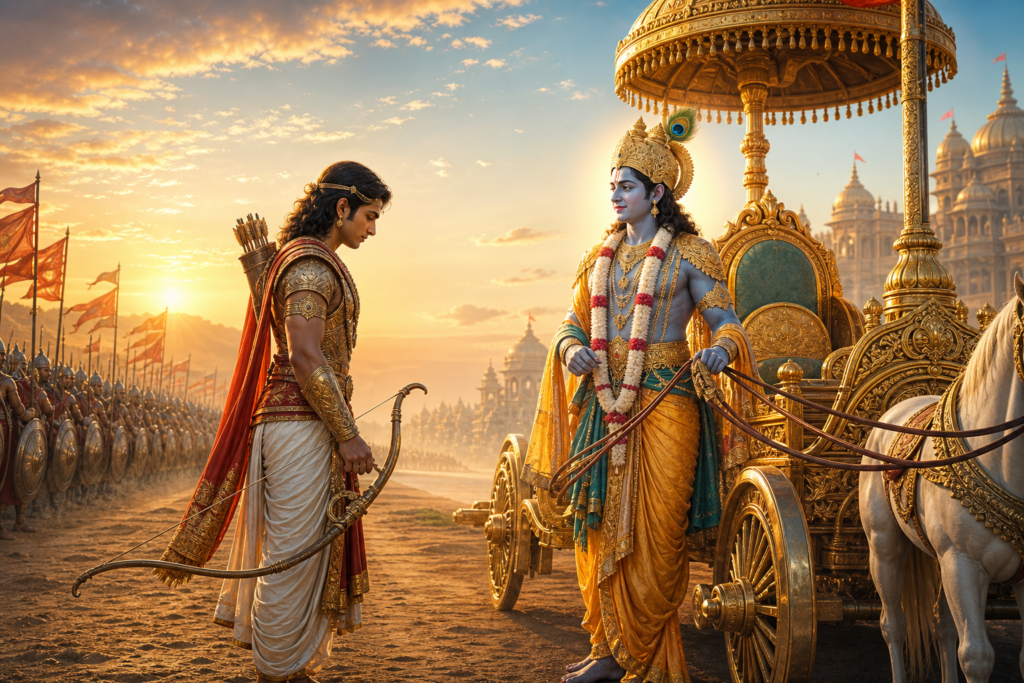
At the epicenter stands the Bhagavad Gita in the Bhishma Parva: a compact dialogue that crystallizes questions still urgent todayHow does one act rightly in a conflicted world? What constitutes just leadership? How should one balance personal vocation (svadharma) with universal ethics (sanatana dharma)? The Gita’s method is pedagogical rather than dogmatic: conversation, discernment (viveka), and action aligned with wisdom.
Beyond the Gita, the epic’s educational architecture comes into sharp focus in Shanti Parva and Anushasana Parva. These books formulate rajadharma (the ethics of rule), apaddharma (duties in crisis), and mokshadharma (the path to liberation), offering a sustained philosophy of society, law, and human flourishing that complements classical works such as the Arthasastra and Dharmasastra traditions.
Shanti Parva is particularly rich in political theory. It engages the problem of matsyanyayathe “law of the fish,” where the strong devour the weakarguing that legitimate kingship and rule-of-law provide the bulwark against chaos. The ideal ruler combines courage with restraint, justice with compassion, and personal discipline with public accountabilityideals that remain central to good governance and constitutionalism.
Vidura-niti in Udyoga Parva distills counsel for administrators, ministers, and citizens. Its aphorisms teach clarity in deliberation, the ethics of truthful speech, prudence in alliances, and an unwavering commitment to the common good. Read as a primer for leadership and civic virtue, Vidura-niti is an enduring manual for statecraft and institutional ethics.
Udyoga Parva also stages diplomacy at the highest level. Krishna’s peace embassy exemplifies principled negotiation: pursue conciliation with patience and reason, define non-negotiables around justice, and recognize when restraint must yield to protective force. The arc from dialogue to Dharma-Yuddha (righteous war) models the moral logic of last-resort action.
The Mahabharata articulates laws of war that prefigure later just-war principles: proportionality, protection of noncombatants, truthfulness in pledges, and restraint in victory. It also documents how these norms fray in crisis, using narrative consequence to teach that adharmaeven when expedientextracts a profound moral cost. The pedagogy is case-based, not prescriptive, sharpening ethical judgment through example and aftermath.
The Yaksha Prashna episode in Vana Parva functions as a timeless examination in wisdom. Through rapid-fire questions to Yudhishthira, it probes prioritiesWhat is the most wondrous thing? What rescues a person in peril?and centers truthfulness, self-mastery, gratitude, and compassion as non-negotiable civic virtues. Many first-time readers experience this section as a mirror held up to conscience.
Mokshadharma discourses in Shanti Parva explore renunciation, yoga, and contemplative knowledge, often echoing the Upanishadic search for the Self (atman) and ultimate reality. Their interiority resonates across dharmic traditions: with the Buddhist insight into impermanence and mindful awareness, the Jain commitment to ethical restraint and ahimsa, and the Sikh emphasis on disciplined action, humility, and seva.
This trans-sectarian resonance is crucial. The Mahabharata’s methodpresenting multiple viewpoints, allowing tensions between dharma and adharma to be argued, and honoring sincere strivingfosters unity in diversity. It models a civilizational pedagogy in which Hinduism, Buddhism, Jainism, and Sikhism can recognize shared ethical ground while maintaining distinctive insights.
Character studies further advance ethical inquiry. Draupadi’s unwavering demand for justice challenges social complacency and highlights the moral agency of women in the public sphere. Her voice re-centers honor, accountability, and the intrinsic dignity of persons against transactional power.
Karna’s arc illuminates the tragedy of divided loyalties and the tension between generosity (dana) and truth. His life invites reflection on social identity, gratitude, and the cost of partial knowledgecomplexities that modern debates on equity and belonging still contend with.
Yudhishthira’s dilemmasfrom the dice game to post-war governanceoffer a painstaking study of leadership under moral uncertainty. His preference for truth is tested by the world’s rough edges, teaching that dharma requires courage not only to act but to accept responsibility for imperfect outcomes.
Arjuna’s paralysis on the Kurukshetra War field portrays doubt not as weakness but as the beginning of higher understanding. The Gita meets him with discernment, placing inner composure (yoga), lucid intellect (buddhi), and selfless action (karma-yoga) at the heart of ethical performance.
Krishna emerges as diplomat, strategist, and teacheran exemplar of engaged wisdom. He upholds the freedom of conscience while guiding toward clarity, enacting a pedagogy that convinces without coercion. This commitment to inquiry over imposition is a cornerstone of India’s spiritual pedagogy and a reason the epic remains open to all seekers.
Historically, the Mahabharata functioned as a civilizational classroom. In the gurukula, recitation trained memory, narrative cultivated empathy, and debate forged judgment. By weaving governance, jurisprudence, and philosophy into story, the epic pioneered an experiential education long before the term existedan Education Philosophy that integrates head and heart.
Tagore’s own creative engagementsmost notably Chitrangada and Karna-Kunti-Samvaddemonstrate how modern literature can converse with ancient itihasa. These works surface the epic’s human core: longing, honor, forgiveness, and the courage to choose the good amid ambiguity. Through them, Tagore advanced a modern, humane reading that was faithful to tradition and alive to contemporary conscience.
Literarily, the Mahabharata’s architecture is sophisticated. A frame narrative delivered by the bard Ugraśrava Sauti preserves memory across generations; nested dialogues (e.g., Sanatsujatiya, Vidura-niti) create a seminar-like classroom within the epic. This multi-layered design invites readers to become participants in ongoing inquiry.
As history, the epic is best approached as itihasa: a vessel of moral-historical memory rather than a chronicle in the modern sense. Its authority rests not on literalism but on its proven capacity to shape ethical character, social responsibility, and wise statecrafta truth Tagore recognized in linking it to complete education.
Modern scholarship, including the Critical Edition developed at the Bhandarkar Oriental Research Institute, enables careful study while honoring the text’s plurality. Reliable translations and commentarial traditions help contextualize passages, track thematic arcs across parvas, and identify interpretive layers without flattening the epic’s voice.
For contemporary learners, a practical pathway begins with the Bhagavad Gita, proceeds to Udyoga Parva for diplomacy and Vidura-niti, then explores Shanti Parva and Anushasana Parva for rajadharma, apaddharma, and mokshadharma. The Yaksha Prashna and select narratives (e.g., Savitri and Nala-Damayanti) enrich personal ethics, resilience, and relationship wisdom.
Professionals in law, public policy, management, and technology can use the Mahabharata as a case method in ethics. The text offers tested insights on negotiation under uncertainty, responsible leadership, governance reforms, crisis decision-making, and the design of fair institutionsfields where dharma and adharma often converge in complex, real-world choices.
Equally, the epic nurtures unity across dharmic traditions. Its commitment to dialogue, compassion, non-possessiveness, and truth aligns with Buddhist mindfulness, Jain Anekantavada, and Sikh valor yoked to seva. Read in this spirit, the Mahabharata becomes a shared cultural commons binding Hinduism, Buddhism, Jainism, and Sikhism in ethical kinship.
Ultimately, Tagore’s assertion is as much a promise as a challenge. The Mahabharata completes education because it educates the whole person: cultivating emotional intelligence through character, moral intelligence through dilemma, civic intelligence through rajadharma, and spiritual intelligence through mokshadharma. Encountered with the seriousness it deserves, India’s living epic still teaches how to live welland how to live together.
Why did Tagore consider the Mahabharata indispensable to education?
The article explains that Tagore saw the Mahabharata as a civilizational curriculum, not merely an ancient story. It unites poetry, philosophy, statecraft, ethics, and spiritual inquiry in a way that trains the whole person.
How does the Mahabharata teach ethics and leadership?
It teaches through case-based narrative, dialogue, and consequence rather than simple rules. Sections such as the Bhagavad Gita, Vidura-niti, Udyoga Parva, Shanti Parva, and Anushasana Parva explore duty, governance, diplomacy, crisis ethics, and liberation.
What role does the Bhagavad Gita play in this reading of the Mahabharata?
The Bhagavad Gita appears as a compact dialogue in the Bhishma Parva that asks how one should act rightly in a conflicted world. The article emphasizes its pedagogical method: conversation, discernment, and action aligned with wisdom.
Why are Shanti Parva and Anushasana Parva important for modern readers?
The article presents these books as major sources for rajadharma, apaddharma, and mokshadharma. They connect governance, law, crisis duty, and human flourishing with questions that remain relevant to constitutionalism and public accountability.
How does the article suggest studying the Mahabharata today?
It recommends beginning with the Bhagavad Gita, then moving to Udyoga Parva for diplomacy and Vidura-niti, and then exploring Shanti Parva and Anushasana Parva. The Yaksha Prashna and selected narratives such as Savitri and Nala-Damayanti can deepen personal ethics and resilience.
How can professionals use the Mahabharata as a case method in ethics?
The article says professionals in law, public policy, management, and technology can use the epic to examine negotiation, responsible leadership, governance reform, crisis decisions, and fair institutions. Its dilemmas show how dharma and adharma can converge in complex real-world choices.
How does the Mahabharata support unity across dharmic traditions?
The article argues that the epic’s many-voiced method honors sincere inquiry and shared ethical ground. Its themes of dialogue, compassion, restraint, truth, humility, and service resonate across Hinduism, Buddhism, Jainism, and Sikhism.