Chakratirtha on the Tungabhadra River in Hampi, Karnataka, is one of the most revered bathing ghats within the Vijayanagara sacred landscape. It is intimately associated with Sri Vyasarajaru (Sri Vyasatirtha, c. 1460–1539), the eminent Dvaita Vedanta scholar and Rajaguru of the Vijayanagara Empire, whose devotional discipline at this ford culminated in a celebrated vision of Mukhyaprana (Hanuman/Vayu Deva). That vision, preserved in local memory and hagiographic traditions, anchors a living practice of Tirtha-Yatra that continues to draw pilgrims, scholars, and heritage enthusiasts.
Philological and topographic readings converge on the name “Chakratirtha”: chakra evokes both the circular eddies that form in the Tungabhadra’s rocky channel and the Sudarshana Chakra of Vishnu, a frequent emblem in temple ritual. Tirtha, the “ford,” signifies a crossinggeographical and soteriologicalwhere worldly flow can be traversed by discipline (anushtana), remembrance (smarana), and purifying snana. Hampi’s riverine ghats render this metaphor architecturally legible in dressed-stone steps, rock-cut shrines, and processional routes.
Within the Vijayanagara Empire’s urban design, Chakratirtha functioned as a node linking temple worship, civic water use, and pilgrimage movement. The wider Hampi complextoday a UNESCO World Heritage Siteattests to an inclusive patronage ecology in which Vaishnava, Shaiva, Shakta, and Jain establishments coexisted. This plural sacred geography offers a concrete reminder that dharmic traditionsHinduism, Buddhism, Jainism, and Sikhismshare concepts such as tirtha, ablution, seva, and sangati that nurture social cohesion alongside spiritual aspiration.
Sri Vyasarajaru stands at the heart of this landscape. As a leading Madhva saint and advisor to emperors such as Krishnadevaraya, he consolidated Dvaita Vedanta through rigorous texts (e.g., Nyayamrita, Tarka-tandava, Tatparya-chandrika) and through accessible public devotion. His pedagogy coupled philosophical precision with lived practice: early-morning snana at Chakratirtha, sandhyavandana, japa, and deep meditation, all framed by a view that the river itself participates in the devotee’s ascent.
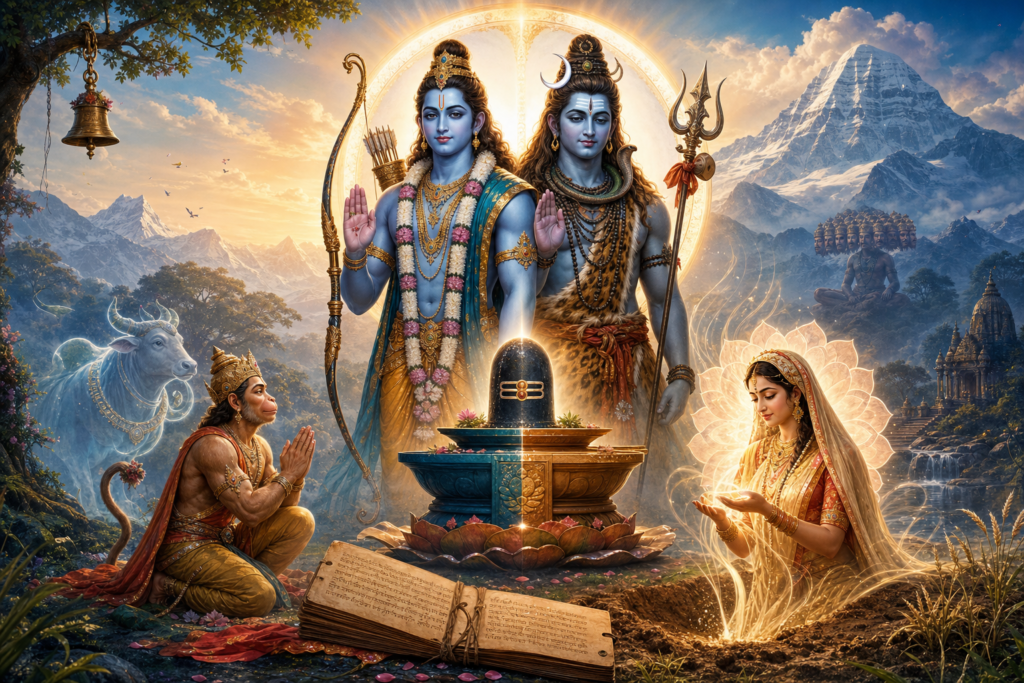
Tradition recounts that during this period of disciplined sadhana at Hampi, Vyasaraja experienced a vivid, revelatory dream-vision of Mukhyaprana, the chief life-breath (Vayu) manifest as Hanuman. The message affirmed divine approval, recalled Hanuman’s birth in the Kishkindha region surrounding Hampi, and instructed that an icon be installed on the very banks of Chakratirtha to safeguard devotees and sanctify the ford. The narrative is consonant with Dvaita theology, wherein Mukhyaprana mediates the devotee’s approach to Vishnu, fortifies ethical resolve, and protects the realm.
Acting on this mandate, Vyasaraja is said to have consecrated Mukhyaprana Devaru at Chakratirtha, shaping both ritual traffic and the site’s identity. In the wider Vijayanagara heartland he is credited with installing over seven hundred Anjaneya (Hanuman) icons, creating a protective garland around settlements, gateways, and river crossings. These imagesoften called “Vyasaraja Hanuman” formsserve as kshetrapala figures that align sovereignty, public safety, and spiritual vigilance.
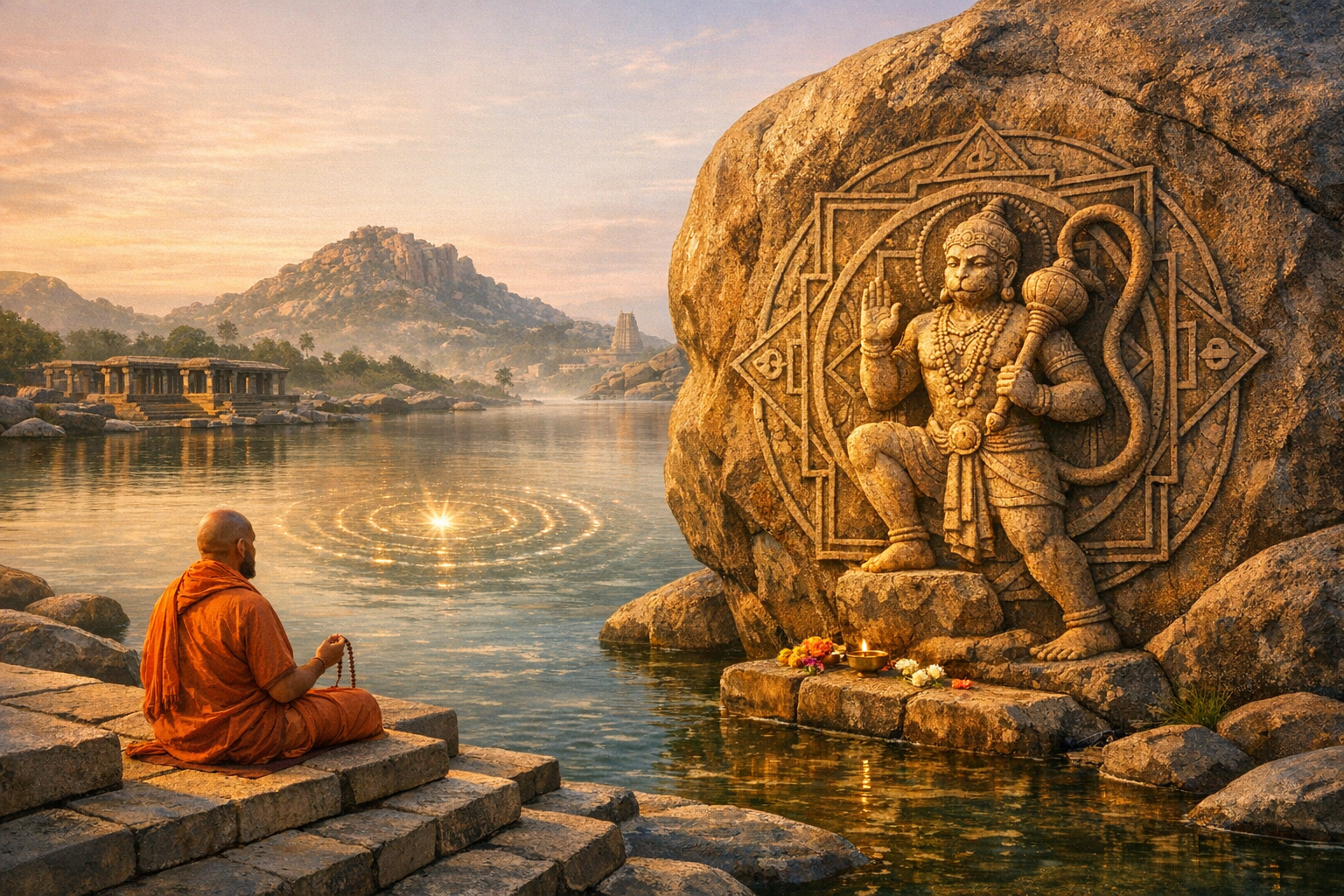
The Hampi region preserves a distinctive memory of Vyasaraja’s agency in the Yantroddharaka Anjaneya, a rock-cut icon framed within a sacred geometric diagram (yantra) overlooking the Tungabhadra near Chakratirtha. According to local lore, repeated attempts to depict Hanuman were playfully effaced until the saint inscribed the figure within the yantra, establishing stillness through mantra, mudra, and geometry before consecration. The result is an image that fuses devotion with technical metaphysics: the yantra encodes order; the deity embodies energy; the river carries both across time.
Iconographically, Mukhyaprana Devaru in the Vyasaraja lineage typically emphasizes alert beneficence and disciplined strengthabhaya (assurance) in one hand, the gada (mace) symbolizing dharmic force in the other, and a dynamically arched tail that signifies pranic ascent. While local styles vary, the throughline is unmistakable: Hanuman stands as the exemplar of unwavering bhakti, prana mastery, and ethical steadfastness. For pilgrims at Chakratirtha, this iconography functions as instructioncultivate focus, align breath and intention, and proceed with courage.
Theological context deepens the site’s meaning. In Dvaita Vedanta, Vayu as Mukhyaprana is the foremost among jivas, incarnating as Hanuman (in the Ramayana), as Bhima (in the Mahabharata), and, for Madhvas, as Sri Madhvacharya himself in the Kali ageeach avatar dedicated to the service of Vishnu. The dream tradition attached to Vyasaraja’s practice at Chakratirtha thus integrates cosmology, epic memory, and lived sadhana into a single, intelligible whole.
Geography and epic memory meet across the river at Anegundi’s Anjanadri Hill, revered locally as the birthplace of Hanuman within the Kishkindha landscape. From Chakratirtha’s steps, this proximity is not merely scenic; it is pedagogic. The devotee’s bath (snana), recitation (parayana) of Sundara Kanda or Hanuman Chalisa, and darshana of Mukhyaprana together reenact a journey from turbulence to clarity, from effort to grace.
Ritual calendars further articulate the site’s pulse. Karthika Masam and Magha Purnima draw heightened streams of pilgrims for holy dips at dawn, when the Tungabhadra’s surface is often glasslike and the granite hills hold and release the first light. On these days, the rhythms of mantra, conch, and bell from nearby shrines knit individual vows to communal celebration, sustaining a Tirtha-Yatra ethos that is recognizably dharmic and broadly inclusive.
As heritage, Chakratirtha exemplifies Vijayanagara’s synthesis of engineering, aesthetics, and devotion: stepped embankments manage hydraulic flow; rock surfaces carry inscriptions and images; processional routes choreograph public piety. As spirituality, it remains a living classroom in which the virtues that Hanuman modelsseva, shraddha, bala, buddhiare practiced rather than merely praised. Both registers are indispensable for conservation that respects tangible fabric and intangible meaning.
Importantly, the narrative of Vyasaraja and Mukhyaprana nourishes unity rather than sectarianism. The shared idea of a tirtha as a compassionate crossing resonates with Jain tirthankara traditions, Buddhist pilgrimage circuits, and Sikh reverence for sarovars and sangati. At Chakratirtha, that unity is not abstract; it is audible in the mingled languages of prayer, visible in the orderly sharing of steps and water, and intelligible in the ethical demand to honor every seeker’s path.
For researchers, pilgrims, and students of Karnataka’s past, Chakratirtha in Hampi offers a precise case study in how sacred geography, imperial history, and philosophical practice interlock. The memory of Sri Vyasarajaru’s vision of Mukhyaprana Devaru, and the consequent installation of an icon on the river’s bank, exemplify a dharmic approach in which place, practice, and protection stand together. To engage this site attentively is to recover that integrationand to carry it forward.
Inspired by this post on Hindu Blog.