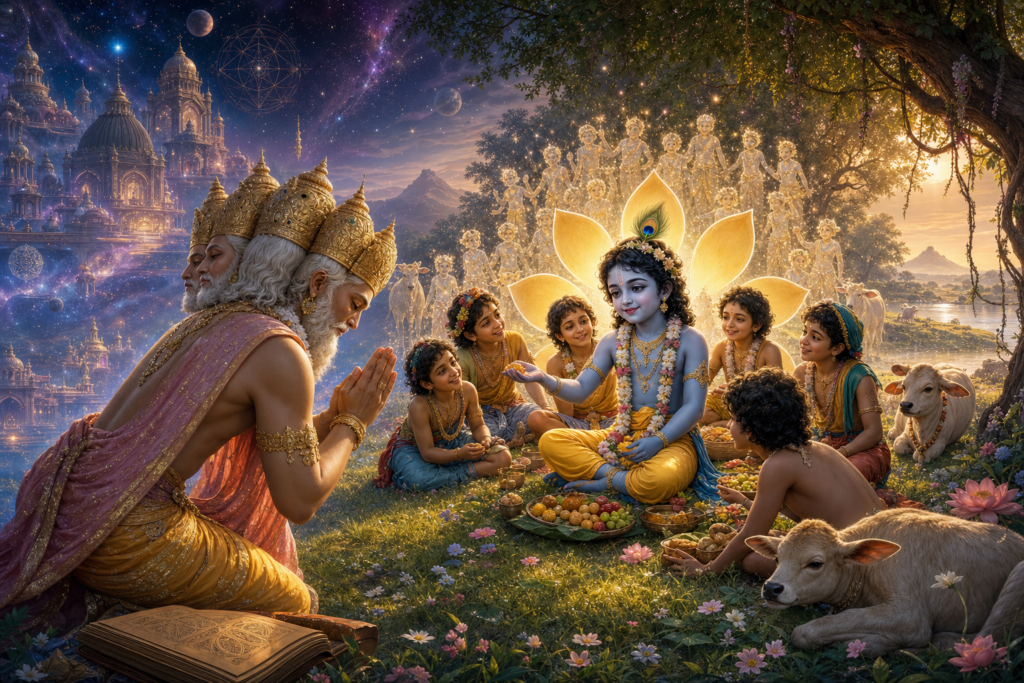
In an era flooded with information, many report feeling overwhelmed, uninspired, and emotionally fatigued. Facts arrive faster than meaning, and novelty often fades before it nourishes. Within Hinduism and the broader family of dharmic traditions, this paradox is clarified: knowledge that is not rooted in universal truth quickly becomes stale, while wisdom anchored in timeless principles remains continually relevant.
Hindu thought frames this continuity through concepts such as satya (truth), ṛta (cosmic order), and dharma (right alignment). The Bhagavad Gita distills the insight succinctly: nāsato vidyate bhāvo nābhāvo vidyate sataḥ. What endures aligns with reality; what withers was never truly grounded. This is less an abstract claim and more a practical test for discerning what heals confusion and sustains clarity over time.
Seen through this lens, information without anchorage to universal principles loses vitality. It may entertain or agitate, but it rarely transforms. By contrast, guidance formed by compassion, responsibility, and interdependencecore to Sanatana Dharmaretains freshness across centuries. Such guidance translates into lived practice, making it resilient to fashion, ideology, or the churn of daily headlines.
This universality is shared across dharmic traditions, reinforcing unity in diversity. Buddhism emphasizes Dhamma, direct insight into the nature of suffering and its cessation. Jainism advances Anekantavada and Ahimsa, encouraging many-sided understanding and non-violence. Sikhism centers Ik Onkar and Seva, affirming oneness and service. Though the expressions differ, each tradition orients attention toward principles that uplift, unify, and can be verified in inner experience and ethical action.
Everyday experience confirms this distinction. After hours of scrolling, a person may feel emptier rather than wiser. Yet a short encounter with a verse from the Upanishads, a teaching from the Bhagavad Gita, a line of gurbani, a reflection on karuṇā, or a brief moment of breath awareness can restore attention, soften agitation, and reawaken meaning. When content conveys universal truth, it does not merely inform; it transforms.
Universal truth in the dharmic sense invites testing through practice. Svādhyāya (self-study), dhyāna (meditation), satsang (company of truth-seeking), kirtan or simran (remembrance), mindful conduct, and seva (service) allow principles to become lived realities. What proves its worth in the laboratory of daily lifebringing clarity, compassion, and steadinessdemonstrates its timelessness.
Several practical criteria help discern what stays fresh: it is compassionate rather than divisive; it strengthens responsibility rather than cynicism; it speaks across cultures and eras; and it can be verified through experience and ethical action. Teachings meeting these criteria align with satya and dharma, remaining relevant whether one is a student, professional, caregiver, or community leader.
Hinduism’s embrace of Ishtadiverse, legitimate paths to the same ultimate realityfurther affirms unity without uniformity. This flexibility honors personal temperament while sustaining social harmony. It also resonates with Buddhist, Jain, and Sikh approaches that prioritize direct realization, non-harm, and service. Plural pathways, one shared commitment: the discovery and embodiment of universal truth.
The contemporary benefit is clear. Anchoring attention in universal wisdom counters information overload, restores emotional balance, and guides ethical decision-making. Whether through the Upanishads’ inquiry, the Bhagavad Gita’s counsel on action, Jain insights on many-sided truth, Buddhist mindfulness, or Sikh seva, dharmic wisdom equips individuals and communities to meet modern challenges with steadiness and care.
Ultimately, what is universally true does not age; it deepens. When knowledge is rooted in satya, it renews perception, uplifts conduct, and fosters unity among Hinduism, Buddhism, Jainism, and Sikhism. In a world saturated with data, the enduring invitation is to live by what remains ever-fresh: universal truth realized in thought, word, and deed.
Inspired by this post on Hindu Blog.