Among the Mahabharata’s many moral crucibles, the episode of Yudhishthira’s half-truth remains one of the most debated. Set in the furnace of the Kurukshetra War, it reveals the collision between personal virtue and public duty, and continues to serve as a touchstone for ethical reflection across dharmic traditions.
As the war intensified, the Kaurava commander Drona proved nearly invincible. Conventional strategies failed to stem his onslaught. Within this context, counsel arose for an extraordinary measure: exploit a linguistic ambiguity to shatter Drona’s resolve without direct combat. The situation forced a confrontation with dharma-sankataa dilemma in which every choice carries moral cost.
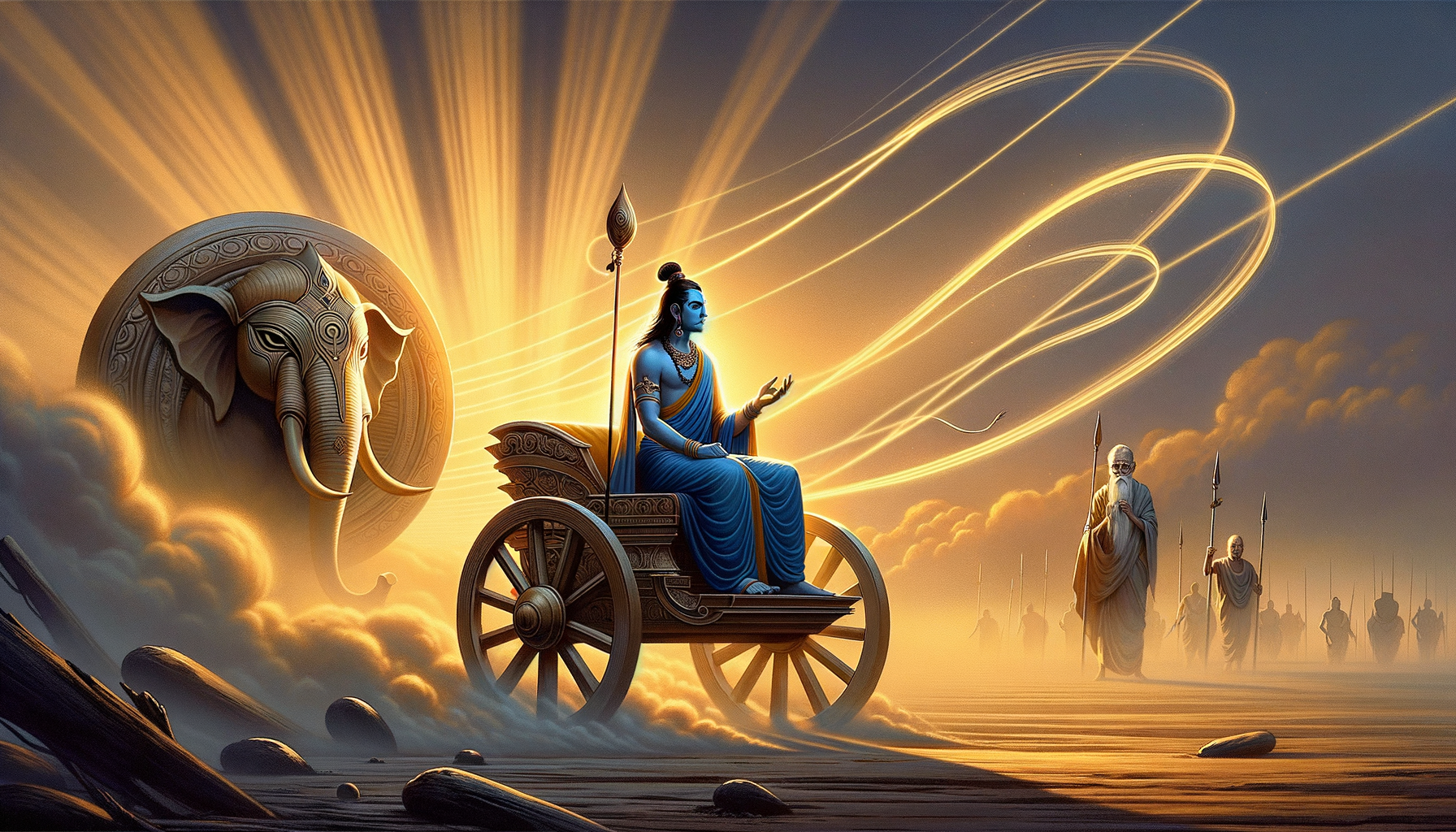
The stratagem hinged on the name “Aśvatthāmā.” After an elephant bearing that name was slain, Yudhishthira announced, “Aśvatthāmā hataḥ,” and, according to many retellings, appended softly, “narovā kuñjarovā.” The first clausetrue in letterconveyed the impression that Drona’s son had died; the secondclarifying that it was the elephantwent unheard amid the din of conches and war drums. Overwhelmed by grief and doubt, Drona set down his arms and was subsequently killed by Dṛṣṭadyumna.
Tradition marks a striking symbol in the aftermath: Yudhishthira’s chariot, said to glide slightly above the earth due to his unwavering satya, is described as touching ground after the half-truth. This motif underscores a central inquiry of the Mahabharata: how should one weigh the purity of means against the imperatives of rajadharma and the protection of the many?
Interpreters across centuries have approached this crisis through a dharmic lens rather than a simplistic verdict. Intention (bhāva), context (deśa-kāla), and consequence (phala) are held in dynamic balance. For some, the act exemplifies the tragic calculus of dharma-yuddha; for others, it illustrates how even righteous ends leave residue when means bend satya. The narrative refuses easy closure, inviting sustained contemplation rather than categorical judgment.
These tensions resonate across dharmic thought. Discussions of upāya-kauśalya (skillful means) in Buddhism, the Jain emphasis on satya and ahiṁsā as uncompromising vows, and the Sikh articulation of dharam-yudh as disciplined, principled force, all illuminate facets of this episode. While each tradition nuances the balance differently, there is a shared commitment to moral clarity, compassion, and responsibilityoffering a unifying framework for reflection rather than division.
Krishna’s counsel in this moment is often read not as a rejection of truth, but as a sober recognition that leadership sometimes must navigate tragic choices to prevent greater catastrophe. Even then, the Mahabharata highlights the inner cost borne by decision-makers; moral injury is acknowledged as part of history’s invisible ledger.
For contemporary readers, this episode becomes a mirror. In public life and leadership, “half-truths” may appear expedient, yet they exact a price on trust, integrity, and inner equilibrium. The Mahabharata encourages interrogating intention, examining alternatives, and foreseeing consequencesan approach as relevant to governance and social movements as it is to personal relationships.
Practical reflections emerge: uphold satya with karuṇā; scrutinize whether the chosen means preserve human dignity; accept accountability for unintended harm; and cultivate steadiness (sthita-prajñatā) through yoga and meditation to discern clearly under pressure. Such practices, anchored in the shared ethical inheritance of Hinduism, Buddhism, Jainism, and Sikhism, foster unity and wisdom in action.
Ultimately, Yudhishthira’s half-truth is not a cautionary tale against dharma-yuddha, nor a license for expediency. It is a profound invitation to think ethically in conditions of conflict, to honor the complexity of real-world decisions, and to seek convergence across dharmic traditions in the pursuit of justice anchored in compassion.
Inspired by this post on Hindu Pad.