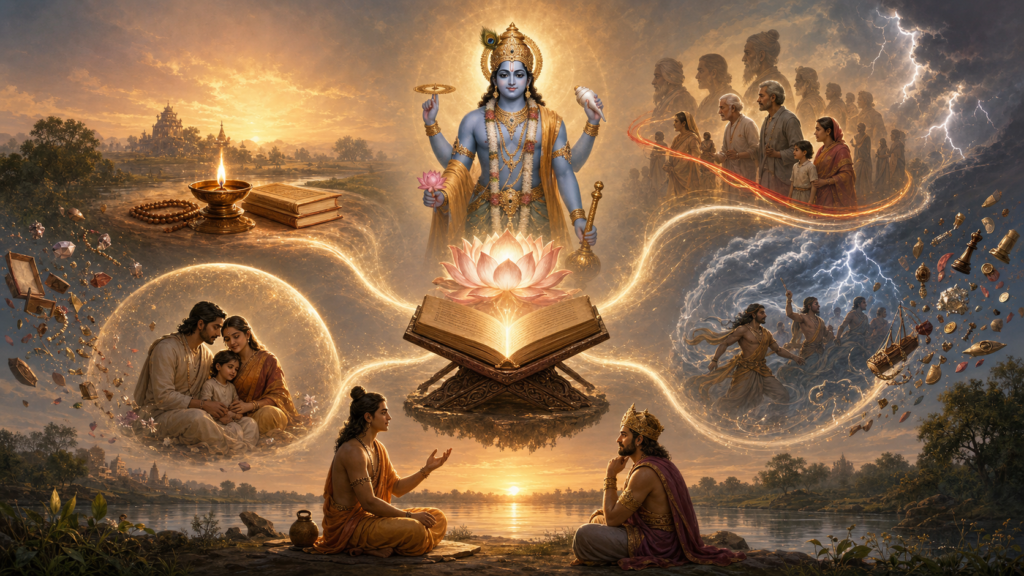
The theme of a deathless Self stands at the core of the Bhagavad Gita and resonates across Dharmic traditions. The statement that “misapprehension of Reality takes place due to non-apprehension of reality” captures a perennial insight: spiritual confusion arises not from irredeemable error but from incomplete seeing. This observation frames a rigorous inquiry into life, death, and ultimate reality that Hinduism, Buddhism, Jainism, and Sikhism each approach with distinctive yet convergent lenses.
At the foundation of misunderstanding lies avidyamis-knowing or not-knowingwhich clouds perception and generates attachment, fear, and grief. Vedanta describes this as confusion between the transient (body, emotion, social identity) and the eternal (atman). Buddhism names a parallel obstacle as ignorance (avijja); Jainism speaks of mithyatva (mistaken views); Sikh teachings critique maya (the entangling appearance). Despite terminological differences, the shared analysis is clear: when attention is seized by the fleeting, the abiding ground of being remains unnoticed.
The Bhagavad Gita offers a precise corrective. It distinguishes the imperishable knower from perishable modifications: what changes belongs to prakriti, while the witness remains changeless. Verses such as 2.16 and 2.20 assert that the real does not cease and the unreal never truly is; the Self is unborn, undying, and unobjectifiable. This teaching is not an abstraction; it arises in the midst of Arjuna’s crisis, where the fear of death and loss magnifies the error of equating identity with the mortal frame. By replacing misapprehension with clear apprehension, the Gita reorients action toward dharma with composure.
Readers often recognize this pattern in ordinary life. In moments of bereavement, anxiety before change, or uncertainty about purpose, attention narrows to what fadesthe role, the relationship, the outcome. The Gita’s analysis meets this human experience with a steady proposition: clarity dissolves panic. When identity widens from body-mind to the witnessing awareness, grief softens into perspective; when action is aligned with dharma and freed from grasping, effort becomes meaningful without becoming burdensome.
This clarity is cultivated through complementary disciplines. Karma Yoga refines intention, shifting effort from self-importance to self-offering. Jnana emphasizes vivekacontinuous discrimination between the changing and the changelessand nididhyasana, sustained contemplation. Dhyana stabilizes attention and reveals the quiet witness beneath mental movement. These methods align with practices honored across Dharmic paths: mindfulness in Buddhism, right vision and ahiṃsa in Jainism, and remembrance of the One in Sikhism. The unity lies in the shared goal: loosening the grip of ignorance and living from clarity and compassion.
An academic lens may ask: how is such knowledge validated? Classical frameworks appeal to reason (yukti), teaching (shastra), and direct insight (anubhava). Reason tests coherence; scripture offers a refined map; contemplative insight verifies in lived experience. Together they transform a consoling idea into a reliable orientationa way of reading the world where samsara’s flux is acknowledged and the possibility of moksha remains central.
Practical reflections follow. First, observe change: breath, mood, and circumstance shift ceaselessly; the noticing presence does not. Second, apply discrimination: when fear arises, ask whether it concerns what is inherently impermanent; such inquiry loosens fear’s hold. Third, act ethically: dharma-centered choices strengthen inner stability, benefiting both self and society. Finally, cultivate compassion: seeing the same presence in all beings softens division and embodies Unity in spiritual diversity.
Approached in this integrated way, the Gita’s message moves beyond doctrine to transformation. It does not deny loss or minimize pain; it contextualizes them within a wider truth. The deathless Self, recognized through clear apprehension, becomes a source of courage, responsibility, and care. In honoring this insight alongside the complementary wisdom of Buddhism, Jainism, and Sikhism, the Dharmic family offers a shared pathway: from illusion to understanding, from fragmentation to wholeness, and from fear to freedom.
Inspired by this post on Hindu Blog.