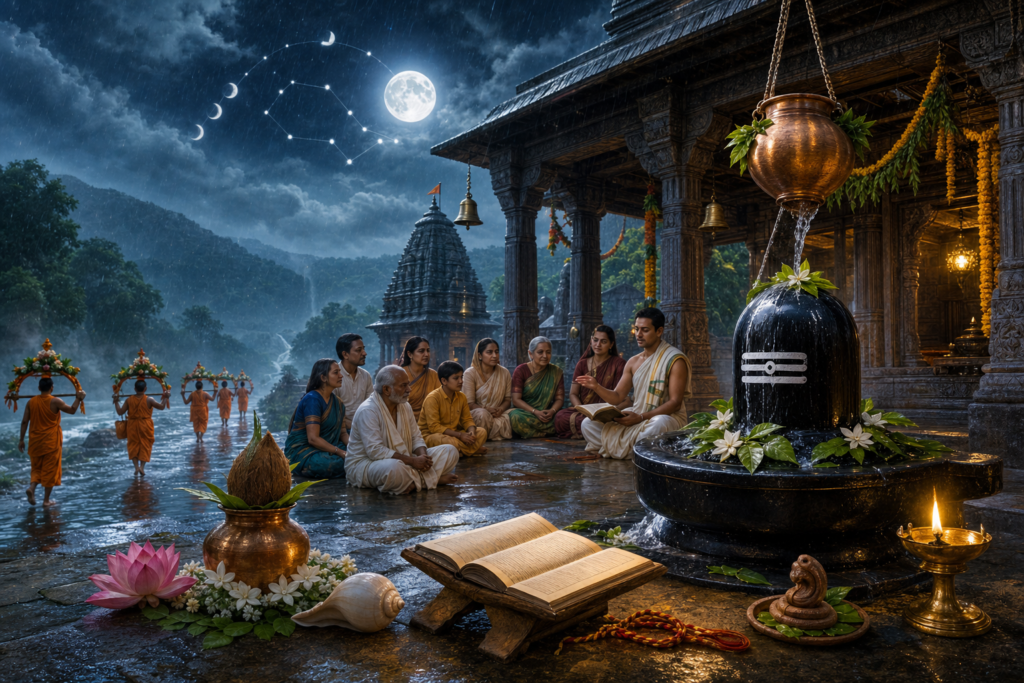
The Sapta Badri Yatra refers to a revered pilgrimage circuit in the Garhwal Himalayas of Uttarakhand, where seven sacred shrines honor Lord Vishnu in distinct forms and sacred settings. Rooted in the long tradition of Hindu pilgrimage (Tirtha-Yatra), the circuit draws seekers who value the confluence of sacred geography, temple architecture, and enduring devotion. Each temple enshrines a unique manifestation of Vishnu and carries local histories, seasonal rhythms, and ritual practices that together shape a cohesive spiritual journey.
Situated across valleys nourished by the Alaknanda and its tributaries, the Sapta Badri temples illustrate how sacred space has developed in dialogue with Himalayan terrain. The yatra is often viewed as complementary to the Char Dham circuit, yet it remains distinct in its focus on Vishnu’s varied iconography and the living traditions of worship that continue in village shrines and high-altitude sanctuaries. References in Purana literature and regional memory underscore the yatra’s historical depth while emphasizing the continuity of dharmic practices across centuries.
Pilgrims frequently describe an atmosphere that blends scholarship with devotion: temple bells resonating against snow-fed gorges, the cadence of mantras carried by mountain winds, and the contemplative quiet that surrounds stone sanctums at dawn. Visitors often report that the yatra encourages inner steadiness and humility, qualities cultivated through darshan, daily puja, and mindful walking between sites. This reflective mode of travel aligns with a wider dharmic ethos shared across Hinduism, Buddhism, Jainism, and Sikhismhonoring non-violence, generosity, self-discipline, and the pursuit of wisdom in ways that build mutual respect and unity.
In practical terms, the circuit typically spans from lower-altitude temple clusters to higher reaches closer to the main axis of Badrinath, with seasonal accessibility guiding the flow of devotees. Most routes are open from late spring to early autumn, when passes are snow-free and local communities can support movement between shrines. During winter months, when upper Himalayan sites may close due to weather, established traditions ensure continuity of worship in accessible locations such as Joshimath, reinforcing the principle that sacred presence remains unbroken even as the landscape shifts.
Symbolically, the sevenfold pattern invites contemplation of completeness and progressionseven as a number of stages, insights, or thresholds on the path of sadhana. The Sapta Badri tradition presents Vishnu as both protector and sustainer, whose diverse forms mirror the many ways devotion takes root in daily life. This diversity within unity is a hallmark of Hindu temples across Uttarakhand and the broader Himalaya, where local narratives, regional festivals, and shared rituals together affirm a living spiritual heritage.
The yatra further encourages responsible travel grounded in reverence for nature. Pilgrims increasingly practice eco-conscious habitsminimizing waste, respecting water sources, and supporting local livelihoodsto preserve the fragile mountain ecology that sustains sacred sites. Such stewardship reflects the dharmic understanding that the Himalaya is not only a destination but a living sanctuary where spiritual duty and environmental care converge.
Ultimately, the Sapta Badri Yatra stands as a testament to continuity: ancient routes walked with modern awareness, timeless worship framed by evolving community life, and a devotional culture that welcomes all who seek quiet reflection and shared harmony. By honoring the many forms of Vishnu and recognizing the shared values across dharmic traditions, the yatra nurtures a spirit of unity that is as elevating as the mountains themselves.
Inspired by this post on Hindu Blog.